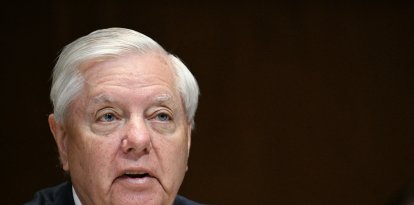
Trump seeks to eliminate senators' veto power over federal judges, ratchets up pressure on Grassley
While the Senate Judiciary Committee chairman insists on maintaining the historic tradition, Trump called it an "old and outdated custom."

Trump and Grassley at the White House/ Jim Watson

Tension grows between Donald Trump and Chuck Grassley over the use of 'blue slips' in judicial nominations. While the chairman of the Senate Judiciary Committee insists on maintaining the historic tradition, Trump defined it as an "old and outdated custom" and continues to push to eliminate it.
The 'blue slip' is not a formal Senate rule nor is it included in the National Constitution, but it is an internal precedent that is more than a hundred years old. It is used in the nomination and confirmation process for federal judges. It has been weeks since Trump expressed his dissatisfaction with this unwritten rule, which he described as a mere "gentleman's agreement." This led him to publicly clash with the Iowa senator.
In a new chapter of this confrontation, the president spoke out on Truth Social about this practice and turned back to Grassley, currently the longest-serving member of the upper chamber.

Politics
Trump afirmó que demandará a Newsom por la redistribución de distritos electorales
Santiago Ospital

The president wrote: "I have a Constitutional Right to appoint Judges and U.S. Attorneys, but that RIGHT has been completely taken away from me in States that have just one Democrat United States Senator. This is because of an old and outdated 'custom' known as a BLUE SLIP, that Senator Chuck Grassley, of the Great State of Iowa, refuses to overturn, even though the Democrats, including Crooked Joe Biden (Twice!), have done so on numerous occasions. Therefore, the only candidates that I can get confirmed for these most important positions are, believe it or not, Democrats! Chuck Grassley should allow strong Republican candidates to ascend to these very vital and powerful roles, and tell the Democrats, as they often tell us, to go to HELL!"
"Chuck Grassley should allow strong Republican candidates to ascend to these very vital and powerful positions and tell the Democrats, as they often tell us, to go to HELL!" he added.
Grassley's response
The veteran Iowa senator was adamant on his X account, where he devoted a few posts to the president's attacks. He explained how the historic rule helped Republicans over the past four years, implying that eliminating it could backfire down the road when the GOP is in the minority in Congress.
"The 100 year old 'blue slip' allows home state senators 2 have input on US attys & district court judges In Biden Administration Republicans kept 30 LIBERALS OFF BENCH THAT PRESident TRUMP CAN NOW FILL With CONSERVATIVES," Grassley noted.
"A U.S. Atty/district judge nominee without a blue slip does not have the votes to get confirmed on the Senate floor, & they don’t have the votes to get out of committee. As chairman, I set President Trump's nominees for SUCCESS, NOT FAILURE," he added.
What is it and how does the 'blue slip' work?
Throughout history, this paper could be a total veto or function simply as a consultation. For example, for much of the 20th century, if one of the state's two senators returned the paper with a negative, the nomination did not go forward. Later, one senator's opposition delayed the process, but it could go forward.
The big change came during the first Trump Administration, coincidentally with Grassley as chairman of the Senate Judiciary Committee. In 2017, Grassley decided to change the rule for judges nominated to appellate courts that span more than one state. In these cases, the 'blue slip' was dropped as a veto.
Different is the case with district judges (who cover only one state), for whom the role continues to function as an assured veto. Now, it depends more on the profile of the judge and the chair of the Judiciary Committee.
In this context, Trump wants to eliminate the rule also for district judges, given that he is blocking some of his nominees coming from states with Democratic senators.
LATEST