Trump: Cartels 'have very strong control' over Mexico
Washington accuses Mexican drug trafficking groups, declared global "terrorist" organizations by Trump, of illegally manufacturing fentanyl with substances from China.

Donald Trump firma una ley para endurecer las penas por tráfico de drogas

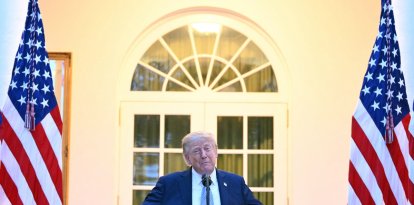
(AFP) — President Donald Trump said Wednesday that drug cartels "have a very strong hold on Mexico" and that "we cannot allow that to happen" as he signed into law a bill increasing penalties for fentanyl trafficking.
Washington accuses Mexican drug cartels—designated as global "terrorist" organizations by Trump—of illegally manufacturing this synthetic opioid using substances sourced from China.
Since returning to the White House, Trump has led an aggressive campaign against the cartels and believes that Canada and Mexico are not doing enough to stop the flow of fentanyl. He has used this as justification to threaten them with tariffs.
In recent months, he has repeatedly said that drug traffickers dominate Mexico. In February, he even accused the Mexican government of having "an intolerable alliance" with the cartels.
This Wednesday, he reiterated his accusations, which have been denied by Mexican authorities.


The new "HALT Fentanyl Law"
The cartels "have a very strong hold on Mexico. We have to do something about it. We cannot allow that to happen," the president said during the signing of the "HALT Fentanyl Act", which was approved by both Republicans and Democrats.
With this legislation, "we deal another defeat to the savage drug traffickers, criminals, and cartels," Trump said.
"The Mexican authorities are terrified. They're terrified to go to their offices. They're terrified to go to work because the cartels have tremendous control over Mexico, the politicians and the people who are elected," the Republican president emphasized.
The new law sets a minimum sentence of 10 years in prison for trafficking more than 100 grams of fentanyl or similar substances.

World
Trump Administration Slams Mexican Banks for Laundering Money for Drug Cartels
Luis Francisco Orozco
"Illicit imitations of fentanyl"
The lawmakers aimed to close loopholes after realizing that cartels alter the composition of fentanyl analogs to evade new laws.
As a result, the law permanently classifies "illicit fentanyl imitations" as Schedule 1 substances—drugs with no accepted medical use and a high potential for abuse. They had been in this category temporarily since 2018.
Trump mentioned carfentanil, calling it "increasingly common." It is a synthetic opioid roughly 10,000 times more potent than morphine and 100 times stronger than fentanyl, with doses as small as two milligrams potentially being lethal.
More than one million overdose deaths
Over the past two decades, more than a million Americans have died from drug overdoses. In 2024 alone, fentanyl was responsible for nearly 50,000 overdose deaths, according to official sources.
LATEST