It doesn’t matter whether Americans call themselves ‘Zionists’
A deluge of anti-Zionist propaganda has impacted support for Israel since Oct. 7; still, the majority of Jews stand with it against its antisemitic and genocidal foes.
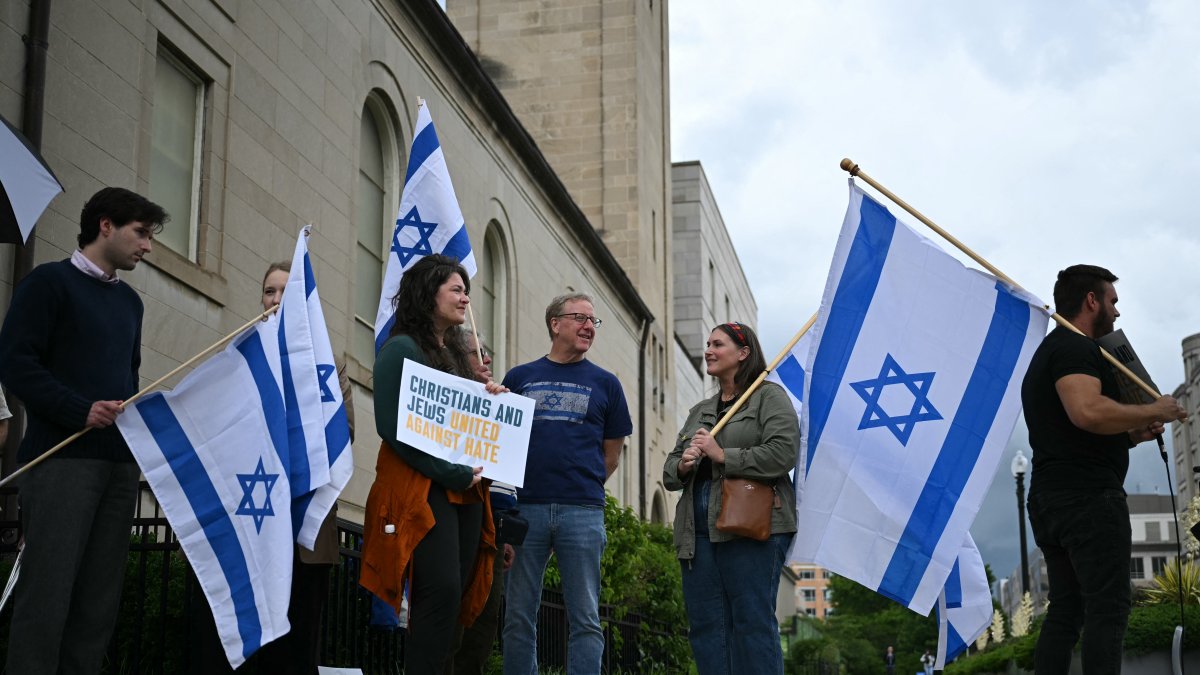
Civilians at a pro-Israel march in Washington, D.C./ Drew Angerer
Over the course of the last generation, a faction of American Jewry that is hostile to Israel has gradually gained greater visibility. A chief talking point is the claim that their stands—and not those of the mainstream Jewish organizations or the pro-Israel community in general—reflect the views of the majority of Jews.
This month, they got some data that they think backs up their claim from the “Survey of Jewish Life Since Oct. 7,” a study by the Jewish Federations of North America, conducted in March of 2025 and released in stages over the past few months. The latest batch on Israel, Zionism and Jewish identity contained at least a few responses that serve to encourage the anti-Israel crowd.
The survey shows that 88% of respondents supported Israel’s right to exist as a Jewish and democratic state; 60% said Israel made them proud to be Jewish; and 71% said they were emotionally attached to it—a dramatic increase over a 2020 survey’s results that showed that only 58% felt that way.
At the same time, only 37% said they identified as Zionists. And approximately one-third of those questioned said they believed that Israel was an “apartheid state” and was “committing genocide against the Palestinians.”
How is it possible to support Israel while still believing such lies?
While there are reasons for genuine concern about the number of Americans, including Jews, who believe the anti-Israel crowd’s big lies about apartheid and genocide, the fact that 63% of those Jews surveyed didn’t say they were “Zionists” shouldn’t concern friends of Israel. Nor should it bolster the claims that most Jews are turning on the Jewish state since Oct. 7.
Nearly 78 years after the birth of the modern State of Israel, the question of who is and isn’t calling themselves a Zionist isn’t particularly relevant to the debate about attitudes toward the Middle East.
An old joke about the definition of the term went that a Zionist was someone who solicited funds from a second individual in order to be able to enable a third person to move to the land of Israel. David Ben-Gurion, one of Israel’s founding fathers and its first prime minister, was well known for insisting that after 1948, the only real Zionists were the ones who lived in Israel. He wanted no part of a Zionism that enabled Jews to live comfortably elsewhere.
That was a product of traditional Zionist ideology that held that the Diaspora needed to be “negated” for the Jewish people to throw off the mindset of powerlessness and homelessness, and therefore embrace their status as a free people living on their own land.
The Diaspora in many lands was more or less negated, although by both the hostility and the often-murderous intent of non-Jews than by the intellectual force of Zionist doctrine. Still, the line about Zionists being people whose purpose was to help others go to Israel rather than making aliyah themselves ignored the reality of post-1948 Jewish life, especially with respect to Western nations like the United States, where Jews lived free and prosperous lives. Israel remained a haven for endangered and persecuted Jewish communities. Americans who went there were an ideologically motivated minority, while those who remained in the United States provided moral, political and financial support for their brethren in the Middle East.
A sizable number of Israel’s supporters still call themselves Zionists. That includes many people who will never seriously consider making aliyah, let alone do it. At this point in history, it’s a semantic distinction as opposed to a real one. Relatively few of them are active members of explicitly Zionist groups, which were once central to Jewish life but have largely declined. If an individual supports Israel’s existence and right to defend itself against genocidal foes, as nearly nine out of 10 Jews do, that’s backing for the minimum position of Zionism.
Assimilation and media bias
What remains troubling is the significant minority of Jews who agreed with the claims about apartheid and genocide. Those charges, both preposterous and false assertions that amount to modern blood libels against Israel, reflect a variety of factors.
In part, it’s a reflection of the growing assimilation and intermarriage among American Jews that has manifested itself in not merely lower rates of affiliation and Jewish philanthropy, but also a decline in what we might term a sense of Jewish peoplehood. The Jewish anti-Zionist left is always blaming declining rates of support on political differences about Israeli Prime Minister Benjamin Netanyahu, or issues like settlements and the peace process. But the truth is that the fastest-growing sector of the Jewish population is the group that demographers call “Jews of no religion.”
Unlike the situation a century ago, before Israel existed, when Jews were often ashamed of their identity, these Jews are proud of being Jewish. But for the most part, they no longer care much about Jewish faith, history and tradition, and instead cling to a form of Jewish identity that revolves around food, humor, entertainment and major urban areas, which is neither transmissible to future generations nor likely to influence the way they live their lives. As such, it’s unlikely that they would actively support a Jewish state and its leaders, no matter whether they were on the right or the left, or what their positions were on the conflict. Nor do they fully understand how integral Israel is to Jewish life, thought and faith.
Support for those claims about apartheid and genocide is also the product of mainstream media coverage of the conflict. Legacy press outlets like The New York Times and CNN have often acted as if they were Hamas’s stenographers since Oct. 7. They have dutifully regurgitated propaganda about alleged Israeli atrocities and reported statistics produced by the Islamist terror group’s Ministry of Health in Gaza, which inflated casualty statistics. That made it appear as if virtually everyone killed in the war, started by Hamas and other Palestinians, were women and children. They also omitted any mention of terrorist fighters killed by the Israel Defense Forces, which amounts to approximately half of the total of Palestinian fatalities—when compared to actual civilians—an unprecedentedly low number in the history of contemporary urban warfare.
Israel is a vibrant, multicultural democracy, and in no way resembles apartheid-era South Africa. If the war in the Gaza Strip was a “genocide,” then so was every other one in history, including that waged by the Allies in World War II against the German Nazis. But those are realities that people who only get their news from liberal media outlets, as is likely the case for many Americans, probably don’t know or understand.
Politics over faith
It is a basic truth of 21st-century American life that politics now plays the role that religion used to have in their lives. So, it is unsurprising that a not insignificant percentage of the majority of Jews who are neither religious nor politically conservative would be greatly influenced by the way the base of the Democratic Party has embraced the toxic doctrines of critical race theory, intersectionality and settler-colonialism. They demonize Israel and falsely label Jews as “white oppressors.”
Indeed, Israel’s critics have always pointed to the fact that the vast majority of Jews have been political liberals who generally opposed sectarian causes in favor of universalist ones and also voted for Democrats, who were often critical of the Israeli government. At the same time, the majority of Israelis are Jews of color who came from North Africa and other parts of the Middle East, not exactly the epitome of white Europeans.
What that narrative of the study left out is the fact that poll after poll proves that huge majorities of Jews still consider Israel to be very important to them. They may not have thought well of Israel’s leaders, and neither knew nor understood much about why the majority of the Jewish state’s voters had long since discarded any backing for a “two-state solution” that the U.S. foreign-policy establishment long asserted was the only answer to the conflict. But most of these Jews still support Israel’s struggle for survival against hostile Arab and Muslim forces determined to destroy the one Jewish state on the planet.
A boost in affiliation
The good news about the JFNA survey is that it validates the widespread perception that the shock of the atrocities committed by Palestinian Arabs on Oct. 7, and the way they incited a wave of antisemitism around the globe, has influenced many Jews to come back to Jewish life. The results show that nearly half of all Jews, including many who don’t label themselves Zionists, are part of a parallel swell of greater engagement in Jewish life since the atrocities of Oct. 7. That includes an increase in affiliation, synagogue and event attendance, and a greater connection with and an interest in Israel.
That shouldn’t lessen worries about assimilation. Nor should the pro-Israel community be complacent about the way that a biased media—and a combination of woke left-wing and alt-right antisemitism—has worked to erode support for the Jewish state. This fact alone has served to increase the number of those who identify with or are willing to believe the lies spread by its genocidal foes, even among those who call themselves Jews.
But the idea that anti-Zionists, whose views seek to strip Jews of rights that no one would think of denying to any other people and thus are indistinguishable from antisemitism, now represent the majority of American Jews is absolutely not true. The organized Jewish world may be largely obsolete, and led by organizations and leaders who have failed to respond adequately to the challenges of the moment. And the labels that were once meaningful in determining the views of most people are just as out of date. But the trauma of Oct. 7, and subsequent increase in global hatred and even violence, has not convinced most Jews to abandon the Jewish state. American Jewry may be in demographic decline, yet the overwhelming majority of those who choose to remain part of the Jewish people still stand with Israel.
© JNS
LATEST