






ANALYSIS
Malinowski concedes New Jersey Dem primary to Analilia Mejia, who has accused Israel of ‘genocide’
Joe Hathaway, the mayor of Randolph, N.J., told JNS that Mejia supports “fringe radical socialism. Our Jewish residents and everyday people in this district need to reject that brand of their party.”
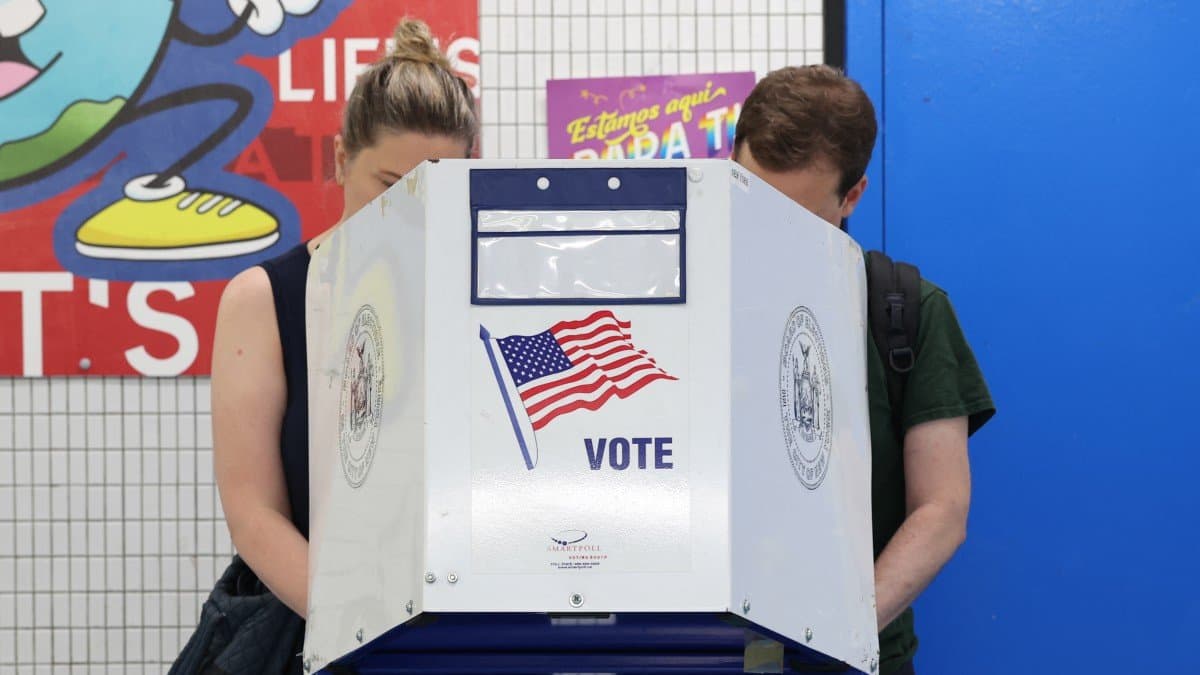

Former congressman Tom Malinowski conceded last week’s contest to fill a U.S. House seat in New Jersey, leaving Democrats with a nominee who has said that Israel committed genocide in the Gaza Strip.
Malinowski, considered the frontrunner to win the seat vacated by New Jersey Gov. Mikie Sherrill, saw his advantage evaporate after the American Israel Public Affairs Committee spent $2.3 million in negative ads against him.
The latest Associated Press count showed him trailing by less than 1,000 votes in a race that was too close to call after the polls closed on Feb. 5. At press time, with 93% of votes counted, progressive activist Analilia Mejia had 18,584 votes (29.1%) to Malinowski’s 17,695 (27.7%).
"A race defined by outside spending by a pro-Israel group that targeted Mr. Malinowski"
“While the race has not been called, Tom Malinowski conceded on Tuesday to Analilia Mejia, a progressive organizer,” New York Times reporter Tracey Tully wrote. “He credited her with inspiring voters with a positive message in a race that was defined by outside spending by a pro-Israel group that targeted Mr. Malinowski.”
Mejia had the support of some of Israel’s biggest critics on Capitol Hill, including Sen. Bernie Sanders (I-Vt.), and Reps. Alexandria Ocasio-Cortez (D-N.Y.) and Ayanna Pressley (D-Mass.).
“In special elections with a dozen candidates, anything can happen,” Israel (“Izzy”) Klein, a Democratic strategist and political chair of the Jewish Democratic Council of America, told JNS.
Malinowski refused to give Israeli Prime Minister Benjamin Netanyahu a blank slate
“Outside groups’ spending in these crowded and quick races can backfire, and in this case, that happened in spectacular fashion,” he said.
Malinowski had received the support of AIPAC during his time in Congress and was running in this year’s Democratic primary with the endorsement of J Street; however, the powerful pro-Israel lobby said it wanted someone more supportive of the Jewish state.
Malinowski said he refused to give Israeli Prime Minister Benjamin Netanyahu a blank slate when it came to US support.
"Their remaining strategy for keeping allies in Congress is intimidation"
“They would rather have an anti-Israel Democrat than one whose definition of pro-Israel is not the same as theirs,” Malinowski told JNS. “To the extent that this organization has any influence on American politics going forward, it will be to make the constituency for a relationship with Israel even smaller than it is today.”
“Their remaining strategy for keeping allies in Congress is intimidation. That only gets you so far,” he said.
Mejia will face Joe Hathaway, the Republican mayor of Randolph, N.J., in a special election on April 16 to finish out Sherrill’s term. Mejia is the favorite in the Democratic-leaning 11th Congressional District in the northern part of the state.
"This is fringe, radical socialism"
Hathaway told JNS that he would highlight Mejia’s position on Israel in an attempt to flip the district.
“At a forum with all of her Democrat opponents, she was the only one to raise her hand when asked if you agree with the concept that Israel is committing genocide in Gaza,” he said. “She was the only one.”
“This is not, you know, mainstream Democrat Party,” he told JNS. “This is fringe, radical socialism, and I think that our Jewish residents and everyday people in this district need to reject that brand of their party.”
Surrounded by supporters on Tuesday, Mejia celebrated her victory while taking a shot at the pro-Israel lobby.
The AIPAC spending certainly made a difference
“AIPAC did all of the voters in New Jersey a very incredible favor because they told us who they are,” she said. “They told us what they’re willing to do, and that is to subvert democracy and silence even their friends.”
Malinowski endorsed Mejia, as did Sherrill and other prominent Democrats. He told JNS that he hadn’t decided what he would do next.
In an email to supporters, Malinowski said that the AIPAC spending certainly made a difference.
“The huge difference between the early vote, which we were winning comfortably, and the Election Day vote, suggests that it had a major effect,” he wrote.
"Those AIPAC attacking Malinowski on his ICE vote did him in"
The advertisements blasted Malinowski for joining a majority of his party in 2019 and voting for a Democratic-sponsored bipartisan spending bill, which included funding for several federal agencies, including U.S. Immigration and Customs Enforcement; strengthened border security; and provided aid to migrants crossing the southern border.
“At the end of the day, those AIPAC attacking Malinowski on his ICE vote did him in,” veteran New Jersey pollster Patrick Murray told JNS.
“It was a colossal backfire on AIPAC’s part, and part of it was because AIPAC—like a lot of political observers and a lot of the Democratic leadership—didn’t fully comprehend the mood of the Democratic electorate,” he said. “They had this perception that this being a moderate district means the Democratic electorate would be more moderate than it really is.”
What happened was Democratic voters came to the polls looking for someone to take on U.S. President Donald Trump, and the AIPAC ads, instead of driving voters to more moderate candidates, such as former New Jersey Lt. Gov. Tahesha Way, convinced them that Mejia, rather than Malinowski, would be a stronger voice against the president, Murray said.
Next round in June
Another election is just around the corner. The primary for the general election takes place in June, and 70% of Democrats who went to the polls last week for the special election chose someone other than Mejia.
“If there’s a consolidation of the many center-left Democratic candidates, the primary in June for the next full term will be much more competitive and may have a very different result,” Klein told JNS.
But Murray said Mejia and Malinowski positioned themselves as anti-Trump fighters, and between them captured nearly 60% of the vote.
“It’s not progressive. It’s partisan,” Murray told JNS. “These are people who want the Democratic Party to take a much stronger stand against Donald Trump.”
A “table-setter for the entire 2026 election year”
Adam Green, co-founder of the Progressive Change Campaign Committee, told JNS that Mejia’s victory was a “table-setter for the entire 2026 election year.”
“This victory signals to voters in countless upcoming primaries that it’s OK to be inspired again—that being inspired and winning are the same, and that electing real organizers like Analilia is key to getting people to the polls and building a durable coalition,” he said.
As for AIPAC, the group’s political action committee and its super PAC entered the year with $124 million in the bank to spend on midterms.
AIPAC’s United Democracy Project super PAC hinted that it might be done in New Jersey’s 11th Congressional District.
“The outcome in NJ-11 was an anticipated possibility, and our focus remains on who will serve the next full term in Congress,” the group stated.
"Democratic Party should have nothing to do with AIPAC"
AIPAC added that it “will be closely monitoring dozens of primary races, including the June NJ-11 primary, to help ensure pro-Israel candidates are elected to Congress.”
Malinowski stated that the Democratic Party should have nothing to do with AIPAC, which he said “demands absolutely fealty to positions that are outside the mainstream of the American pro-Israel community and then smears those who don’t fall in line.”
He said he would oppose any candidate in the June primary with AIPAC support and urged “my supporters to do so as well.”
🛠 Do you think there is an error in this article?
Recommendations




LATEST