Next phase of Gaza peace plan ‘not reconstruction’ but demilitarization, Netanyahu says
"We have an interest in advancing this phase, not delaying it," the premier told Knesset lawmakers.

Israeli Prime Minister Benjamin Netanyahu

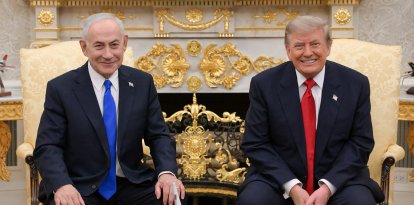
Israeli Prime Minister Benjamin Netanyahu said Monday that the next phase of U.S. President Donald Trump’s Gaza peace plan would focus on disarming Hamas and demilitarizing the Strip, not reconstruction.
“We are at the threshold of the next phase: Disarming Hamas and demilitarizing the Gaza Strip,” Netanyahu told Knesset lawmakers, shortly after he officially announced that the Israel Defense Forces had recovered the remains of the last hostage from the coastal territory.
Netanyahu spoke alongside Albanian Prime Minister Edi Rama at a special Knesset session honoring the European leader.
“The next phase is not reconstruction,” Netanyahu said. “We have an interest in advancing this phase, not delaying it. The sooner we do so, the sooner we will complete the objectives of the war.”
According to the prime minister, demilitarization “will happen—as our friend Trump said—the easy way or the hard way, but it will happen.”
Earlier in his remarks, the leader of the Jewish state announced that, for the first time since 2014, “there are no more hostages in Gaza” following the return for burial of Israel Police Master Sgt. Ran Gvili, who was killed and abducted by Palestinian terrorists during the Oct. 7, 2023, massacre.
“I congratulate the commanders of the Israel Defense Forces and the Shin Bet on the flawless execution of this mission,” he continued. “I promised you, citizens of Israel—we will bring everyone home.”
During his speech, the prime minister removed the yellow hostage ribbon-pin from his jacket, telling Knesset members: “Now that the mission has been completed, it can be removed, for the sons and daughters have returned to their borders,” citing from the book of Jeremiah (31:17).
Israel’s Prime Minister’s Office announced on Sunday that the IDF, since late last week, had been “conducting a focused operation to exhaust all of the intelligence that has been gathered in the effort to locate” Gvili.
On Sunday night, the military confirmed that its soldiers had recovered the police officer’s remains from a cemetery in the northern Gaza Strip.
“Following the completion of the identification process by the National Center of Forensic Medicine in collaboration with the Israel Police and the Military Rabbinate, IDF representatives informed the family of the hostage Ran Gvili, of blessed memory, that their loved one has been identified and will be laid to rest,” the IDF Spokesperson’s Unit said.
“Today, a painful chapter comes to an end—for the first time in over a decade, there are no Israeli hostages held in Gaza,” the military said in a separate statement. “For 843 days, our people were taken from us. Held in brutal conditions by an enemy that shows no respect for human life.”
Trump told U.S. outlet Axios in an interview on Monday that Hamas has helped locate Gvili in accordance with the truce deal he brokered and urged the terror group to follow through on its commitment to disarm.
The president said U.S. special envoy Steve Witkoff and Board of Peace member Jared Kushner had briefed him about the recovery on Monday morning. Trump then called Netanyahu, who he said, “was thrilled.”
Trump said that efforts to recover and identify Gvili’s remains were “very tough,” saying that IDF search teams had to go through “hundreds of bodies” in the Gaza cemetery and describing it as “a hard scene.”
Hamas assisted in the search, he said, giving the terror group credit for working “very hard to get the body back” and coordinating with Israel. “Now we have to disarm Hamas like they promised,” Trump added.
Under the U.S.-brokered ceasefire and hostage-release agreement that went into effect last year, the terrorist group committed to returning for burial all 28 bodies it was holding captive on Oct. 13. However, Hamas slow-walked their return, delaying disarmament, set to take place in Phase 2 with a deployment of international forces to the Gaza Strip.
Hamas leader Khaled Mashaal has rejected demands that his group lay down arms, declaring on Dec. 7 that “protecting the resistance project and its weapons is the right of our people to defend themselves.
“The resistance and its weapons are the ummah’s [Islamic nation] honor and pride,” the terrorist told an anti-Israel summit in Istanbul on Dec. 7, saying, “A thousand statements are not worth a single projectile of iron.”
Israel on Sunday night announced that it had agreed to Washington’s request to reopen Gaza’s Rafah Crossing with Egypt for the passage of people after the completion of the attempt to locate Gvili’s remains.
“Upon completion of this operation, and in accordance with what has been agreed upon with the U.S., Israel will open the Rafah Crossing,” Netanyahu’s office said in a statement late on Sunday.
Ali Shaath, the chief commissioner of the National Committee for the Administration of Gaza (NCAG), a body operating under the Board of Peace, said last week that the opening would allow for the entry of NCAG officials to begin the Strip’s rebuilding after two years of war.
The opening of Gaza’s Rafah Crossing “is a crucial first step in alleviating the immense suffering of our people in Gaza,” Shaath stated on Jan. 22, adding that the NCAG “is planning to return to Gaza as soon as possible and take up its responsibilities in a peaceful and coordinated manner.”
The Israel Defense Forces will maintain a presence around the crossing, which it has controlled since May 2024, and all entrants and departures will pass through an IDF checkpoint, Israel Hayom reported last week.
LATEST