ANALYSIS
California found no women harmed by abortion pill 'reversal' after six-week trial
California subjected clinics offering the abortion pill "reversal" to a six-week trial. It sought more than $20 million in fines and did not call a single woman to testify that she felt deceived or harmed. According to state practice and reports on the case, the judge has about 90 days to render a decision.
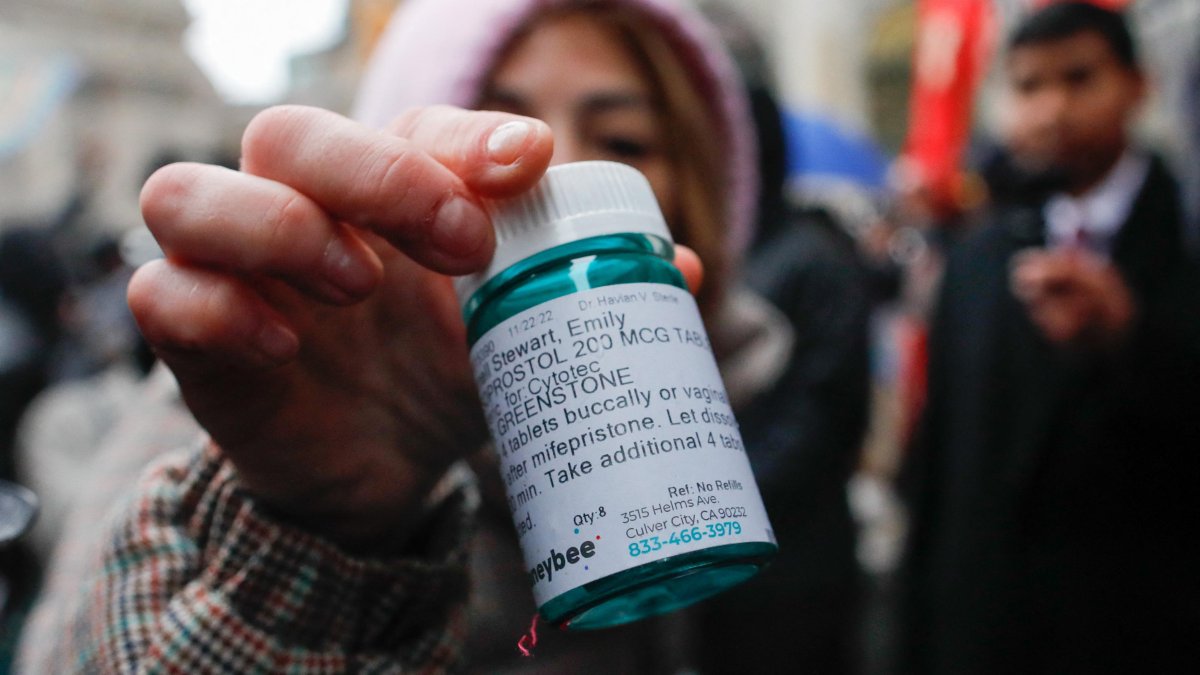
A pro-abortion activist holding abortion pills during a protest—File photo

Following a six-week trial and testimony from 25 witnesses, the State of California failed to identify any woman who had been harmed by the protocol known as the abortion pill reversal (APR), according to as reported by LifeNews from the legal representatives of the defendant organizations, Heartbeat International and RealOptions Obria Medical Clinics.
The case, considered the first of its kind to go to trial in the U.S., pits the state attorney general's office against two pregnancy support networks that provide information and access to this treatment.
Attorney General Rob Bonta does not dispute this fact. His lawsuit does not require a victim, but rather seeks to prove that Heartbeat International and RealOptions falsely advertise a treatment that, he alleges, lacks solid scientific evidence. Judge Patrick McKinney of the Alameda Superior Court has not yet ruled.

What the APR protocol is and why it is at the center of the litigation
Abortion pill reversal is an updated application of a treatment used since the 1950s to combat miscarriages, which involves administering bioidentical progesterone to counteract the effects of mifepristone, the first drug used in medical abortions. Mifepristone works by blocking progesterone, a natural hormone necessary to maintain pregnancy.
Heartbeat International, the largest network of pregnancy support centers in the U.S. and globally, manages the Abortion Pill Rescue Network (APRN), which consists of nearly 1,500 healthcare professionals, pregnancy centers and hospitals worldwide that follow the APR protocol.
For its part, RealOptions, a network of Christian-inspired medical clinics with five licensed centers in the San Francisco area, is affiliated with Heartbeat and a member of the APRN. According to data cited by these organizations, the protocol has saved more than 8,000 lives to date.

Society
Cardinal Cupich and two orders of nuns sue Illinois days before a law on assisted death takes effect
Carlos Dominguez
The allegation: Deceptive advertising and consumer protection
California Attorney General Rob Bonta accuses Heartbeat and RealOptions of misleading women about the reversal of the abortion pill, alleging that their communications violate the state's false advertising law.
The lawsuit seeks more than $20 million in penalties and aims to prohibit both entities from presenting the APR as safe and effective. To calculate potential fines, the prosecution is treating visits to the APR website, conversations with the helpline, and the consent form to begin the protocol as separate violations under two different statutes.
The defendants, represented by the Thomas More Society and the law firm LiMandri & Jonna, argue that their messages about APR are noncommercial, based on religious and women's-rights motivations, and therefore protected under the First Amendment. They further argue that the state has not demonstrated that any of their statements were false or misleading.

The trial: Testimony in their favor, no victims or consumer complaints
According to defense attorneys, after six weeks of oral arguments, 25 witnesses and nearly 200 pieces of documentary evidence, the prosecution did not identify any woman harmed by APR, nor did it file a consumer complaint against the protocol, Heartbeat, or RealOptions. Bonta's lawsuit alleges false advertising. In contrast, three women who underwent the reversal testified in favor of the protocol, and more than 200 signed a letter of support, according to LifeNews.
A key moment, according to the defense's account, came when the prosecution's expert, Dr. Mitchell Creinin, a critic of the APR, did not swear that the protocol "does not work" or that it "is unsafe." Creinin and the state maintain, however, that there is no high-quality scientific evidence demonstrating its effectiveness. The defense presented studies and clinical data supporting its safety and efficacy; the state considers them insufficient.

Politics
Nearly 70% of Americans reject mail-order abortion: A poll that sets the stage for the midterms
Carlos Dominguez
Another incident, according to the defense, involved the American College of Obstetricians and Gynecologists (ACOG): A representative reportedly admitted that its guidelines on APR did not come from the standard clinical guideline process, but rather from the government relations department, as reported by LifeNews. For the defendants, this makes the guidelines a non-medical opinion; ACOG has not publicly confirmed this interpretation in this text.
Heartbeat does not promise that APR will work in all cases. It cites a 64–68% success rate from an observational study by Delgado (2018), which was published and peer-reviewed, and which also describes no increase in birth defects and fewer preterm births than in the general population. The State challenges that study and denies that it proves a cause-and-effect relationship.

Awaiting the ruling
Representatives from Heartbeat and RealOptions expressed hope for a favorable ruling. They emphasized that, in their view, the prosecution failed to meet its burden of proof or present any victims, and announced that, whether they win or lose at the trial court level, they will continue to litigate to "uphold" the rights of their organizations and, according to Breen, so that this protocol can be offered as a real medical option after starting a medical abortion.
LATEST