The ‘no sabo’ voters: The new generation of Hispanics who helped defeat Trump
The "no sabo" group consists of young people of Hispanic origin born in the United States who struggle with certain Spanish verb conjugations. They played a key role in the midterms.
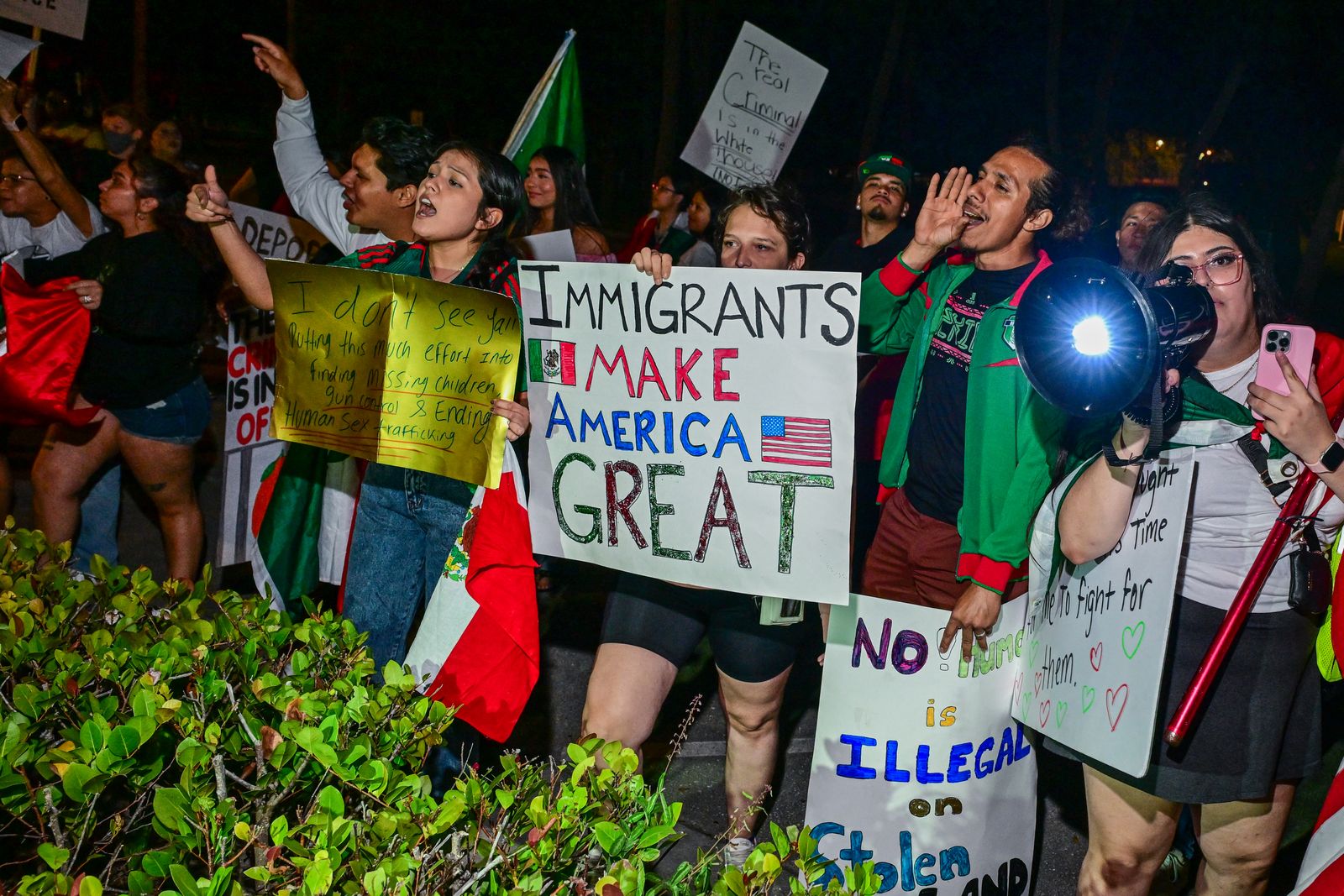
A group of Hispanics is protesting against ICE immigration raids
His family calls them "no sabo." They are young people of Hispanic origin born in the United States who struggle with some Spanish verb conjugations, but who contributed to Donald Trump's electoral upset.
This year, several of them walked out of class to protest the mass immigration raids by U.S. Immigration and Customs Enforcement (ICE), promoted by Trump.
Many claimed to be the voice of their parents, and those eligible to vote went to the polls on Tuesday. They are part of a large Hispanic electorate that two years ago placed its trust in Trump believing he would improve the economy, but who have now turned their backs on the Republicans in the midterm elections.
About 44.9 million people speak Spanish at home in the United States, 13.9% of the population aged five and older. It is the second most widely spoken language after English, according to official figures.
"I'm a "no sabo.” I know enough Spanish to talk to my mom regularly. But the 'no sabos' really do know," said Víctor Bucio, a 34-year-old American of Mexican descent, in Texas.
"I think this is the wake-up call someone needs to understand the importance of their vote in American society," he added. Social media is flooded with videos of immigrant parents proudly showing how their "no sabo" children voted on Tuesday.
Tuesday's Latino turnout will likely be the highest in history for a U.S. midterm election," said Janet Murguía, president of UnidosUS.
This Hispanic rights advocacy group opposes the "out-of-control mass deportation campaign and the abusive, violent and cruel tactics epitomized by ICE.”
Texas is now Democratic
Their votes influenced the election of Gina Hinojosa, a Latina woman raised in a Mexican Catholic household, as governor of Texas. With this victory, Hinojosa ended three decades of Republican dominance in that state.
They also celebrated the election of Xavier Becerra, who has Mexican roots, as governor of California.
"Don't let them get to you," Hinojosa recalls his grandmother telling him.
"Many Latina women in Texas grew up hearing those very same words from their mothers, from their grandmothers (...). This victory belongs to you and to them," she said.
The Tex-Mex singer Bobby Pulido, now a Democratic candidate, also flipped a Republican seat in Texas.
"A huge thank you to everyone who went out to vote. We broke records. There's a generation that wasn't politically active before, and they'll decide who they want as their leaders," said the now-representative for Texas's 15th district, a state where 40% of the population is Latino.
Even Mexico's president, Claudia Sheinbaum, highlighted the victory of Hinojosa and Becerra. "We are very pleased that Mexican-Americans have received this recognition," she said.
According to the AP Voter Poll conducted after the election, 6 out of 10 Hispanic voters supported Democrat James Talarico in his Senate race in Texas.
Among young Hispanics aged 18 to 29, 70% voted for Democratic candidates for the House of Representatives, according to estimates from CIRCLE, a research center at Tufts University.
I condemn Trump
In states like Florida, Republicans partially weathered the Democratic wave, albeit by a narrow margin.
Viviana Castro, a 67-year-old retiree of Venezuelan origin, says she is "proud to have voted against that man (Trump)."
"The way he's treating immigrants is unethical, immoral and not what a human being deserves," Castro said from Doral.
On her Instagram account "Qué Hacer en Austin," which has 432,000 followers, Mexican-born Katia Marroquin received requests for help finding lawyers or guidance regarding ICE detentions, which prompted her to encourage people to vote.
"There were several surprises. The 'no sabo kids' turned out to vote; many are under 30. There was also a greater presence of women among those who voted. I think it was out of empathy," he said.
Bucio said it is "sad" that an event had to occur that personally affected Hispanics, such as ICE raids, for them to vote.
For Yadira Sánchez, executive director of the civil society organization Poder LatinX, young Hispanics have a clear understanding of the situation.
"Our community has made constant sacrifices to meet its basic needs (...) Many families are raising children in the United States whom some call 'no sabo kids,' but we call them the 'yo sí voto' generation."
🛠 Do you think there is an error in this article?
Recommendations




LATEST