Trump defends his policies on Venezuela, immigration and security before the UN: 'America is back'
The U.S. president addressed the UN General Assembly on the situations in Venezuela, Cuba, and Iran; the war between Russia and Ukraine; immigration; and drug cartels, in addition to questioning the International Criminal Court and rejecting the idea of a global government.
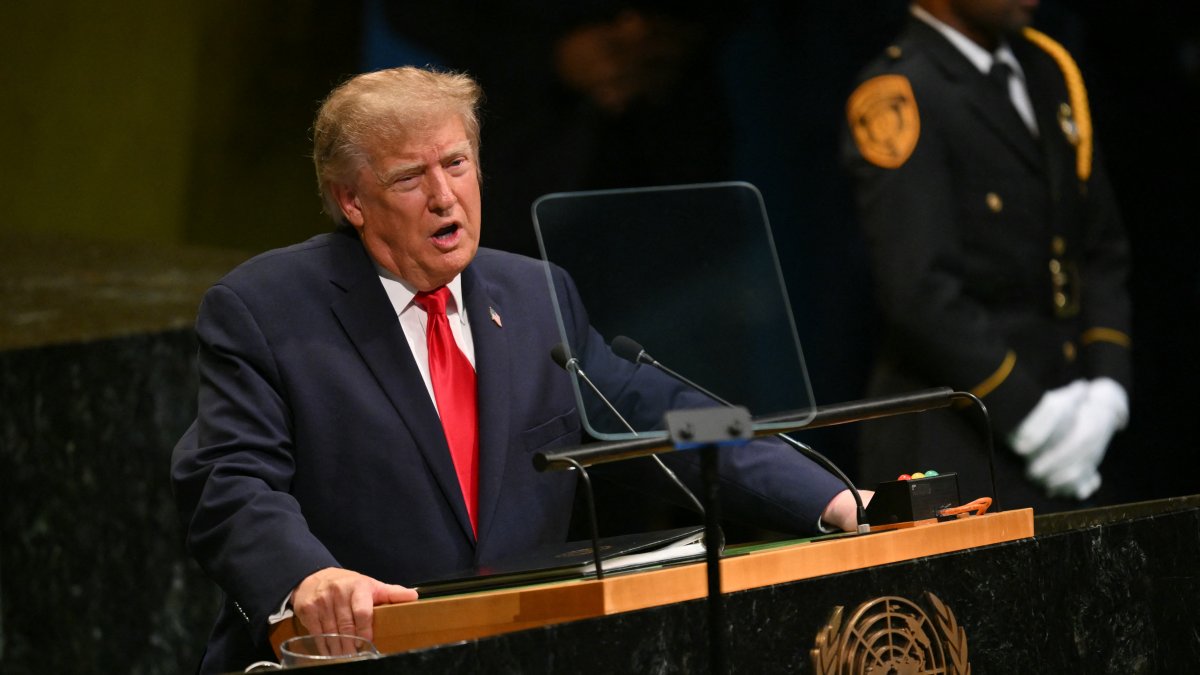
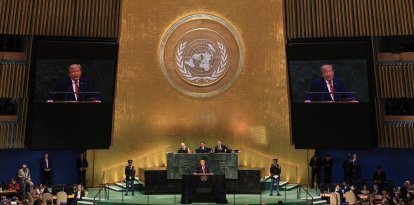
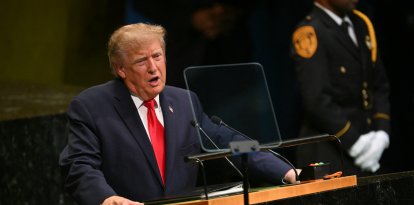
President Donald Trump at the UN

President Donald Trump addressed the United Nations General Assembly on Tuesday, covering a broad agenda that combined foreign policy issues with domestic U.S. matters, including the situations in Cuba, Venezuela, and Iran; the war between Russia and Ukraine; immigration; the fight against drug cartels; the future of artificial intelligence; and the role of the International Criminal Court.
Regarding Cuba, Trump stated that the island's regime has maintained ties with left-wing groups and communist networks in the United States for decades. "The Cuban regime has also spent decades coordinating with left-wing radicals and communist networks here in the United States, as our State Department has detailed," he said.
Regarding Venezuela, Trump highlighted the recently announced oil agreement. "Last month, we signed the largest oil deal in history, covering 65 billion barrels of oil, which will benefit both Venezuela and the United States enormously," he said.
The White House has presented this agreement as part of a three-phase plan for Venezuela, which calls for the country's stabilization, economic recovery and an eventual democratic transition. During his remarks, Trump also stated that Nicolás Maduro was a dictator who was captured by the United States and highlighted the January 3 operation, which culminated in his transfer to a U.S. federal prison.
"Do I annihilate the Islamic Republic?"
Regarding Iran, Trump raised the possibility of reaching an agreement to end the conflict in the Middle East, though he also warned of the possibility of a military escalation. I have a big decision to make — will a deal be made with Iran that lets them rebuild and create a far greater country than it ever was before, maybe one of the greatest in the Middle East or even the world?" he asked.
He then outlined the opposite scenario: "Or do I annihilate the Islamic Republic and do it quickly, never giving them a chance to kill and destroy people and countries again? Do I drive them into hell with no chance of survival and no hope of future greatness or generations?"
Trump stated, however, that he believes it is possible to reach an agreement after the U.S. midterm elections in November. "I believe we'll make a deal right after the election because it doesn't make sense for them not to," he said. "They're waiting to see how I do in the midterm election. What they don't realize is that I'm not running. I did that already, and won in a landslide."

The war between Russia and Ukraine
Regarding the war between Russia and Ukraine, Trump said that Washington is working with the leaders of both countries to try to reach an agreement. "We're working very closely with the leaders of Russia and Ukraine, and we will get that one done. It's going to happen, I think, more quickly than people understand. They've had it," he said.
Another key topic was artificial intelligence. Trump rejected calls to establish international oversight of this technology and announced that the U.S. government will begin using the term "superintelligence" instead of "artificial intelligence" in its communications.
Trump also once again questioned the role of international organizations. In particular, he called on member countries of the International Criminal Court (ICC) to withdraw from the body. "The United States is equally opposed to the out-of-control institution known as the International Criminal Court," he stated.
"I call on all nations that are members of the ICC to officially resign from this rogue institution immediately," he added. Trump further maintained that the United States "will never allow U.S. service members or anyone else to be investigated or given show-trials by an anti-American tribunal with no jurisdiction over us."
"There is no human right to illegal immigration"
During his speech, Trump also defended the sovereignty of the United States in the face of illegal immigration and rejected the existence of a supposed right to enter a country illegally. "There is no human right to illegal immigration — but there IS a right to remain a sovereign nation," he stated.
Along the same lines, he reiterated his rejection of supranational government mechanisms. "There is no global government — and while I am President, there will be NO GLOBAL TAXES," he maintained.
The U.S. president also focused part of his remarks on the fight against drug cartels. Trump recalled that, upon taking office, he designated the cartels as Foreign Terrorist Organizations and stated that the U.S. Armed Forces were mobilized to combat them.
"The cartels are the ISIS of the Western Hemisphere — NOT good people. They are enemies at war with civilization, using murder, rape, torture, and extortion as instruments of terror, they should be killed, exiled, or detained as enemy combatants without the possibility of release."
"Our country is stronger today than ever before"
During his remarks, Trump also highlighted the creation of the Peace Board, noting that nearly 30 countries have joined the body he chairs and thanking the participating countries for their contributions to aid programs.
Trump also defended the state of the United States under his administration. He highlighted the U.S. economy, its military might and its technological leadership:
"Two and a half centuries after the cause of liberty found its home on this continent, I can report to you with pride that America is BACK — and our country is stronger today than ever before," he said.
LATEST