ANALYSIS
From crisis to rebirth: 250 Years of extraordinary American resilience
From the Civil War, which in the 19th century threatened to permanently divide the country, to the Great Depression of the 1930s, through the attacks of Sept. 11, 2001, the financial crisis of 2008 and the COVID-19 pandemic in 2020, the nation has demonstrated a remarkable ability to overcome its worst crises and, in many cases, emerge stronger.
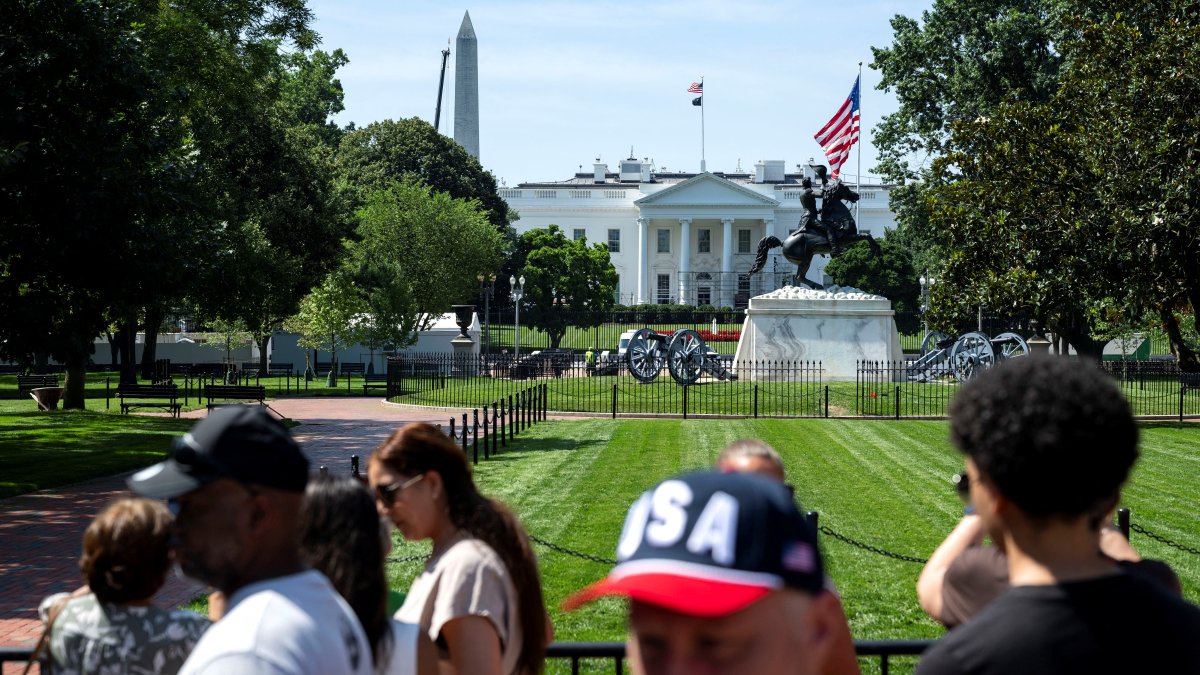
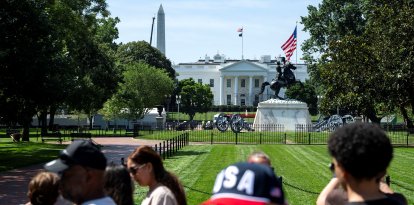
People walk and take photos in Lafayette Square

On the 250th anniversary of its independence, the United States once again demonstrates one of its most distinctive characteristics: its ability to overcome the most serious crises and emerge stronger. This resilience is no accident, but rather part of the nation’s historical spirit.
Throughout its history, the U.S. has faced challenges that at the time seemed existential. However, on each occasion it has found a way to rebuild itself.
From the Civil War, which in the 19th century threatened to permanently divide the country, to the Great Depression of the 1930s, through the attacks of Sept. 11, 2001, the 2008 financial crisis and the COVID-19 pandemic in 2020, the nation has demonstrated a remarkable ability to overcome its worst crises and, in many cases, emerge stronger.
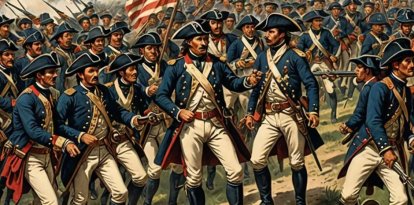
The Civil War: The “rebirth” of the United States
The American Civil War, which lasted from 1861 to 1865, was the bloodiest conflict in the country’s history. Estimates of casualties range from about 620,000 to nearly 750,000 deaths, according to the demographic review by historian J. David Hacker.
The conflict threatened the very survival of the United States, devastated much of the South, and ended with the Union’s victory, which preserved national integrity, abolished slavery and paved the way for the country’s industrial consolidation.
The United States emerged from the war profoundly transformed. The Union prevailed militarily and prevented the permanent partition of the country, while the Emancipation Proclamation and, later, the 13th Amendment legally abolished slavery. The war also paved the way for far-reaching political and economic reorganization.
Historian James McPherson, winner of the Pulitzer Prize for his book "Battle Cry of Freedom," has been one of the authors who has best explained the profound significance of the American Civil War. In his interpretation, the conflict not only preserved the Union but also brought about a “rebirth of freedom” by transforming a decentralized republic into a more centralized nation-state by abolishing slavery and laying the institutional and political foundations of the United States.
From the worst crisis to the greatest economic boom in history
The economic collapse of 1929 marked the beginning of the Great Depression, the darkest period in the history of the U.S. economy in the 20th century. According to official data from the Bureau of Labor Statistics (BLS), unemployment reached a devastating peak of 24.9% in 1933. In real terms, this meant that nearly one in four American workers was unemployed.
The decline in industrial production, the collapse of agricultural prices and the spread of poverty gave rise to iconic images of the crisis, such as the homeless encampments known as “Hoovervilles” and the long lines for bread.
In his acceptance speech as the Democratic nominee in 1932, Franklin D. Roosevelt (FDR) promised to implement a “New Deal” for the American people. After taking office in March 1933, he launched an ambitious economic recovery program.
During his first 100 days, Roosevelt persuaded Congress to pass a comprehensive package of emergency legislation. He declared a bank holiday to stop bank runs and created numerous federal agencies known as the “alphabet agencies.”
Among the most important New Deal agencies were the Agricultural Adjustment Administration (AAA), which sought to stabilize agricultural prices and support farms; the Civilian Conservation Corps (CCC), which employed young people in conservation projects; the Tennessee Valley Authority (TVA), which created jobs and electrified large rural areas of the South; the Federal Emergency Relief Administration (FERA) and the Works Progress Administration (WPA), which provided aid and massive employment through public works and cultural projects; and the National Recovery Administration (NRA), which sought to regulate industrial competition through codes affecting prices, wages and production.
Although it failed to completely eliminate unemployment—which still hovered around 14% in 1940—the New Deal created jobs, stabilized the economy and established a new, more active role for the government in the lives of citizens.
The arsenal that pulled the U.S. out of the depression
The true end of the Depression came with the war effort during World War II. Industrial mobilization turned the United States into what FDR called “the arsenal of democracy.”
Between 1939 and 1945, the U.S. economy experienced an exceptional war-driven expansion: nominal GDP rose from $93.4 billion in 1939 to $228 billion in 1945, while unemployment fell from 14.6% in 1940 to 1.9% in 1943 and reached 1.2% in 1944. These figures show the extent to which the war effort transformed production and absorbed the labor force in the United States.
By 1945, the United States accounted for nearly 50% of global GDP, establishing itself as by far the world’s leading economic power.
After 9/11: Reconstruction and fortification of the U.S.
Following the attacks of Sept. 11, 2001, which left nearly 3,000 dead and deeply scarred the national consciousness, the United States responded with determination under the leadership of George W. Bush. The country rebuilt the World Trade Center (WTC)—now known as One World Trade Center, the tallest building in the Western Hemisphere—as a symbol of resilience.
In addition, the United States significantly strengthened its national security apparatus. In 2002, the Department of Homeland Security (DHS) was created through the Homeland Security Act, the largest reorganization of the federal government since World War II. Previously, the USA Patriot Act (Patriot Act) was passed by Congress and signed by President George W. Bush on Oct. 26, 2001, significantly expanding surveillance powers and counterterrorism efforts.
Subsequently, in 2004, the Office of the Director of National Intelligence (DNI) was created as part of a sweeping reform aimed at improving coordination among agencies such as the CIA, the FBI and the NSA.
The Great Recession of 2008: Response to the financial collapse
The 2008 financial crisis, triggered by the bursting of the housing bubble and irresponsible practices in the subprime mortgage sector, led to the worst recession in the United States since the Great Depression. Between 2008 and 2010, more than 8.7 million jobs were lost, the unemployment rate reached 10%, and millions of families lost their homes to foreclosure.
Faced with the collapse, the government responded with unprecedented measures: the bank bailout program, the Troubled Asset Relief Program (TARP), worth $700 billion, designed to prevent the collapse of major banks and stabilize the financial system. In 2009, President Barack Obama spearheaded the American Recovery and Reinvestment Act (ARRA), a massive fiscal stimulus package of $831 billion that included tax cuts, infrastructure investment, and direct aid to states and citizens.
At the same time, the Federal Reserve (Fed) implemented an extraordinary monetary policy: it lowered interest rates to virtually zero and launched several rounds of Quantitative Easing (Q.E.), purchasing trillions of dollars in bonds to inject liquidity into the market.
Although these measures were highly controversial, they succeeded in preventing a total collapse of the financial system and laid the groundwork for a gradual recovery of the U.S. economy.
TARP was harshly criticized by both Republicans and progressive groups, who viewed it as an unfair bailout of the banks responsible for the crisis using taxpayer money, thereby encouraging “moral hazard.” The ARRA stimulus package was strongly questioned by Republicans and liberal economists, who considered it excessively expensive and riddled with inefficient political spending. Q.E. was met with opposition, particularly among conservative and libertarian economists, as well as those of the Austrian School, who argued that creating trillions of dollars distorted the markets, punished savers and increased inequality by primarily benefiting owners of financial assets.
The COVID-19 pandemic: The sharpest collapse and its rapid recovery
The COVID-19 pandemic triggered the fastest economic collapse in the modern history of the United States in 2020. In just two months, more than 22.4 million nonfarm jobs were lost, according to the BLS, representing a 15% drop in total employment. This collapse was driven primarily by mandatory lockdowns and government restrictions that brought key sectors such as leisure, hospitality and retail to a standstill.
Despite the magnitude of the crisis, the U.S. economy demonstrated extraordinary resilience. Thanks to an emergency response that included stimulus packages totaling more than $5 trillion, support from the Federal Reserve, and, especially, innovation and adaptation by the private sector, a V-shaped recovery was achieved—that is, a sharp decline followed by a rapid and vigorous rebound—one of the fastest among the developed nations of the G7 and G10.
The first Trump administration played a key role with initiatives such as Operation Warp Speed, which accelerated vaccine development through efficient partnerships with the private sector, avoiding excessive bureaucracy. American companies pivoted quickly, driving e-commerce, remote work and industrial restructuring, which highlighted the strength of free-market capitalism in the face of the limitations of state planning.
In the wake of the pandemic, the U.S. economy recovered thanks to the innovative spirit of its people and the free-enterprise system, free from government overreach.
Beyond the state: The strength of the American people
As it approaches its 250th anniversary, that resilience—rooted in the founding principles, economic freedom, personal responsibility and limited government, remains the best guarantee that the United States will not only survive future challenges but will continue to lead the free world as a beacon of opportunity, innovation and prosperity.
LATEST