
Robbery at the Louvre: A metaphor for a France in ruins
The Louvre, one of the most important symbols of French splendor, now joins the growing list of things the government can no longer protect, such as freedom of expression, women, children, tourists, education, peace, order, cleanliness, health, transportation, and its own stability.
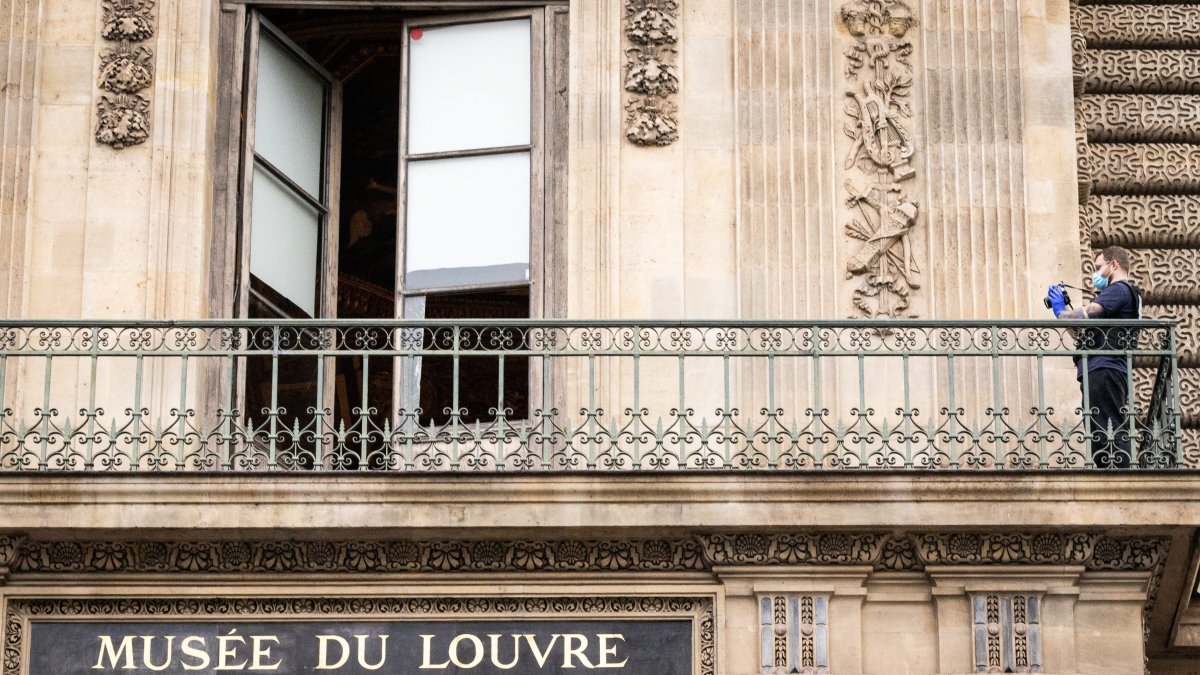
The scientific police investigating in the Louvre museum after the robbery.
Last Sunday, four thieves broke into the Louvre, in Paris, shortly after its opening and stole priceless relics from the French crown. The robbery took place in broad daylight, between 9:30 and 9:40. The assailants arrived at the museum, two on motorcycles and two others in a car, and gained access to the interior through the facade located on the side facing the Seine River, by a mechanized staircase like those used in removals. They entered through a balcony into the Apollo gallery, located on the second floor, and smashed stained-glass windows in the super-ornate gallery, built for Louis XIV. The robbery lasted between 4 and 7 minutes, but the immeasurable embarrassment will take much longer to dissipate.
The Louvre, one of the most important symbols of French splendor, attracting more than ten million visitors a year, now joins the growing list of things the government can no longer protect, such as freedom of expression, women, children, tourists, education, peace, order, cleanliness, health, transportation, and its own stability.
A France subjected to helplessness
Throughout the country, chaos has become a daily occurrence. The most serious political crisis since the founding, the Fifth Republic, coincides with a spectacular increase in criminal violence: three murders, 600 robberies with violence, 330 robberies with firearms and 700 car thefts are committed every day in France. Young people between the ages of thirteen and seventeen are responsible for almost a third of armed robberies. Shoplifting and looting in stores - from neighborhood stores to the most exclusive boutiques - is out of control.
Riots break out over anything: a concert, an arrest, a bill, a soccer match. After PSG won the Champions, dozens of youths posted on TikTok that the Champs-Elysées would burn that night, and it did. Last October, when the rap group L2B's free concert was canceled, thousands of fans instantly transformed into a mob armed with smoke bombs and hammers, smashing shop windows in the middle of Paris. Several cities have had to impose curfews for minors in the face of drug-related violence and gang settlements. Each week brings a new shock, a reminder that France is adrift, sunk in an anomie that is no longer even talked about because it has become part of the landscape.
In this context, last Sunday's robbery generated a shock that evoked the trauma of the Notre Dame fire, transforming itself into a political scandal that merged two citizen anxieties: rampant insecurity and the decline of the nation. And this is not an isolated case. The theft of relics and artifacts from churches across the country is constant: in 2024, more than a thousand events were recorded in France, ranging from graffiti to serious damage such as fires or theft of sacred objects. Churches listed as UNESCO heritage have been vandalized and set on fire.
Million-dollar thefts, the order of the day
Last mid-September, just a few weeks ago, another scandalous robbery occurred at the National Museum of Natural History in Paris, during which samples of native gold valued at $700,000 were taken. The thieves used a grinder and a blowtorch to gain access to the complex next to the Seine River, which is heavily frequented, by the way. The native gold was of immense scientific and cultural value; its heritage value is incalculable. A police source stated that the museum's alarm and surveillance systems had been disabled by a cyberattack in July, although it was unclear whether they were functioning when the theft occurred.
In early September 2025, the Musée National Adrien Dubouché in Limoges, a benchmark for porcelain, suffered an early morning robbery. The thieves made off with three pieces of great value: two Chinese dishes from the 14th and 15th centuries and a Chinese porcelain vase from the 18th century. The latter vase alone was valued at six and a half million euros.
These events followed a dismal November 2024. On the 20th, four men armed with axes and baseball bats smashed display cases in broad daylight at the Cognacq-Jay museum in Paris, making off with seven valuable 18th-century snuff boxes. Literally the next day, on November 21, another armed robbery hit the Hieron Museum of Sacred Art, where they stole the centerpiece of jewelry, the work "Vita Vitae," a national treasure valued at several million euros. The recent theft from the Louvre, therefore, comes at a critical time for cultural institutions, when French heritage is bleeding from ever deeper and more frequent wounds.
It is worth recalling an even more humiliating theft, that of the Museum of Modern Art in Paris, in May 2010: Vjeran Tomic, a Croatian thief nicknamed "Spiderman," made off with masterpieces valued at more than 100 million euros. The case revealed serious security flaws at the museum, such as motion detectors that had not been working for two months and three guards who failed to detect him. Tomic's goal was to take a single painting, Fernand Léger's Still Life with Candelabra, but when no alarm was triggered, he decided to take four additional works: Léger's Nature Morte aux Chandeliers, Braque's L'Olivier Près de l'Estaque, Modigliani's La Femme à l'Éventail, Picasso's Le pigeon aux petits pois and Henri Matisse's La Pastorale. Tomic was not caught thanks to the investigation, but was caught red-handed after trying to commit another heist and confessed to the theft from the Museum of Modern Art, but the paintings were not recovered.
Returning to Sunday's robbery, it is not that there had been no warning: a recent internal audit had already warned about the ineffectiveness of both the staff and the alarm systems. The world's most famous museum was defenseless. A report by the French Court of Auditors, prior to Sunday's robbery, had detected flaws in the Louvre's security; similar warnings have come from Versailles and the Museum d'Orsay.
The document, produced before the heist for publication in December but which has been advanced by French media, says there are rooms that do not have security cameras. The Le Figaro newspaper points to persistent delays in updating the technical installations of the world's most visited museum. In the Denon sector, which houses the stolen Apollo Gallery as well as La Gioconda, a third of the rooms have no surveillance cameras at all. In the Richelieu sector, three quarters of the rooms lack surveillance. Barely more than a third of the rooms have at least one camera, says the Court of Auditors, which points the finger directly at the museum's management.
DEI policies
Dominique Buffin, the woman in charge of security at the Louvre, is now under scrutiny, and some argue that she owes her post to the policies of Diversity, Equity and Inclusion (DEI). Never before had a woman held such a strategic post, and her appointment was celebrated by the left because it broke stereotypes; little was said about her capacity for the position. Criticism also fell on Laurence des Cars, the first female director, who is accused of having prioritized ideology over efficiency in the management of the museum.
The theft of the Louvre was not an anomaly: it was the perfect scene of a nation that no longer knows how to protect what defines it. The warnings were there, and those responsible looked the other way while prioritizing ideology over merit.
What happened on Sunday was not only looting, but the confirmation of a surrender. Now the Louvre, the face of France, bears the scar of a humiliation that will not be easily erased.
LATEST