Mamdani says he has ‘productive’ and ‘honest’ relationship with Trump
The New York City mayor told “PBS” that he has met with Orthodox Jewish leaders about antisemitism, “childcare and housing and quality-of-life issues.”
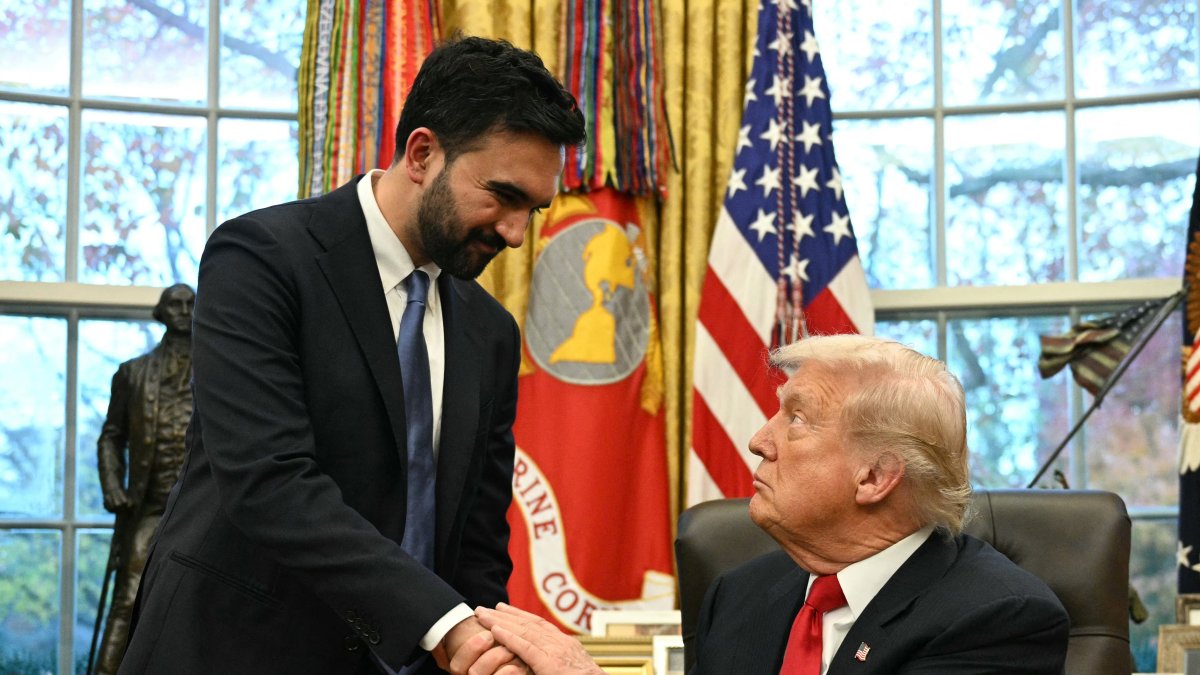
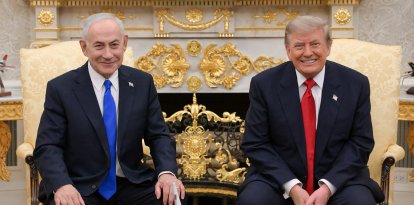
Zohran Mamdani junto a Donald Trump en la Casa Blanca

“Zohran Mamdani, the New York City mayor, told Amna Nawaz of PBS Newshour on Friday that he hopes being the first Muslim mayor will inspire New Yorkers.
“This may be the first time they’re seeing a Muslim in public office during the month of Ramadan and all that comes with it,” he told Nawaz. “For me, I am seeing so many Muslims who have been here far longer than I have, who have been doing this work, and they’ve been doing it no matter what the demand is.”
Mamdani said in the interview that it was “one of the most meaningful evenings I’ve had as the mayor” to break his fast one day with Rikers Island inmates. “It was really an occasion to recognize the humanity in others, and also, in doing so, recognize more of it in ourselves,” he said.
Nawaz said she thought it was “fair to describe” the community safety department Mamdani announced as a “pared-down vision” of the one he talked about on the campaign trail with a $1 million budget.
"New Yorkers can’t afford to wait for an answer to the mental health crisis"
“Our ambitions will never be pared down. This is the beginning of what it looks like to fulfill that promise,” he said. “It’s the start. However, New Yorkers can’t afford to wait for an answer to the mental health crisis.”
Nawaz mentioned that in Mamdani’s first months at City Hall, there have been “anti-Muslim protesters outside your home—not protesting your policies or anything else, protesting your faith outside of the place that you live.” She didn’t mention the attempted terror attack against those protesters but asked Mamdani about several members of Congress who have said that “Muslims don’t belong in American society,” that “we need more Islamophobia, not less” and “no more Islamic immigration.”
“I think there’s an unabashed nature to it, and it is being echoed from the highest offices in this country. They do so without any sense of shame, and what is remarkable about Islamophobia and anti-Muslim bigotry is not that it is bigoted, for there is so much bigotry in this country,” he said. “It is that there are very few who speak up in opposition to it—the manner in which it has become normalized.”
Hating Muslims “is not exclusive to any one political party,”
Hating Muslims “is not exclusive to any one political party,” Mamdani said. “It is endemic, frankly, to our politics. And what this kind of bigotry shows is a complete erasure of 1 million or so Muslims who call the city home, whose identity has often been one that they are made to feel as if is in tension with being a New Yorker.”
Mamdani, who has drawn criticism for the way he has talked about policing in the city, said that he is “very lucky that I have an incredible team of NYPD officers, who keep me safe each and every day.”
“My fear, frankly, is for those whose names we do not know, whose professions we do not know, who are seen and understood to be Muslim and will be attacked for it,” he said. “They will not have the protections that I do.”
NYC changed the way it reported hate crimes in February
Nawaz asked Mamdani about Jewish New Yorkers as well. The city changed the way it reported hate crimes in February, after January statistics in the first month of Mamdani’s mayorship showed a 182% increase in Jew-hatred.
Despite the new reporting, New York City Police Department statistics showed that 55% of hate crimes in the city targeted Jews in February, compared to about 2% that were anti-Muslim. (Pew Research Center data suggests that there were twice as many Jews as Muslims in New York in 2023-24, but other numbers show a much narrower gap.)
Nawaz asked Mamdani what his conversations with Jews have been like.
“They have been continuing, and it’s really been a pleasure to meet with so many Jewish leaders across the city,” he said. “It was actually not that long ago in this very room that I met with a number of Orthodox leaders across this city, and we discussed antisemitism and our commitment to rooting it out across the five boroughs.”
“We also discussed childcare and housing and quality-of-life issues, because those are also the concerns that fill the lives of Jewish New Yorkers across this city,” he said. “My job is not to be a mayor just for those who voted for me or those who agree with my politics. My job is to be the mayor for everyone who calls this city home, and to deliver to them a city that they can be proud of.”
"One thing we have very much in agreement is a love of New York City"
The mayor was also asked during the interview about his relationship with US President Donald Trump, who had previously called him a “lunatic” but with whom he met in the Oval Office at least twice.
“The president and I have many disagreements. We’re not shy about them. We’ve been public about them. We’ve been private about them,” the mayor said. “One thing we have very much in agreement is a love of New York City, and so, in that meeting, in the subsequent conversations in the following Oval Office meeting, I have gone back to the president with our hopes for what it could look like to actually put this city on a better footing in the years to come.”
That plan includes constructing more public housing than the city has seen since the early 1970s, Mamdani said. He added that he told the president that federal immigration raids are “cruel and inhumane” and “do nothing to advance the cause of public safety.”
“I gave him and his chief-of-staff a list of five who had been detained in or around Columbia University, and maybe about 30 or so minutes after the meeting, the president called me to say that he made the decision that he was going to release the student who had been detained that morning,” Mamdani said.
"My job is not to litigate the disagreements but to deliver for the people of New York City”
“I think it’s a productive relationship between the mayor of this city, the president of this country, and one that is also honest. I want to always be honest with the president and with the public about where those disagreements are,” he said, “and also that my job is not to litigate the disagreements but to deliver for the people of New York City.”
When Nawaz asked twice how often Mamdani talks with Trump, the mayor replied, “I will keep that between the two of us.”
LATEST