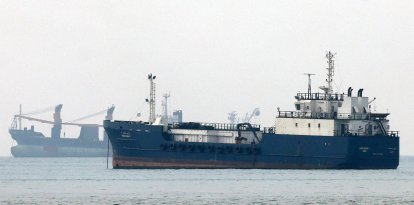
Oil is flowing again in the Gulf as the Iranian Regime's economy struggles
The partial resumption of oil flows has already led to a drop in prices: on Monday, Brent crude fell 0.79% to $101.44 per barrel, and West Texas Intermediate (WTI) dropped 1.2% to $90.02.
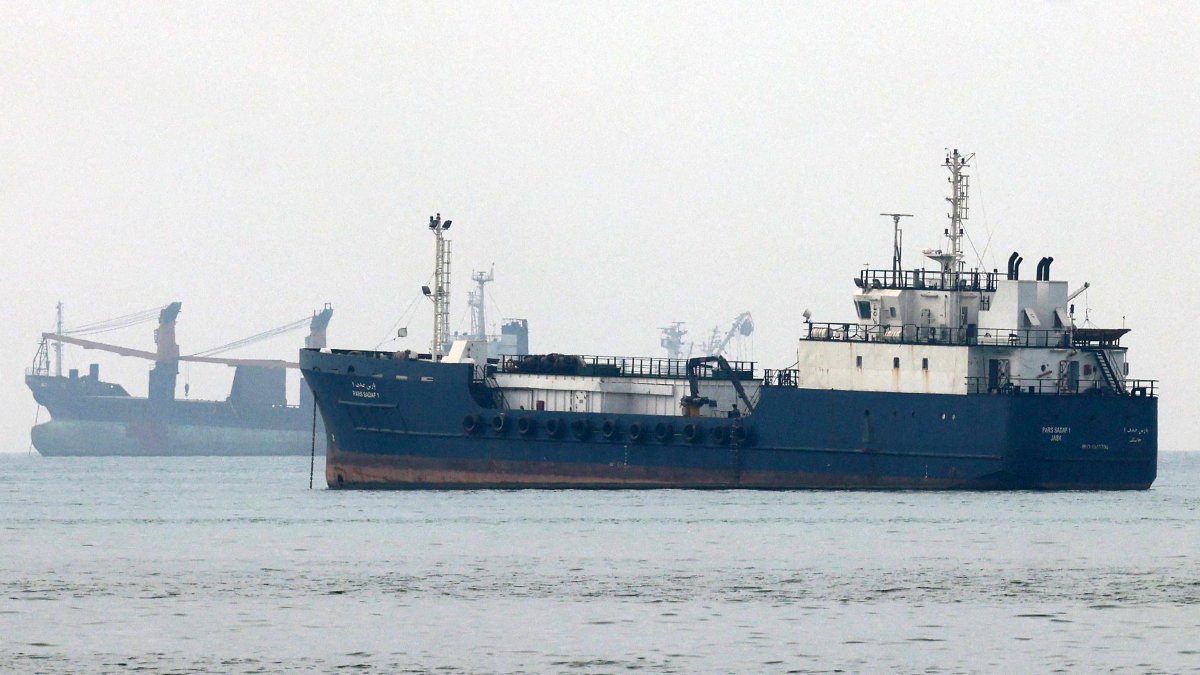
Ship crosses the Strait of Hormuz—File photo

Crude oil exports from the Middle East, excluding Iran, exceeded pre-war levels last week, reaching peaks of over 18 million barrels per day, despite Iranian attacks on oil tankers in the Strait of Hormuz, according to a report released Monday by the maritime tracking platform Kpler.
Kpler also noted last Wednesday that, for several days in September, crude oil exports from the region reached at least 16.5 million barrels per day.
This surge contrasts with the economic collapse acknowledged by the Iranian regime itself, where the U.S. naval blockade and sanctions have strangled its oil exports, caused its currency to plummet, and triggered a cost-of-living crisis, according to a report by the New York Times (NYT).
World
US withdraws all its B-1 bombers from UK base at Fairford following alleged foiled terrorist plot
Emmanuel Alejandro Rondón
The flow is recovering thanks to alternative routes
Most of the crude oil now flows through pipelines in Saudi Arabia and the United Arab Emirates, and the figures also include shipments via the Red Sea, a route increasingly used to circumvent Iran's blockade of the Strait of Hormuz, through which one-fifth of the world's oil supply previously passed.
According to AFP, Iran claims it still controls the strait and that ships passing without its authorization risk being attacked, but more and more are managing to cross, while alternative routes are operating at full capacity. Even so, experts warn that the situation is far from normal. The strait remains dangerous for navigation, and damage to energy infrastructure has reduced refining capacity and natural gas exports.
The partial restoration of the flow has already led to a drop in prices: on Monday, Brent fell 0.79% to $101.44 per barrel, and West Texas Intermediate dropped 1.2% to $90.02.

The Iranian Regime's economic collapse
The NYT reported on Sunday the warnings from Iran's national security adviser, Mohsen Rezaei, who admitted at a high-level government meeting that the rapid economic deterioration has plunged the country into "one of the most difficult periods in its history," after more than seven months of war.
The Iranian currency, the rial, has plummeted since the U.S. and Israel launched their offensive in February, with a sharp decline in recent weeks after Washington tightened sanctions and imposed a naval blockade that has made imports more expensive and deepened a cost-of-living crisis that had already sparked nationwide protests in December, which were suppressed with lethal force.

Politics
Trump doesn't rule out 'annihilating' Iran, as oil prices rise 2% and Brent crude breaks $100 again
Carlos Dominguez
In recent days, public and private sector employees, including nurses and teachers, have announced on social media that they are leaving their jobs because their salaries are no longer enough to make ends meet, while retirees have protested partial non-payment of their pensions.
In addition to the blockade, the United States has blocked most civilian air traffic between Iran and the rest of the world, adding a new layer of economic isolation that some sanctions experts believe could affect critical imports, including medicines.
New sanctions and rewards targeting the IRGC
State Department spokesperson Tommy Pigott noted that Iran has continued to attempt to acquire weapons and related materiel "in violation of reinstated UN measures," and that today's sanctions target those activities and third-country entities that support Iran's defense and proliferation industries.
In addition, Washington offered rewards of up to $15 million for information leading to the dismantling of the financial mechanisms of the Islamic Revolutionary Guard Corps (IRGC) and its affiliates.
LATEST