Vivas & Plenas
Inner dialogue: Why your inner voice defines your life
We talk with specialist Cristi Mota about how to identify, transform, and re-train the internal monologue that shapes our confidence, our decisions, and our emotional well-being.
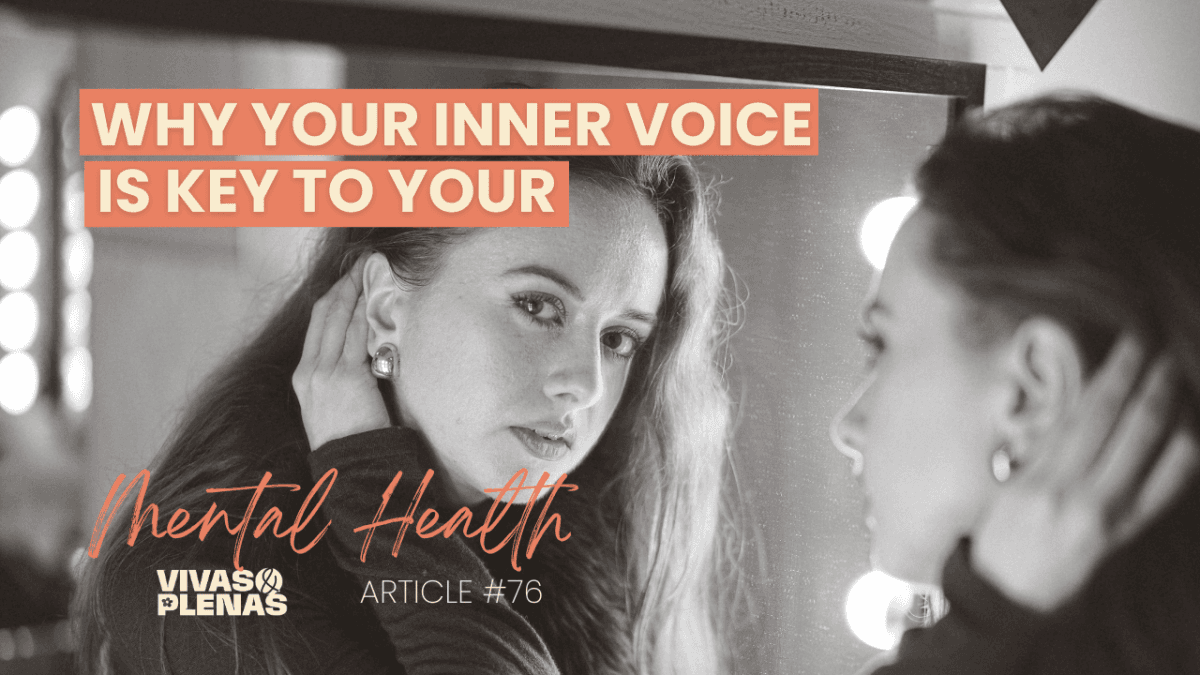
In this episode of Vivas y Plenas, Flor Elena Robledo talks with Cristi Mota about one of the most influential voices in our lives: our inner voice, that constant dialogue that stays with us from the moment we wake up until the day ends. That voice can become a source of strength, confidence, and hope, or, on the contrary, a barrier that limits our growth, disrupts our emotional peace, and distorts the way we see ourselves.
The most surprising part, Cristi points out, is that we are often harder on ourselves than on anyone we love. In this conversation, we explore how to identify the thoughts we repeat every day, how to transform a negative inner dialogue, and how to build an inner voice that fuels our identity, our purpose, and our emotional well-being. Because what we tell ourselves in private ends up shaping how we show up in public.
What Is inner dialogue, really?
Cristi explains that we all have a constant internal monologue, a mental language that never truly falls silent: memories, anticipations, repeated phrases, imagined conversations with other people. That's what we mean by the inner dialogue we all carry, often without even realizing it, throughout the entire day.
Although research has pointed out that men may experience more moments of “not thinking about anything,” Cristi clarifies that inner dialogue is present in them too, even if it shows up differently. In women, who tend to verbalize more outwardly, that inner dialogue also tends to be more intense on the inside.
Why your inner voice is key to mental health
Research shows, Cristi notes, that the quality of a person's mental health is directly linked to their inner voice, to how they speak to themselves and how they treat themselves. That inner narrative shapes how we interpret life, the meaning we give to circumstances, and even the decisions we make every day.
“The story I tell myself is what actually counts,” Cristi sums up. When someone keeps repeating a negative story about themselves, they end up acting and responding according to that story, reinforcing it without realizing it.
How our inner voice is shaped in childhood
How is that voice formed? According to Cristi, it's shaped by identity: what we think of ourselves and of the people around us, our fears, our insecurities, and the value we place on ourselves. That belief system begins forming in the womb and is reinforced by the voice of our caregivers: how we're spoken to and treated as children starts to define what our own inner voice will become.
Cristi shares a personal example: her eight-year-old son came home saying, “I'm not good at math.” When his dad sat down and patiently explained it to him, and the boy was able to understand the topic, his inner dialogue changed completely, to the point that he's now drawn to that very subject. As Cristi sums it up: as a person thinks, so they become.
The cycle that reinforces what we already believe
One of the central points of the conversation is why we tend to look for “proof” that confirms what we already believe about ourselves, whether in victimhood or in the role of “superhero.” Cristi explains that we start surrounding our lives with voices, content, and algorithms that reinforce that same idea, with no one to challenge it, constantly feeding the cycle.
That's why, she says, the first step is identifying whether that inner voice lifts us up or brings us down, encourages or discourages us, because it's the one voice we can't turn off. We can stop listening to a negative friend or certain content, but we can't silence our own voice.
The three types of inner dialogue (and which one is healthy)
Cristi suggests identifying which type of voice dominates our inner dialogue. At one extreme is the constant critic: negative, never satisfied. At the other extreme is the “cheerleader” who demands perfection and ends up lying to us with unrealistic positivity. In the middle, the healthy balance, is a compassionate but realistic dialogue: instructive, functional, one that speaks the truth in love, without self-sabotage or self-deception.
A well-trained inner dialogue, Cristi clarifies, isn't always positive to the point of denying mistakes. It speaks with compassion, but also with truth.
Who are you agreeing with?
Flor Elena adds a key reflection: everything in life comes down to agreements. When we speak badly about ourselves or diminish ourselves, we're agreeing with a force working against us. When we choose an inner voice that recognizes our worth and purpose, we're agreeing with what's right, with what brings us health and well-being, with the voice of our Creator.
A question Cristi recommends asking often is simply: Why do I think what I think? That question opens the door to identifying where that inner dialogue is really coming from.
How to help kids identify their inner dialogue
When asked how to support children who are more reserved by nature, Cristi recommends first observing whether there are any risk behaviors (changes in sleep, eating habits, or withdrawal) that call for professional support. If not, she suggests offering resources to help that inner dialogue start to come out: a journal, a shared hands-on or creative activity, like cooking or building something together, where conversation tends to arise naturally, without forcing it.
She also recommends teaching kids to name and validate what they feel, without needing to have all the answers: “I can see you're going through something hard, I'm here” is, in itself, an act of validation.
The power of vulnerability and validation
The conversation highlights that sharing our own emotions with our children too, without needing to disclose every detail of a struggle, creates a safe space where they also feel comfortable sharing what they're going through. No one talks about their struggles in an environment of judgment; they only open up in an environment of grace.
Listening before advising, validating before correcting, and holding space with patience are, according to Cristi, tools that build trust and, over time, foster a healthier inner dialogue in the people around us.
Re-training your inner voice: The first step toward well-being
Cristi closes with a hopeful message: no matter where we are today, we can always choose to re-train our inner voice. Recognizing, caring for, and transforming that dialogue is the path to discovering, behind that voice, a higher truth that sustains us through every circumstance.
Want to hear the full conversation?
Watch the full episode with Cristi Mota on our YouTube channel.
Follow us on social media too:
Instagram: @vivasyplenas
TikTok: @vivasyplenas
Facebook: Vivas & Plenas
🛠 Do you think there is an error in this article?
Recommendations








LATEST