2026 Nobel Prize in physics: A Wisconsin scientist is honored for his breakthroughs in cosmic neutrinos
Francis Halzen, born in Belgium and affiliated with the University of Wisconsin–Madison, was recognized for his decisive contributions to the IceCube Observatory and the discovery of high-energy neutrinos from space.

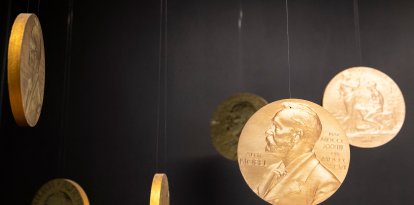
(FILE) Official Nobel Prize medals

Physicist Francis Halzen won the 2026 Nobel Prize in physics for his decisive contribution to the IceCube Neutrino Observatory and the discovery of high-energy neutrinos of astrophysical origin, the Royal Swedish Academy of Sciences announced.
According to The Associated Press (AP), the 82-year-old scientist's work advanced the study of these tiny and elusive cosmic particles, which are considered a new source of information about some of the most extreme processes in the universe.
"It was a big surprise, and obviously I wasn't expecting it," Halzen said during a phone call with the Nobel Committee from Italy, according to the news agency.
Antarctic ice as a detector
Halzen played a central role in the development of the IceCube Neutrino Observatory, installed beneath the ice at the South Pole. His work helped demonstrate that enormous volumes of Antarctic ice could be used to detect the flashes generated when neutrinos interact with matter.
The Swedish Academy emphasized that his vision and scientific leadership were fundamental to turning IceCube into a gigantic detector of approximately one cubic kilometer, equipped with thousands of sensors capable of recording signals produced by neutrinos originating from remote regions of the universe.
These particles have an extremely small mass and no electric charge, which allows them to pass through large amounts of matter with virtually no interaction. Trillions of neutrinos pass through the human body every second without leaving a detectable signal.
Studying them allows scientists to investigate phenomena such as stellar explosions and other extremely energetic cosmic environments.
"This experiment in Antarctica is a revolutionary way of understanding the universe that we didn't have before," Michael Moloney, executive director of the American Institute of Physics, explained to the AP.

Prize of about $1.2 million
Belgian Prime Minister Bart De Wever congratulated the scientist and noted that he becomes the eleventh Belgian to receive a Nobel Prize, according to the AP.
The award was announced in Stockholm by Ellen Moons, Secretary General of the Royal Swedish Academy of Sciences.
This year's Nobel Prize in physics comes with a prize of 12 million Swedish kronor, approximately $1.2 million. Nobel Week will continue with the announcement of the chemistry prize on Wednesday, followed by the literature prize on Thursday and the Nobel Peace Prize on Friday.
LATEST