In the throes of real revolution
The world has not seen an uprising of this scale in the Islamic Republic, at least not in contemporary times. The people are defiant and keep pouring into the streets.
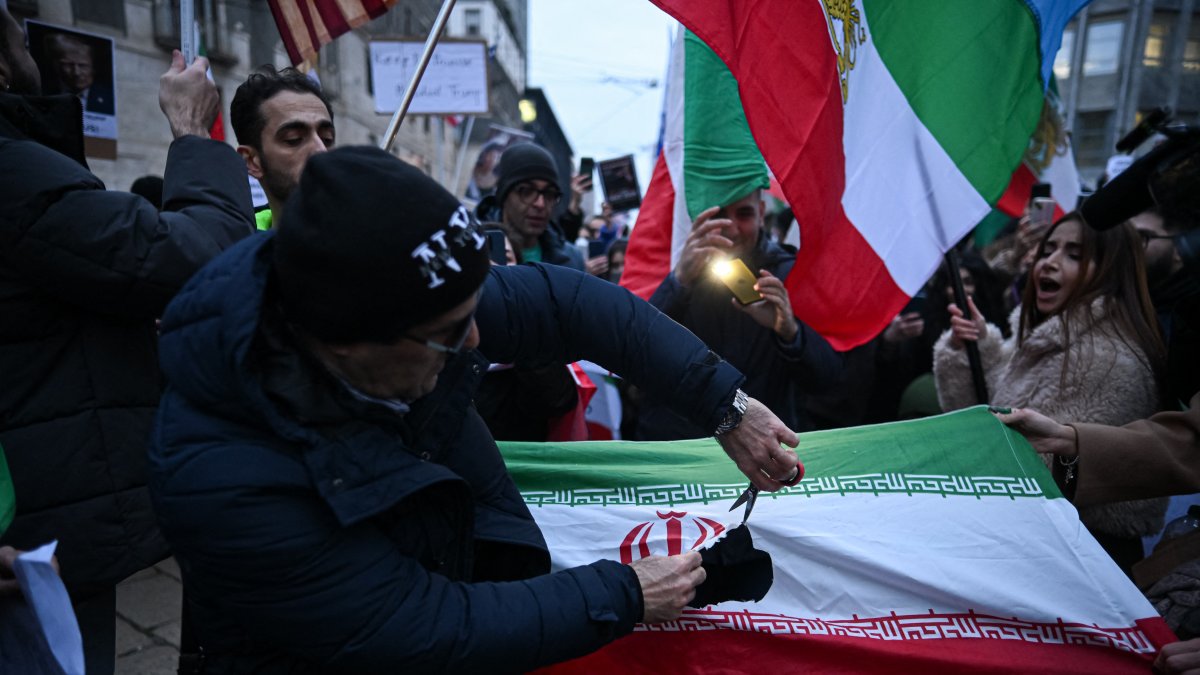
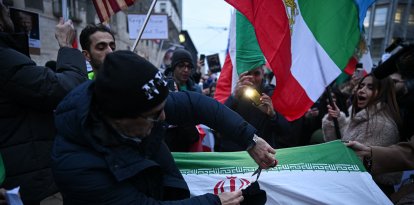
A protester cuts the flag of the Islamic Republic of Iran
The situation in Iran has become a moving story; demonstrations have spread throughout all 31 provinces. Streets are ablaze. Hungry to overthrow the suffocating Islamic Republic and desperate for a better life, protesters have been out for two weeks now. What began in the marketplace with the immense devaluation of the rial, coupled with restrictions on water due to mismanagement and drought, quickly spread throughout the entire population. It soon took on a serious, almost desperate, ideological tone.
The Shi’ite dystopian empire, with its repressive Islamic Revolutionary Guard Corps, armed police officers and thugs of the Basij, has been firing weapons straight into the crowds of defiant marchers.
The wounded and dead have been taken to overcrowded hospitals. Despite the heavy-handed crackdown, protests have continued to grow in size and intensity. Their resilience in the face of such brutal repression has drawn international attention and condemnation of the regime’s actions. Somehow, although the internet has been cut off (which indicates that the regime wants to hide its hideous brutality), many Iranian dissidents have been able to release dramatic images, showing thousands upon thousands of people out on the streets.
It is impossible to know the full extent of the Islamic Republic’s coercive repression. Protesters have been chanting, “Death, death to the dictator!” Many have shouted, “Forget Hamas! Forget Hezbollah! My life for a (liberated) Iran!” and “Iranians, raise your voice, shout out for your rights!” Some even exclaim, “This is the final battle! Pahlavi will return.”
"Demonstrators have recently been brutally met with live fire and machine guns"
A few photos showed demonstrators displaying and dancing with an unfurled Israeli flag. One man brought down the flag of the Islamic Republic, while another raised the former Persian flag with the sun rising and a lion. Crowds toppled and burned statues of U.S.-slain IRGC commander Qassam Soleimani; Ruhollah Khomeini, the ayatollah ruled following the Islamic Revolution in 1979; and the current ayatollah, 86-year-old Ali Khamenei.
Eyewitness accounts describe chaotic and harrowing scenes, with sirens blaring and smoke rising above city squares as security forces attempt to quell the unrest. There is burning not only in Tehran, the government capital, but throughout the streets. Demonstrators have recently been brutally met with live fire and machine guns. Despite the escalating violence, protesters continue to chant slogans demanding freedom and reform, expressing a unified resolve against the regime’s oppressive measures. The atmosphere is tense and uncertain, with many fearing further escalation but refusing to back down in their pursuit of change.
This population is risking everything they have, including their lives. The people are defiant, albeit scared and intimidated. Yet they keep pouring onto the streets.
"Iranian Parliament Speaker Mohammed Bagher Ghalibaf stated on Sunday that both the United States and Israel are fair game"
These displays of defiance highlight a deep-seated frustration and desire for change among the Iranian population. Restrictions notwithstanding, social media has played a crucial role in amplifying the voices of Iranians and sharing their message with the world. International observers continue to monitor the situation closely, as calls for solidarity and support for the Iranian people’s struggle grow louder.
The world has not seen an uprising of this scale in the Islamic Republic, at least not in contemporary times. Movement against the mullahs was seen in 2003, 2009, 2011-2012, 2017-2018, 2019-2020, 2021-2022 and 2022-2023, sparked by elections, economic hardship and social issues. But not on this level
Ali Larijani, secretary of Iran’s Supreme National Security Council, stressed the need for “a more severe crackdown against elements stoking insecurity and damaging people and public property amid riots in the country.” Khamenei said that his government “will not back down.” Iranian President Masoud Pezeshkian claimed that the United States and Israel have been directing rioters to destabilize Iran, saying “armed groups linked to foreign forces are killing civilians.”
Accustomed to their usual habits of displacing the Islamic Republic’s blame on others, Iranian Parliament Speaker Mohammed Bagher Ghalibaf stated on Sunday that both the United States and Israel are fair game. That, of course, came as a result of threats by U.S. President Donald Trump if more blood was shed in Iranian streets.
It is a wait-and-see moment. But it has never seemed more real.
LATEST