Stability Without Legitimacy in Venezuela: Why the Current Transition Plan Won’t Hold
Stability in Venezuela will not come from postponing legitimacy. It will come from aligning authority, incentives, and timelines in a way that removes the logic of looting and replaces it with a credible path forward.
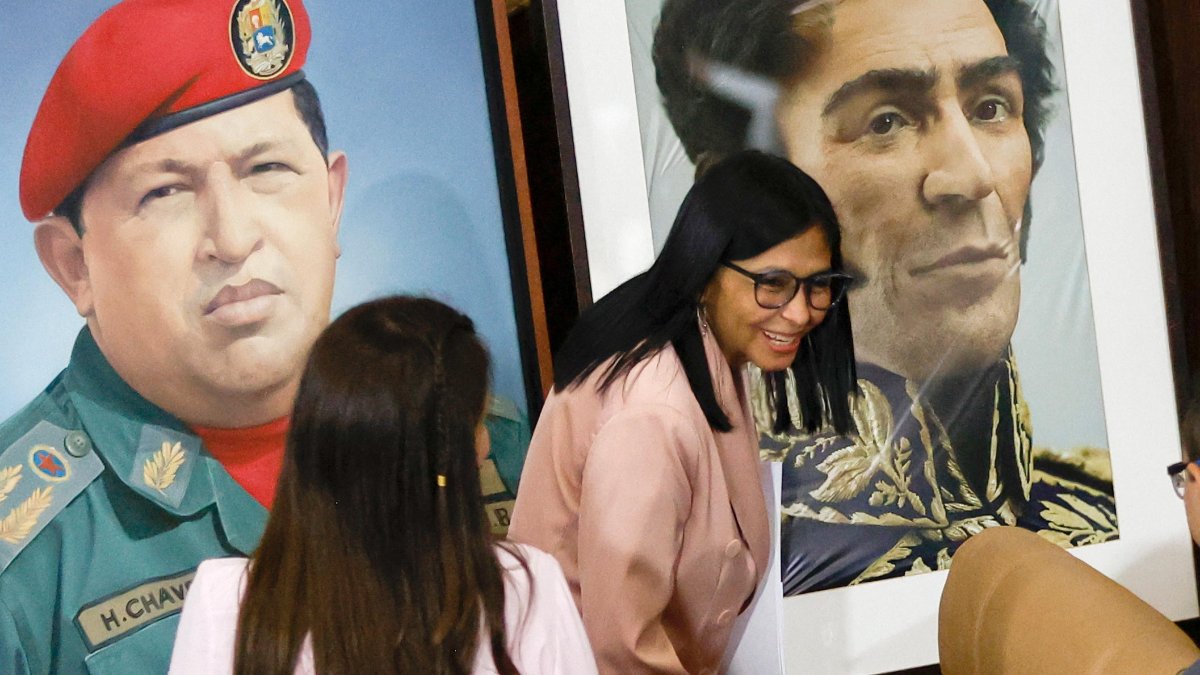
Delcy Rodríguez junto a los retratos de Chávez y Bolívar.
The central premise of the current U.S. administration’s approach to Venezuela is that stability can be achieved by keeping the old regime’s leadership in place while postponing the transfer of legitimate authority. This assumption is not only risky —it is internally contradictory. Political transitions do not fail because legitimacy arrives too quickly; they fail when those who still control the state know their time is limited and act accordingly. Venezuela is now being asked to test this theory under conditions where the incentives point decisively toward instability.
The administration has stated that the United States now exercises decisive influence over Venezuela’s political transition and that Delcy Rodríguez —Nicolás Maduro’s closest collaborator— will follow instructions from Washington. The stated priorities are clear and sequential: stabilize the economy, repair infrastructure, and eventually hold new elections.
At the same time, the administration has made equally clear that María Corina Machado, the most popular opposition figure in the country and the central symbol of democratic legitimacy, will play no role in the transition. Instead, Rodríguez will remain in power until these objectives are met.
Among Venezuelans, this strategy inspires confusion more than confidence. There is broad gratitude for U.S. actions that helped bring an end to Maduro’s rule. But there is little belief that a transition anchored in the continued authority of the regime’s inner circle can deliver order, accountability, or investor confidence.
The argument advanced by U.S. officials is that retaining elements of the Chavista apparatus is necessary to preserve stability and administrative continuity. That argument fails to account for how incentives change once elections become unavoidable. As the prospect of electoral defeat approaches, officials who remain in power but lack a future in the system face a clear calculation: extract what can be extracted and prepare an exit.
History offers little reason to expect restraint under such conditions. End-of-regime periods are typically marked by accelerated capital flight, paralysis inside state institutions, and large-scale diversion of public assets. Expectations that order will be maintained simply because elections are scheduled are not credible when those tasked with maintaining order know they are unlikely to survive politically —or legally —once power changes hands.
Even this pessimistic scenario assumes that Rodríguez and her immediate circle can maintain control over the state until elections take place. That assumption is far from certain. As access to state resources narrows and timelines shorten, internal competition within Chavismo will intensify. Challenges from rival factions are not hypothetical; they are structurally predictable. If central authority fractures, the result will not be a managed transition but a rapid deterioration of state capacity, with consequences well beyond Venezuela’s borders.
There is an alternative path. Venezuela held elections in 2024 in which the opposition candidate, endorsed and hand-picked by María Corina Machado, received nearly eight million votes. Recognizing this outcome and orienting U.S. policy toward facilitating the transfer of authority to a legitimate leadership would fundamentally change the incentive structure of the transition.
Under such an approach, U.S. leverage would be used not to indefinitely sustain an interim authority drawn from the old regime, but to impose a negotiated, time-bound transfer of control over state institutions. Responsibilities would shift incrementally under a defined timetable, reducing uncertainty and sharply limiting opportunities for large-scale looting.
A legitimate incoming leadership could provide the assurances needed to keep essential government functions operating while gradually installing new administrators. Exit guarantees — including exile arrangements — could be structured early to reduce incentives for obstruction and predation. With credible enforcement and sequencing, the final institution to change leadership would be the armed forces, not the first.
Stability in Venezuela will not come from postponing legitimacy. It will come from aligning authority, incentives, and timelines in a way that removes the logic of looting and replaces it with a credible path forward. The current plan does the opposite —and that is why it is unlikely to hold.
LATEST