
Bye bye, body positive: Sydney Sweeney and the revenge of the pretty girls
Wokism is a political phenomenon that has turned into a tantrum of resentful people who thought that the American Eagle campaign would help them resurrect their cause. However, despite having criminalized beauty in Western culture, the world still considers girls like Sydney pretty.
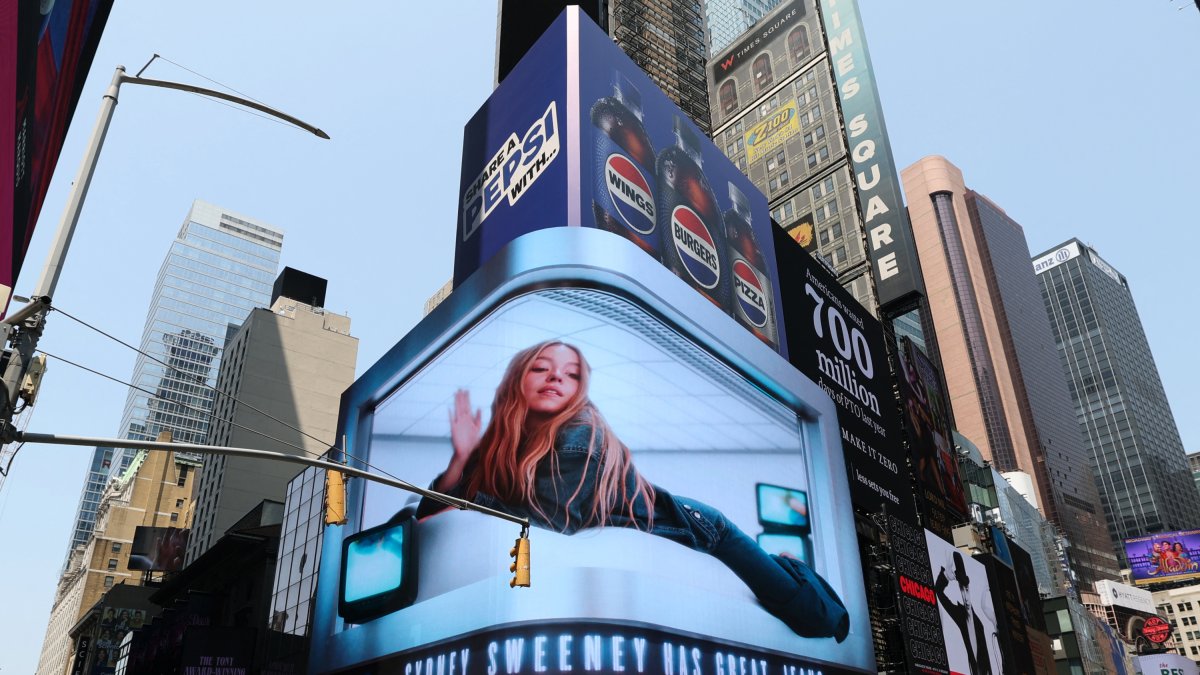
Sydney Sweeney advertising in Times Square, New York.
Everything changed for clothing company American Eagle when the company launched a new ad campaign starring beautiful actress Sydney Sweeney and various versions of the punchline, "Sydney Sweeney has cool jeans." This is a clear pun on genes, praising not only her pants, but also the body she was born with.
Having a beautiful girl appear in a fashion brand's ad campaign is not exactly a revolutionary concept. So how can it be a scandal for a brand to use an attractive woman to sell clothes in 2025? The answer lies in the ideological delirium that has taken hold of the advertising industry in recent years: a sector once famous for creativity, irony, glamour and beauty has been colonized by the woke ideology. Today, a new generation of creatives is beginning to rebel against the stupidity and failure of their progressive predecessors. They are fed up with brands that pretend to be virtuous, only to become a guarantee of bankruptcy in their attempt to moralize those who did not ask for it. A return to common sense and clarity of purpose - which is to sell, not indoctrinate - was a social demand, as evidenced by the sales success of American Eagle and the fame achieved by Sydney Sweeney.
As a result of the bold advertising, the company, the ad and Sydney Sweeney have become the subject of political debate in recent days. Complaints abound on social media, where various users point out - or rather project, assume and hallucinate - alleged connotations of white supremacy, eugenics, racist hierarchies and the imposition of imperialist ideals. Last year, Sweeney caused a stir by appearing on Saturday Night Live in a low-cut black dress. And on that occasion, there was no message like the ones about American Eagle: it was just her and her attributes.
Sydney Sweeney, evidently, is a remarkably gifted young white woman who embodies an ideal of beauty that has been tried to exterminate since the beginning of this century, with special fury in the last decade, and with real obsession in the last five years. What we are witnessing is a reaction to the fact, uncomfortable for some, that almost all of humanity perceives women like Sydney as more desirable, as they have been throughout history. And that understandably provokes resentment, envy, anger, even violence, particularly among those who have spent years repeating that the concept of beauty is a cultural construct and that everything is relative. Yet, despite having criminalized beauty in Western culture, the world still considers girls like Sydney beautiful.
Anyone who watched television, walked down the street or went to the beach in the 80s and 90s would have seen many such ladies. Sydney would not have represented anything exceptional at that time, and there were far more statuesque and stunning women. There were Pamela Anderson and the Baywatch girls, supermodels like Cindy Crawford, Linda Evangelista, Christy Turlington and Claudia Schiffer. The pulpy ones like Carmen Electra and Denise Richards. Unique beauties like Brooke Shields, Kelly LeBrock, Magnet or Kate Moss. It was a time when beauty was everywhere.
And that was until dastardly corporate marketing creatives decided that listening to the tantrums of the left woke was a good idea. They believed, wrongly, that it gave people anxiety and frustration to see pretty girls. They mistook the resentful activists for the entirety of the consuming public. So they started showing obese bodies in Calvin Klein underwear. They put zombie-like models on the runway and promoted them as desirable characters with armpit hair like Kamala Harris' stepdaughter. For years, they repeated to us that the public prefers to see themselves reflected on the screen, no matter how ugly that reflection may be. They went from idealizing the beautiful to idealizing the ugly, and in doing so, deprived the viewer of something essential in advertising: the aspirational value of beauty. And that's not how this business works.
The media and advertising developed a new fixation with "real" female figures, which came to be called body positive, a dogma that promotes the idea that all body types, regardless of shape, size or appearance, are identically pleasing to the eye. Underwear ads, instead of the usual top models, showed deliberately ugly people. This was the time when the breeding ground that led to #MeToo originated, and from then on, everyone started to walk on eggshells, having to say that something ugly is "diverse" and always in a panic to offend. Due to political correctness, female beauty was eliminated from the screens. The cultural advance of the left was accelerated under the wokish Obama administration, which made the old standards of beauty a target of attack. Trump's first presidency did not face this attack either, and the identitarian left and fourth-wave feminism took advantage to leapfrog.
Then, Gillette decided to lecture its own customers by accusing them of toxic masculinity, and Bud Light proclaimed that Dylan Mulvaney was not only a woman, but cute! And if you didn't think so, well, you were straight up a fascist.
Over the last decade, fashion, advertising and culture have embraced a peculiar interpretation of inclusivity, and obesity has shifted from a medical concern to a cause for celebration. Sports Illustrated, once a symbol of health and beauty, published a cover featuring a "plus-size" model in a revealing swimsuit, which was unnecessary. Several magazines and clothing houses followed suit, exposing their own XL girls irresponsibly, promoting a model dangerous to health, but proud of their commitment to diversity. Plus-size models accounted for 26.4% of all appearances at major Fashion Week events globally. According to data from the industry itself, brands using XL models in their advertising campaigns increased by 41% in 2025.
If Sydney Sweeney weighed 264 pounds, or had a face full of tattoos and piercings, or were Mr. John Sweeney and had a beard, or wore green hair and a keffiyeh around his neck, no one would have complained. But they wouldn't have sold a single pair of jeans either. The reason is to be found in the ABC of advertising: the target audience would not see themselves represented by these characters, and, more importantly, because most of them do not aspire to look like that. In general, we all dream of being prettier, not uglier. Many women aspire to emulate Sydney Sweeney, but none of them hope to gain 220 pounds, develop pimples and hair everywhere or become toothless.
Traditional media is full of analysis about the ad, criticizing it for being "aimed at the male gaze," but what is the problem? The problem is that they are right: the campaign, indeed, is very seductive, and that defeats the narrative that beauty doesn't matter, that it is a construct of another era, a bygone stage. But no, it's not like that; it was enough that Sydney Sweeney put on a tank top and peeked out to see a car engine to throw 10 years of woke narrative in the trash, reversing ten years of feminist social engineering, making it clear that people who enjoy beauty will not be punished in the Trump era.
And it was also enough for her to walk around in her skinny jeans for American Eagle to grow in sales and stock price. Pretty girls do sell products, and no one gives a damn if it affects the sensibilities of the offended. The outlandish claims against American Eagle didn't matter either. Clearly, consumers appreciate seeing beauty and confidence without complexes. A new Dunkin' ad emerged, featuring a handsome young man promoting their new products and claiming to have become the "king of summer" thanks to his golden tan, inherited from his genetics.
Wokism is a political phenomenon turned into a temper tantrum by resentful people who thought that the American Eagle campaign would revive their cause. This is tragic in many ways, but especially because of the deep sense of grievance that these people carry about the beauty of others.
That American Eagle thought it could launch this campaign and that Sydney Sweeney was encouraged to do it (as of this writing, the young woman has yet to apologize for being pretty) speaks volumes. It's fantastic news about the cultural changes we're seeing. The resurgence of seductive, ironic and playful advertising signals a change worth celebrating. This renewed acceptance of marketing, which is a fundamental part of the American spirit, suggests that society is emerging from a long period of self-hatred, lack of pride and mediocrity. At last, the pretties have their revenge.
LATEST