Boeing's stock falls following software glitch affecting 737 MAX's automated flight guidance system
A spokesperson for the Federal Aviation Administration (FAA) said the agency "is working closely with Boeing and the airlines" and will convene an advisory committee.

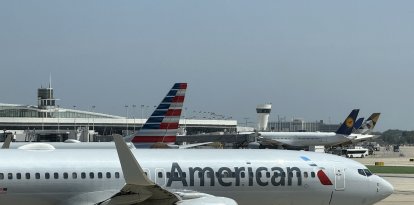
An American Airlines plane—File photo

Boeing shares were down between 4% and 5% during Monday's trading session, following reports of a software glitch in the 737 MAX that could leave pilots without automated flight guidance after a missed approach.
What's wrong and how Boeing explains it
The Wall Street Journal reported over the weekend that the defect stems from a cockpit software update. The glitch can be triggered when, after aborting an approach, the crew modifies the programmed route. In that scenario, an automated flight guidance feature (VNAV) may become unavailable.
"Last month, we notified all 737 operators of a software issue in which pilots may not have access to automated flight guidance during a specific landing scenario," a Boeing spokesperson said in a statement.

Society
Airbus completes nonstop flight of more than 24 hours between Australia and France
Carlos Dominguez
"We shared information with operators that reinforced existing pilot procedures for safely handling these situations," the spokesperson added.
Boeing stated that its engineers "are working on a software update to permanently resolve the issue" and emphasized that pilots are trained to land safely without that system.
The FAA: Immediate action if there is a risk
A spokesperson for the Federal Aviation Administration (FAA) said the agency "is working closely with Boeing and the airlines," and will convene an advisory committee.
"We will take immediate action if we identify a safety issue," the FAA spokesperson said.
Three major buyers are not operating the affected version
Three of the MAX's major buyers told AFP that they are not flying aircraft with the problematic new version of the flight management computer (FMC) software.
"United currently has no 737s operating with this new FMC software, and we are not accepting deliveries of new aircraft with the new FMC software," United said.
Southwest Airlines "is aware of the issue and is in contact with Boeing and the FAA," according to a spokesperson, who added that all newly delivered aircraft have earlier versions of the software installed.
"We have been in contact with Boeing and the FAA and will continue to work closely with both as they evaluate this matter and determine the next steps," said a spokesperson for Alaska Airlines, which also does not operate aircraft with the new software.
At a critical juncture for the MAX 10's certification
Boeing CEO Kelly Ortberg said on September 16 at a Wall Street conference that flight testing on the aircraft was complete, but that the company was still submitting documentation to the FAA.
"You'll see that certification very soon," Ortberg said.
The FAA certified the 737 MAX 7, the smaller and long-delayed model, on August 3.
LATEST