ANALYSIS
The venezuelan regime sought immunity for Delcy Rodríguez and remained silent regarding Maduro, according to the U.S. Attorney's Office for the Southern District of New York
That contrast is in the court record, and prosecutors invoke it in asking the judge to deny the motions to dismiss. It is not, however, the principal argument, since the filing rests above all on the fact that the United States has not recognized Maduro as president since January 2019.
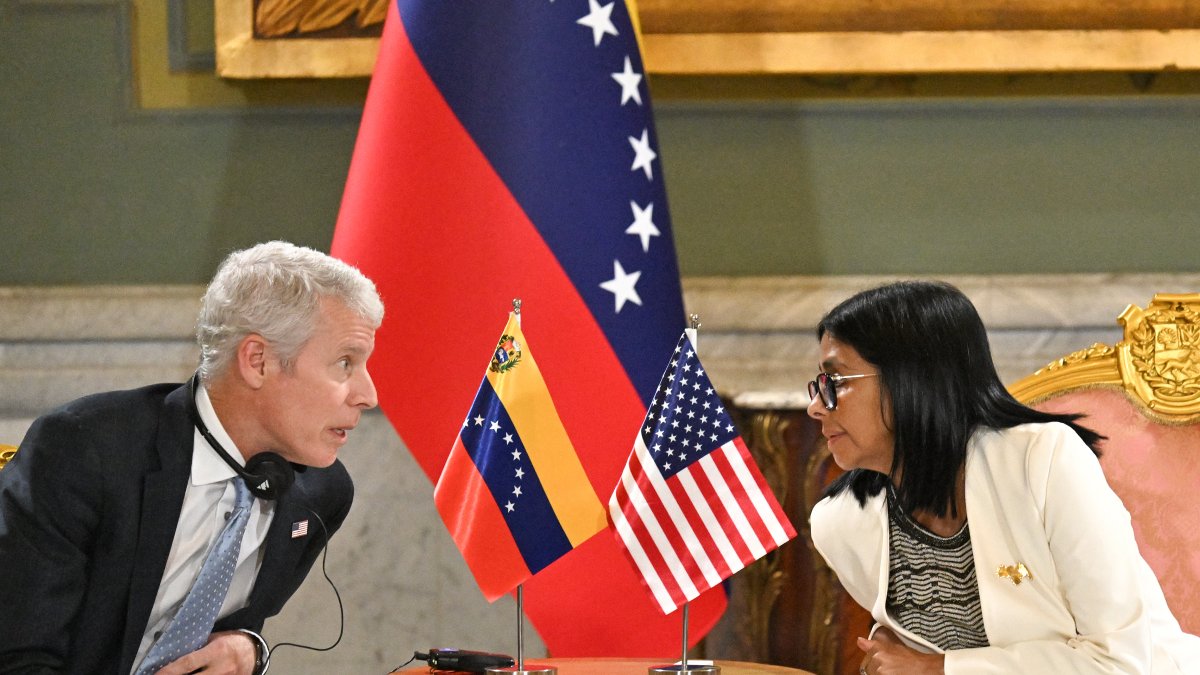
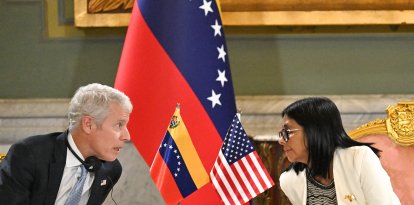
Energy Secretary Chris Wright and the president of the interim government, Delcy Rodríguez

The Chavista regime in Venezuela activated diplomatic channels to obtain "head-of-state immunity" for Delcy Rodríguez and, in contrast, did not file any claim on behalf of former Venezuelan dictator Nicolás Maduro or his wife, Cilia Flores, as stated in an official document from the U.S. Attorney's Office in New York.
This discrepancy is noted in the case file, and the U.S. Attorney's Office cites it in asking the judge to deny the motions to dismiss. It is not, however, the main argument. The brief relies primarily on the fact that the United States has not recognized Maduro as president since January 2019.
Politics
Trump praises Machado, assures her that 'everything will be alright' in response to her request to return to Venezuela
Andrés Ignacio Henríquez
A 57-page memorandum filed with Judge Hellerstein
On October 2, the U.S. Attorney's Office for the Southern District of New York filed with Judge Alvin K. Hellerstein a legal memorandum opposing the motions to dismiss filed by Nicolás Maduro Moros and Cilia Flores. The case is United States of America v. Nicolás Maduro Moros and Cilia Flores de Maduro, and the brief is signed by the office of U.S. Attorney James M. McDonald. The defense seeks to have the criminal proceedings dismissed on the grounds of head-of-state immunity and, in Maduro's case, also on the grounds that the charge of narco-terrorism is insufficient.
The key point regarding the relationship between Caracas and the trial is a section of facts titled "Venezuela's Non-Assertion of Immunity". There, the key sentence is this: "To date, Venezuela has not asserted that Maduro Moros or Flores de Maduro are immune from prosecution in this case or in any other proceeding currently pending in the United States."
Caracas used the mechanism for Rodríguez, but not for Maduro
The same section notes that the Venezuelan government did use the mechanism—and used it for someone else. In a diplomatic note dated May 14, 2026, the Venezuelan Embassy transmitted a formal request for the U.S. to grant Rodríguez "head-of-state immunity" in Kenemore v. Maduro, 25 Civ. 23652, in the Southern District of Florida. Both Rodríguez and Maduro are named as defendants in that civil lawsuit.
The note invoked "well-established principles of customary international law and sovereign courtesy," according to which a recognized head of state enjoys absolute immunity from foreign courts.
On July 20, 2026, the United States filed a "suggestion of immunity" with the Florida court—a formal notice informing the court that it recognized Rodríguez as the head of state of Venezuela and that, as such, she enjoyed immunity in that civil lawsuit. The New York memorandum adds the counterpoint: The Venezuelan government did not request immunity for Maduro in Kenemore, even though he was also a defendant.
This sequence of events is supported by the statement from Juan Pablo Segura, undersecretary for Western Hemisphere Affairs, dated October 2 and cited in the brief. The Prosecutor's Office cites this to establish two facts: that Caracas was aware of the diplomatic channel and used it in favor of Rodríguez, and that it did not activate it for Maduro or for Cilia Flores.
Who Washington Recognizes: The Legal Key
The Prosecutor's Office's legal basis predates the May note. The brief states that the United States has not recognized Maduro as president of Venezuela, nor Flores as first lady, since January 2019. It states that, following the 2018 election, the State Department recognized the 2015 National Assembly and, subsequently, the government of Juan Guaidó, and that it withdrew its recognition of Maduro. It adds that neither the Trump administration nor the Biden administration changed that position.
On March 5, the United States announced the normalization of relations with Venezuela "under the interim presidency" of Delcy Rodríguez. On March 7, President Trump confirmed formal recognition of that government. Maduro's arrest occurred on January 3, 2026. In the view of the Prosecutor's Office, the Executive Branch recognized another person as head of state and proceeded with the prosecution. That determination, it argues, is decisive: the immunity of a foreign head of state depends on recognition by the Executive Branch, and the courts must defer to it.
The Prosecutor's Office also rejects the notion that de facto control is sufficient to restore immunity, and maintains that immunity for official acts does not apply either. Among the factors it cites is, precisely, that the foreign state has not claimed such protection. The conclusion of the brief is limited to requesting that the motions to dismiss be denied.
World
Venezuela: Activist Rocío San Miguel receives 'acquittal' after being charged with terrorism
Williams Perdomo
Trial Schedule: June 1, 2027
The trial date does not appear in the October 2 memorandum. It is set forth in an order dated July 22, 2026, in which Judge Hellerstein adopted the schedule proposed by the parties: the trial will begin on June 1, 2027 and the final pretrial conference is scheduled for May 25 of that year.
Maduro and Flores have pleaded not guilty. The indictment, returned by a grand jury on December 23, 2025, charges them with a conspiracy to traffic cocaine between 1999 and 2025, in alliance, according to the prosecution, with the FARC, the ELN, the Sinaloa Cartel, Los Zetas, and El Tren de Aragua, as well as crimes involving machine guns and explosive devices. Maduro is also charged with conspiracy to commit narco-terrorism.

LATEST