The Great Western Schism 2.0
While Europe has moved towards a form of post-Westernism, the United States under Trump has initiated a movement of civilizational reassertion.
Published / Updated
In the summer of 1054, a seemingly minor scene took place in Constantinople. A delegation sent by Pope Leo IX entered Hagia Sophia during the liturgy and left a bull of excommunication on the altar against Patriarch Michael Cerularius. The gesture was as solemn as it was provocative. Days later, the response was symmetrical: the patriarch excommunicated the Roman envoys. That ceremony sealed what history would come to know as the Great Schism between Rome and Byzantium.
What is striking is that, for years, few contemporaries understood that this was not just another theological dispute, but the visible symptom of a deep civilizational fracture. Rome and Constantinople had ceased to share the same idea of authority, power and tradition. The Christian West and the Christian East were no longer the same world.
Something similar is happening today between the United States and Europe. U.S. Vice President J.D. Vance announced it a year ago now at the Munich Security Conference, when he warned of Europe's authoritarian drift and its renunciation of the values that defined classical liberal Western society. And it culminated a few days ago with the State Department's refusal to grant entry visas to former E.U. commissioners openly in favor of censoring freedom of speech on the big American social networks operating in Europe.
The outcry has not been long in coming, and Brussels and a good number of European capitals are already claiming President Trump and his administration are enemies of Europe.
But this is a deeply misguided reaction.
Donald Trump is not a passing eccentricity, but the political expression of a previous cultural rupture. His rise reflects a reaction against a model of globalization that has weakened national sovereignty, eroded the middle classes and relativized basic pillars of Western civilization such as freedom of speech, national identity, borders, merit and productive work.
While Europe has moved toward a form of post-Westernism, the United States—or at least a substantial part of American society—has initiated a movement of civilizational reassertion.
Europe and the post-Western path
Today's Europe is defined less and less by what it is and more and more by what it rejects. It rejects its past, is suspicious of its cultural identity, distrusts the nation as a political framework and considers any attachment to tradition problematic. The European Union has evolved from a pragmatic economic project into an ideological structure, marked by hyper-regulation, interventionism and a restrictive conception of freedom of speech in the name of supposedly superior causes.
The result is an aging, demographically fragile, energy-dependent and strategically irrelevant continent. Unable to defend itself without the United States, Europe also seems unable to define which values it wants to defend. Instead of exercising moral leadership, it merely issues regulations.
"Trumpism does not seek to destroy the West, but to rescue it from its progressive dissolution. That is why it is incomprehensible to European elites, who have assumed the transition towards a post-national, post-religious and post-historical world is inevitable—and even desirable."
In this context, Trump's criticism of Europe—his demand for greater defense spending, his rejection of climate dogma and his condemnation of ideological censorship—is not a whim, but an uncomfortable realization: Europe no longer acts as a fully Western actor, but as a civilization that is tired of itself.
The United States as the new Byzantium
This is where the historical analogy gains force. After the fall of Rome, the Empire did not disappear. It moved to the East. Byzantium retained Roman law, imperial structure, Christian tradition and a strong sense of continuity. While the West fragmented, the East resisted.
The United States occupies a similar position today. Despite its internal crises, it retains fundamental elements that Europe has been diluting: a revered Constitution, a robust defense of free speech, a shared national identity and a moral foundation—religious or civic—that continues to articulate public life.
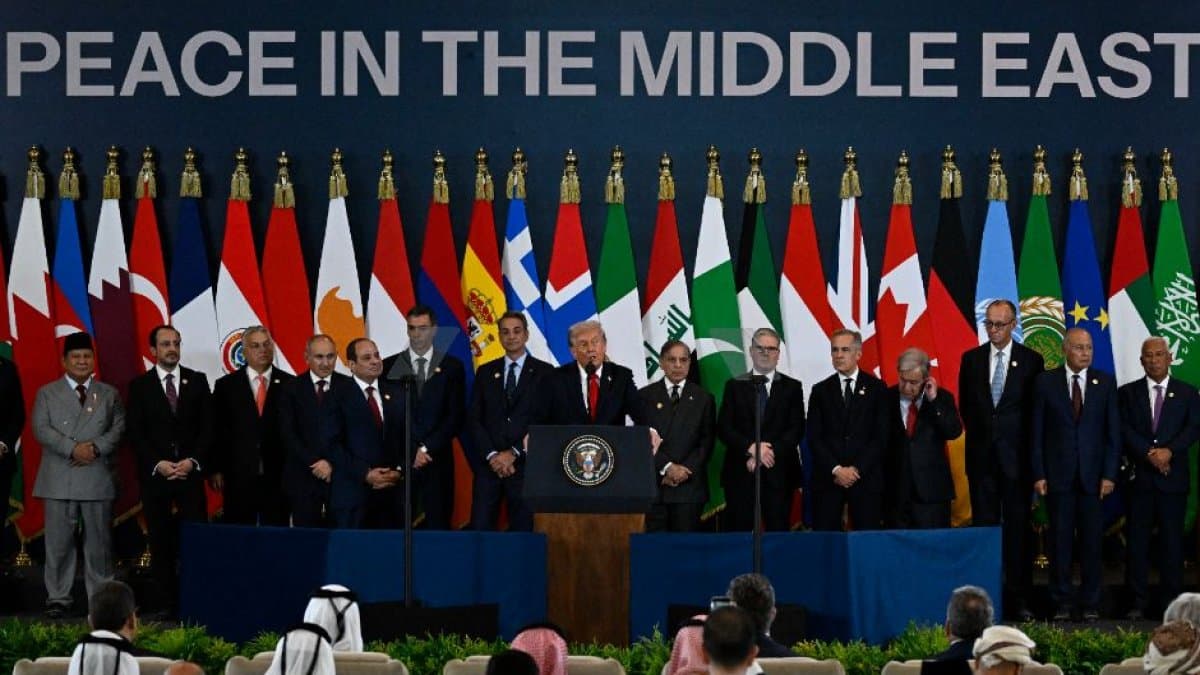
Trumpism does not seek to destroy the West, but to rescue it from its progressive dissolution. That is why it is incomprehensible to European elites, who have assumed the transition towards a post-national, post-religious and post-historical world is inevitable—and even desirable.
The West is not disappearing; Europe is abandoning it. And this time it is not preserved in the East, but in the West, in the United States of America.
A schism, not a collapse
To speak of schism is more accurate than to speak of decline. The West is not dying: it is dividing. On the one side is Europe renouncing its foundations in the name of a technocratic utopia; on the other, America that, with Trump as a catalyst, is trying to preserve what it considers essential.
As in the 11th century, the rupture is not occurring all at once or by a formal declaration. It is manifesting itself in accumulated disagreements, in symbolic gestures, in mutual incomprehensions. Europe sees Trump as a threat. Trump sees Europe as a warning.
History teaches us that these fractures are not resolved with good manners or joint statements. They are ruptures of worldview. Rome and Byzantium followed different paths for centuries. They shared a common origin, but no longer a destiny.
The question, today, is not whether Trump divides the West. The question is whether Europe still wants to be part of it.
🛠 Do you think there is an error in this article?
Recommendations




LATEST