The colonialism no one talks about: Arab imperialism
To call Jewish self-determination “colonialism” while ignoring the Arab conquests that Islamized the region uses historical erasure as a weapon against Israel.
Published
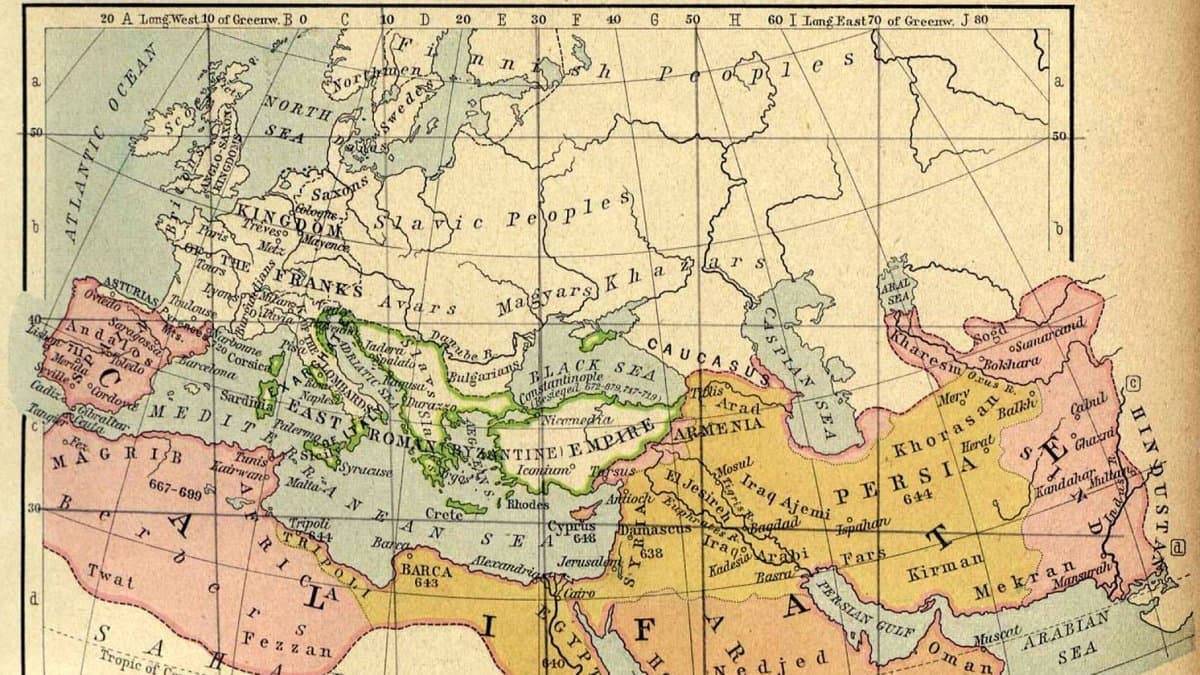
When the Arab armies surged out of the Arabian Peninsula in the seventh century, they created an empire larger than Rome in barely a century. By 750 C.E., they controlled 13 million square kilometers, ruled more than 50 million people and redrew the map of three continents. Egypt, Syria, Mesopotamia, North Africa, Persia and as far as Spain were absorbed into a vast imperial system built on conquest and domination.
However, when “colonialism” is invoked today, this empire is rarely mentioned. Only Europe and other Western nations are put in the dock.
This selective memory distorts history. It erases the suffering of entire peoples and presents conquest and subjugation as if they were merely cultural diffusion. The Arab-Muslim expansion was not a benign flowering of civilization, but a deliberate project of empire, motivated by religious and political ambition.
From its inception, Islam carried an imperial vision. Under Muhammad, the warrior-prophet, the early Muslim community saw expansion as a divine mandate. Conquest was central, creating a model of domination that endured for centuries.
The world was divided into Dar al-Islam, the “abode of Islam,” lands ruled by Muslims, and Dar al-Harb, the “abode of war,” lands yet to be subdued. Non-Muslims under Arab rule were tolerated only as dhimmis, second-class subjects compelled to pay the humiliating jizya tax and live under laws marking their inferiority.
The human toll of this imperialism was immense. When Arab armies conquered Egypt around 639 C.E., Coptic Christians formed the majority of the country. Within centuries, heavy taxation, social restrictions and pressures to convert reduced them to roughly 10% of the population. Churches were destroyed, and the administration was Arabized, leaving Copts politically marginalized for centuries.
Sassanid Persia, conquered by Arabs in 651 C.E., was a fully Zoroastrian state. Arab rule brought the destruction of temples, forced conversions and an imposed Islamic administration. By the 10th century, Zoroastrians had become a tiny minority.
The Berbers of Libya, Algeria, Tunisia and Morocco, indigenous polytheists, were gradually Arabized and Islamized. Their languages, religions, and cultural identities were replaced or suppressed under Arab rule, and many were incorporated into the Arab military as auxiliaries, losing their indigenous traditions.
The Arab slave trade, spanning from the 7th to the late 19th century, lasted more than 1,200 years, far longer than the Atlantic slave trade. Between 10 million and 18 million Africans were captured and transported along multiple routes across the Sahara, through the Red Sea into the Arabian Peninsula, and via the Indian Ocean to Persia, Arabia and India. Male slaves were often castrated, while women were assimilated into Arab households, leaving few Afro-descendant communities able to preserve cultural memory.
Yet Western academics and activists—eager to atone for Europe’s sins—speak of colonialism as if it were an exclusively European phenomenon. Meanwhile, Arab imperialism is celebrated as the “Golden Age of Islam,” highlighting contributions to science, philosophy and culture, while its legacy of conquest, forced conversion and subjugation is ignored.
It is as if history itself began in the seventh century, with Islam’s spread erasing all who came before: Copts, Persians, Assyrians, Berbers, Jews. Nations that thrived for centuries vanished into the shadows of Arab rule.
The legacy of Dar al-Islam is not confined to the past. Arab nationalism and Islamist movements still assume the Middle East “belongs” to Arabs and that minorities must submit. The persecution of Copts in Egypt, the oppression of Kurds in Syria and Iraq, the near-erasure of Assyrian Christians and the Yazidi genocide by ISIS echo the imperial mindset of conquest. Jihadist groups such as Hamas, ISIS and the Taliban invoke the division between Dar al-Islam and Dar al-Harb to justify perpetual war and terrorism.
To criticize Arab imperialism today risks accusations of Islamophobia. Any attempt to highlight early conquest violence or centuries of Arabization is dismissed as reactionary. By contrast, condemning Western colonialism is encouraged as it fits neatly within progressive, anti-racist frameworks dominating Western academia.
This asymmetry produces a distorted historical consciousness. The Levant and North Africa are thought of as “naturally Arab,” as though Arab identity were indigenous. But Egypt was overwhelmingly Coptic, the Maghreb largely Berber, Mesopotamia Assyrian and Aramaic-speaking, the Levant a mosaic of faiths and languages. These were not “Arab lands,” they were made Arab by conquest and cultural suppression.
Modern Arab nationalism, born in the 20th century, compounded the distortion. Figures like Egyptian President Gamal Abdel Nasser or the Ba’ath Party built legitimacy by denouncing Western colonialism while ignoring earlier Arab imperialism that defined the region for centuries. The irony: Arab nationalism, hailed as anti-colonial, was itself built on a colonial legacy.
Absurdly, Israel is routinely accused of “colonialism,” a grotesque inversion of reality. Zionism is not colonial but the most successful anti-colonial movement in history: The return of an indigenous people to their ancestral land after centuries of foreign rule. To call Jewish self-determination “colonialism” while ignoring the Arab conquests that Arabized and Islamized the region is not only intellectually dishonest; it uses historical erasure as a weapon against the one nation in the Middle East that decolonized itself.
The debate on colonialism remains strikingly one-sided. While Europe’s colonial crimes are scrutinized, the Arab conquests transforming North Africa and the Middle East are often celebrated. Such silence is not oversight; it is political. It fosters the illusion that imperialism is uniquely Western, when in truth it has been recurring throughout human civilization.
Acknowledging Arab imperialism does not diminish Europe’s colonial crimes. It restores balance, reminding us that domination is not the monopoly of one continent or culture. It gives voice to forgotten nations such as the Copts, Berbers and Assyrians, whose suffering predates European ships in the Americas.
A real reckoning with empire means holding Arab imperialism to the same standard as Europe. Until then, colonial history is a half-truth, and politics built on it a dangerous fiction. This selective outrage twists history into a weapon instead of a mirror.

🛠 Do you think there is an error in this article?
Recommendations








LATEST