Breaking the curse: Elon Musk and the latest crusade against bipartisanship
Third parties are no longer a rarity; they are, in many cases, the new face of democratic politics. Trump was also the outsider and such a change could rekindle in him that spark of rebellion and remind him of his original purpose.

Trump and Musk in Pennsylvania/ Jim Watson
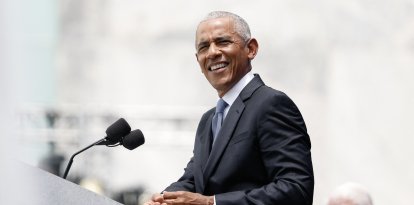
At the White House Correspondents' Dinner in 2011, then-President Barack Obama viciously mocked tycoon and media star Donald Trump, ridiculing his political aspirations. Trump, his face strained, was immortalized as a target of scorn before the eyes of the world. That televised humiliation has been pointed to as the spark that ignited the tycoon's will to win the presidency against all odds. The lesson is clear: it is not always smart to belittle an outsider with resources, ambition and an audience of his own.
This comes on the back of the scorn and expletives that Elon Musk is receiving as a result of his idea of founding a party. In such an entrenched two-party system, the idea of a "third party" is usually dismissed with resignation. And it makes sense; history is littered with attempts that are labeled failures, efforts that fade in the face of the relentless two-party system. Yet Elon Musk persists with the proposal to found the "America Party", in the wake of Donald Trump's signing of the BIG BEAUTIFUL BILL. For Musk, this bill represents a step backwards and the realization that the party structure is incapable of fighting a corrupt and wasteful system that no longer serves the people, but itself. The outrage, palpable in his posts on X, transformed into a viral poll where a resounding percentage of participants expressed their desire for a new political party.
U.S. political history is a graveyard of third party aspirations. Since the mid-19th century, following the election of Abraham Lincoln, bipartisanship has exercised an almost absolute dominance of the power chessboard. This logic has its roots even in the early days of the republic, with the rivalry between Federalists and Democratic-Republicans. The statistics are eloquent: in most presidential elections since 1924, Democrats and Republicans have accounted for more than 90% of the popular vote.
The reasons for this hegemony are reiterated around the world. The lack of media and advertising attention is a monumental obstacle. The media, in its quest for simplification and funding, reinforces the two-party paradigm. Second, the financial laws and bureaucratic requirements to run for office are a formidable barrier to entry for any new contender. Third, the polarization generated by an election race creates a news bottleneck that prioritizes scandals and controversies between the major candidates. And fourth, third parties often fall into the trap of basing their campaign on a group of narrow and controversial issues, which, once exposed, are co-opted by one of the two main parties, emptying the original proposal of its content.
However, it is a mistake to underestimate their impact. Despite their demonstrated inability to date to come to power, the alternative parties have been agenda-setters and catalysts for change. They have forced Democrats and Republicans to address thorny issues they might otherwise have preferred to dismiss. They have acted as a constant prod, forcing a response from the major parties and encouraging broader representation of political interests.
The "vote wasting" narrative is another of the difficulties that, as a recurring caveat of the traditional parties, is presented to maintain monopoly. But this narrative ignores the fact that the emergence of a third party is often the symptom of a latent demand in the air, a widespread dissatisfaction with existing options.
Musk knows this, and unlike other third party founders, he has some invaluable assets: his personal fortune and X, the social network makes for excellence when it comes to political debate and news circulation. This allows him to evade the two problems that stifle most alternative contenders. However, his challenge and greatest asset lies in the awareness that he will not be able to become president. This has led him to formulate a plan that not only satisfies the malcontents, but also promises a sophisticated and minimalist strategy that will convince those who still believe in the tactical intelligence to solve the country's problems.
His strategy, at the level of what is "possible", focuses on securing some key seats in Congress, with the goal of creating a bloc capable of maintaining the balance of power and curbing what he perceives as the worst excesses of both parties. Far from portraying himself as a maximalist party, he has said he aims to pick up between 2 and 3 seats in the Senate and between 8 and 10 in the House of Representatives. According to Musk, this would be enough to tip the balance in a legislature as polarized as the current one.
Voter dissatisfaction is an undeniable fact and the demand for an alternative is in the air. The great rise of third parties at the turn of the century demonstrates this. People are desperately looking for a way out of the stagnation and polarization guilty of the idea of "us against them" that damages the social fabric so much. Musk's proposal is one more symptom of the crisis of bipartisanship that is manifesting itself throughout the world in the framework of liberal democracies. It is the result of a system that has stifled debate and polarized politics to the extreme. The shortcomings of the two-party system are recurrent and worsening: the excessive influence of lobby groups, which undermines representation; limitation of choices and simplification of issues or the decline in civic participation, as voters feel disillusioned when they perceive that their vote has no relevance.
The third party phenomenon is not unique to the United States; it is a global rebellion against the traditional political system. For decades, Western democracies were dominated by two-party structures or stable coalitions. However, in recent years, a constellation of new parties and movements have broken this logic, presenting themselves as vehicles of rebellion against the elites.
In Argentina, the libertarian irruption with Javier Milei and his recently created party, La Libertad Avanza (LLA), is a paradigmatic case. In only two years, the movement went from being marginal to conquering the presidency in 2023. Milei's particularity lies in the fact that, unlike other third parties that only erode the dominant forces, LLA achieved total victory.
In the UK, the space left by the collapse of one of the most solid two-party systems in the world has elevated the chances of Reform UK, led by Nigel Farage. Despite an electoral system that penalizes third parties, its rhetoric allowed it to obtain astonishing results in the 2024 elections, even surpassing the Conservative Party in multiple districts. Reform UK capitalized on the disenchantment towards a political class accused of betraying the popular will.
Germany has also experienced this phenomenon with the advance of Alternative for Germany (AfD), which has outperformed the traditional parties in several eastern states. Its discourse has caught on among those dissatisfied with mass immigration and the climate agenda. Spain and Italy have seen the consolidation of the new right with VOX and Fratelli d'Italia that channel the demands of sectors despised by the establishment formations and managed to consolidate themselves as central players reaching, in the Italian case, to take over the government.
The cases multiply and the labels become insufficient when these forces no longer act as marginal or testimonial, but as possible (or real) alternatives for power. The crisis of representation, institutional attrition and the rise of identity agendas have opened a post-consensus stage where obsolete cleavages are mixed with new axes of discussion that traditional politics prefers to avoid. Third parties are no longer a rarity; they are, in many cases, the new face of democratic politics. When analyzing Musk's proposal, this determining factor in the rest of the world must be considered, because beyond the particularities, to a large extent the demands of the Trumpist voter are the same as those of the voters of these "third parties" in the rest of the world. The picture changes substantively.
These days, many have been the comparisons made between Musk and Ross Perot and his historic 18.9% of the popular vote as an independent candidate in 1992, support that then, in subsequent election calls faded which is often presented as the irrefutable proof of his failure. However, this vision is superficial.
Perot's campaign was a true epic. It was a feat against the tide of the entrenched system, a rallying cry that resonated with millions of jaded voters. It was not a failure, but the canary in the mine that laid bare the apparent solidity of bipartisanship. Its impact was more lasting and fundamental than the statistics suggest. Perot's voter pattern demonstrated how third parties foster responsiveness of the major parties and broader representation of political interests, since it forced the major parties to talk about their proposals in the political arena. In this sense, their participation played a vital role, acting as a catalyst for demands and expanded representation. His legacy is not measured in presidential victories, but in the jolt he gave to the establishment, exposing its weaknesses and the deep citizen dissatisfaction.
Elon Musk's initiative, regardless of what he might achieve in the short term, is a further step in this direction. Musk is using his platform and influence to highlight the flaws of a system he considers obsolete and corrupt. His proposal, by targeting key congressional seats, aims at a strategic objective: to create a power bloc that can influence the legislative agenda and break the two-party monopoly, while aiming to erect itself as a referee.
The global trend, with the rise of anti-establishment parties and the deep decay of the system, rightly denounced by Donald Trump himself suggests that the demand for alternatives is stronger than ever. And while Trump has criticized Musk, it is impossible to forget that the president has on many occasions expressed his support for various parties around the world, most, in fact, of the alternative leaders cited above. While an eventual Musk party could "eat into" part of Trump's electorate, it could also, paradoxically, help Trump remember why he entered politics. Trump, too, was the outsider who challenged the establishment. This project could rekindle in him that spark of rebellion and remind him of his original purpose.
But, beyond the contest between eccentric and strong-minded characters, the possible creation of an alternative, whether founded by Musk or anyone else, is one more seed in a fertile ground for change. Although bipartisanship has shown amazing resilience, the cracks are increasingly visible. The question is no longer if the two-party system will fall, but when, and who will star in that moment.
LATEST