Israel as a symbol of centrist betrayal in the culture war
Anyone who thinks this is only about Israel is wrong. It's about the kind of society we want to be.
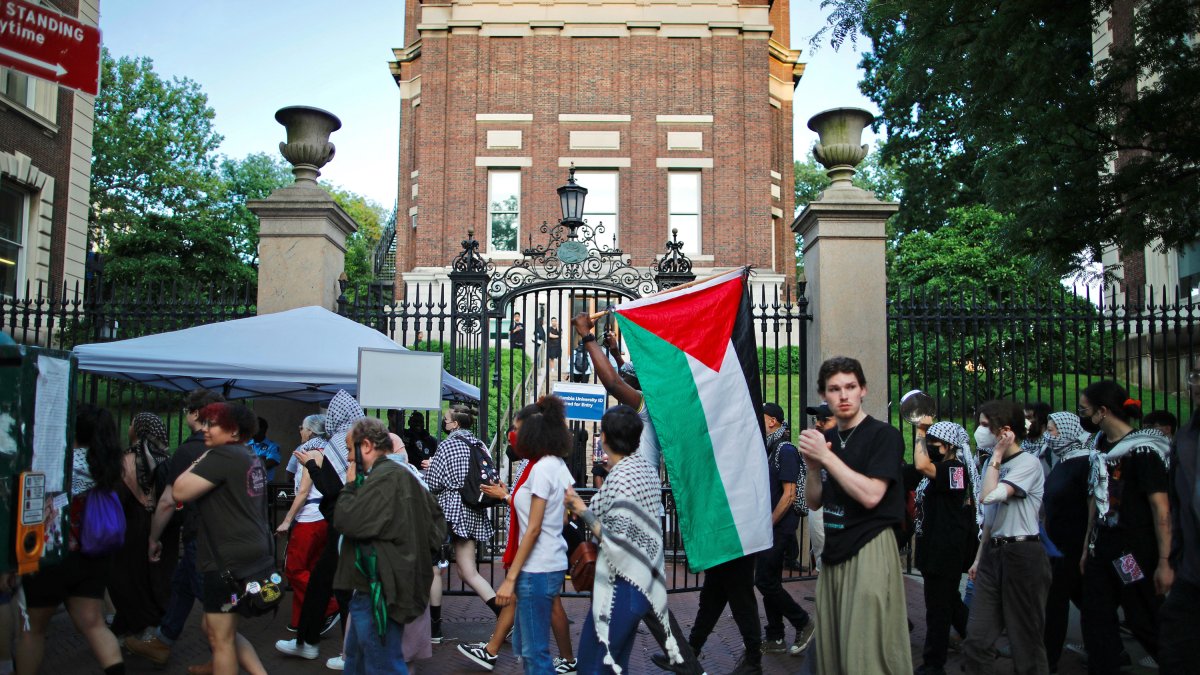
Pro-Palestinian university protests.
"Firewood to the monkey that's made of rubber" they say in Spain. With that phrase one could summarize the treatment that Israel receives by many Western media outlets and aware public opinion. It is beaten relentlessly because, apparently, it won't break. It is the favorite punching bag of those who want to exhibit virtue without cost. But behind the overkill there is not only foreign policy, there is a cultural war. And what is attacked, in reality, is not so much a country as a symbol: Israel represents what a part of the West has decided to repudiate. And the most painful part of this process is not the declared hatred of the extremes, but the silent claudication of the moderates, the centrists, who have sold their souls to the comfort of exposing virtue.
Today's political culture has replaced facts with narratives. In this scenario, disinformation is no longer fought, but selected. Lies that do not fit are discarded, but those that serve the correct emotional frame are amplified. The narrative wants Israel to be "genocidal." The word, so loaded with history, is now thrown around with the frivolity of a slogan. It is used without rigor, without context, without any consideration for its moral weight. In prime time Israel can be accused of crimes against humanity without the journalist cross-examining, without anyone bothering to confront facts, figures, precedents. The idea that Israel is not to be understood, only judged has been normalized. And the harsher and louder the judgment, the more virtuous it is reflected in the mirror of social networks.
The worrying thing is not so much ignorance, but the will to ignore. Thinking is dangerous when one has turned one's sensitivity into a personal brand. Because thinking implies nuancing, and nuancing tarnishes indignation. Thus, one can cry for the Palestinian children—without stopping to consider why their leaders turn them into human shields—and at the same time ignore the Yazidi girls, the homosexuals executed in Iran, or the Israelis massacred on October 7. That date is no longer mentioned. It disturbs. It complicates the narrative. It breaks the single victim image. Israel has no right to be victim, only executioner.
"The center accommodates extremism in the hope of survival, and always, always, ends up devoured by it."
This selective sensitivity is no accident. It is ideology. In the height of absurdity, the new cultural left has elevated the Palestinian cause to the totem of its anticolonial vision. Obviating that Jews are a people indigenous to the region, the supposedly egalitarian secularists embrace narratives of religious and radical terrorist groups that deny rights to women and various minorities. But what is most serious is not the virulence of the radical activists. What is devastating is the betrayal of those who should resist this reductionism: the moderates, the centrists, those who call themselves rational. They have preferred to surrender to the current rather than confront it. They remain silent, and with their silence they legitimize the lie.
There is fear. Fear to step out of the script, to think differently, to raise their voice to denounce that the emperor is naked. That is why many opt for performative neutrality: they say they condemn violence "on both sides," but only protest against one. And meanwhile, those who should raise their voices to defend nuance, history, international law, prefer to keep their seat at the table of the "respectable." The pattern repeats itself: the center accommodates itself to extremism in the hope of survival. And it always, always, ends up devoured by it.
Israel, today, is more than a state. It is a symbol. It symbolizes the resistance of a civilization that still believes in self-defense, in the right to exist, in identity without guilt. That is why it is demanded an unattainable purity while excusing everything in its enemies. It is denied the right to make mistakes, while the crimes of those who vow to destroy it are normalized. It is forgiven for what it is, not what it does. For if Israel can defend itself, then perhaps other countries can too. And that puts at risk the dogma of eternal guilt that is so profitable in decadent democracies.

Whoever thinks that this is only about Israel is wrong. It is about the kind of society we want to be. One that confronts emotional totalitarianism or one that applauds it while it destroys the pillars of reason. For what is at stake is not the fate of a distant state, but the very possibility of sustaining a culture that values truth over hysteria, principles over appearances.
It is not a matter of justifying everything Israel does. Nor to ignore the suffering of Palestinian civilians. It is about understanding where the conflict comes from, who perpetuates it, who instrumentalizes it. And, above all, to stop demanding that a democracy surrounded by theocracies and militias be more perfect than ourselves.
Today, the moral judgment passed on Israel says more about the issuer than about the country being judged. And what it reveals is a West that has lost its way, that no longer distinguishes between truth and narrative, between legitimate criticism and justified hatred. A West that has traded responsibility for applause, thought for posturing.
Israel is holding on. Meanwhile, Western moderates seem to want to echo that phrase attributed to Bishop Bossuet: "God laughs at men who deplore the effects whose causes they appreciate."
LATEST