INTERVIEW
Iddo Netanyahu: "No country or people can survive if there are not enough young men who are willing to lay down their lives down for it"
An Israeli physician, writer, and playwright, he has just reissued 'Yoni's Last Battle', a book in which he describes the planning and preparations by an elite Israeli commando unit for the spectacular rescue operation of passengers from an Air France plane hijacked and diverted to Uganda by Palestinian terrorists in 1976.
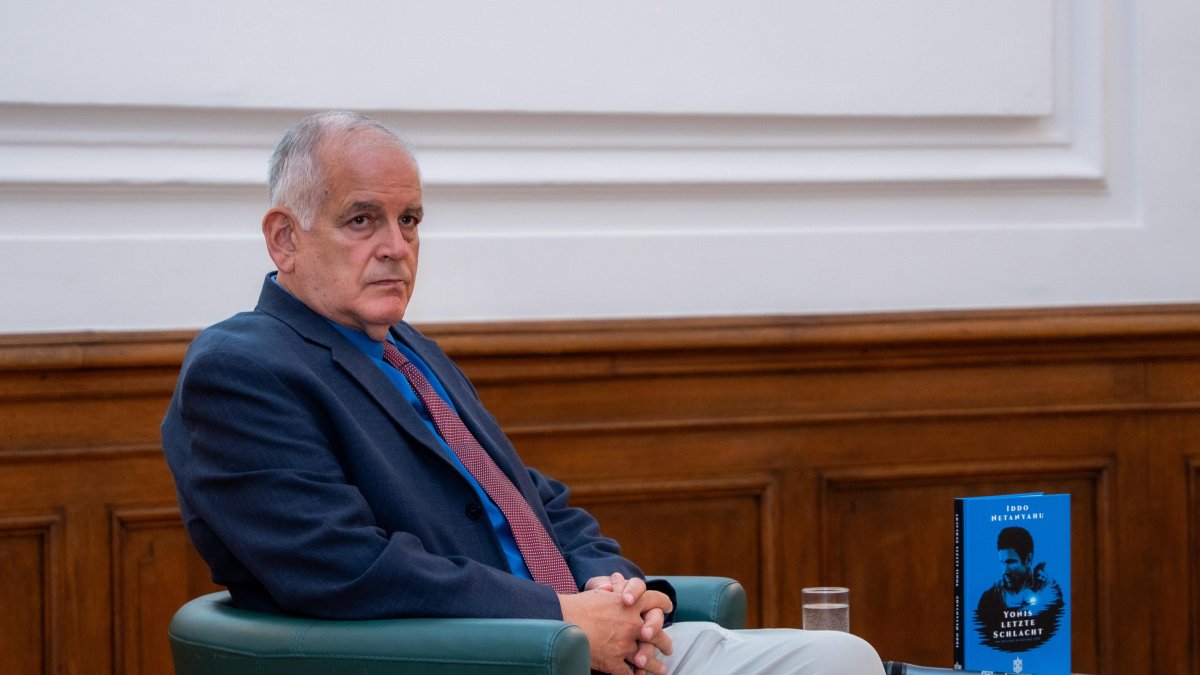
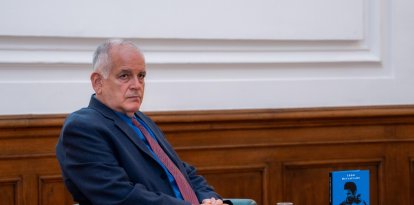
Iddo Netanyahu

On June 27, 1976, an Air France plane was hijacked by Palestinian and German terrorists from the RAF and diverted to Entebbe Airport in Uganda. A week later, more than a hundred hostages were freed in a spectacular rescue operation and flown to Israel, more than 4,000 kilometers away. The operation was carried out by an elite Israeli commando unit, Sayeret Matkal, known simply as the Unit. Lieutenant Colonel Yoni (Yonatan) Netanyahu, commander of the Unit, achieved worldwide fame following the operation’s stunning success. He was the only Israeli soldier to lose his life in the Entebbe raid.
His brother Iddo, who, like his other brother Benjamin Netanyahu, was also a member of the Unit, published Yoni’s Last Battle in 1991, a book that describes the planning and preparations for the mission, as well as its nearly flawless execution. Today, fifty years later, the book has been reissued. We spoke with the author about the Entebbe operation and the legacy his brother Yoni has left in Israel’s history and collective consciousness.
Iddo Netanyahu is an Israeli physician, writer, and playwright. He is the younger brother of Prime Minister Benjamin 'Bibi' Netanyahu and Yonatan 'Yoni' Netanyahu. He spent part of his childhood in the United States, where he later returned to attend college. He also studied at the Hebrew University of Jerusalem. Between 1970 and 1973, he served in the elite Sayeret Matkal unit and fought in the Yom Kippur War. As a doctor, he specialized in radiology, but devoted much of his time to writing. He is the author of several books, as well as acclaimed plays.
You wrote this book fifteen years after the Entebbe operation. You, your brother and your father began gathering information and conducting interviews. Did you feel that justice had not been done to the Unit and to your brother?
The great bulk of the material was gathered by me. Doing this became necessary when patently false information was being spread about Yoni and the raid. I felt it was important to document the actual facts, and so I started interviewing on tape the participants of the raid, mainly from Yoni's unit but not only them. Remarkably, nearly all these people had never given testimony about the operation. The historical truth was quite easy for me to arrive at, since all of the participants, except for Yoni, came back alive. Once I felt I had the required material, I started writing the book, which for the first time told the true story of Entebbe – a story which is literally amazing.
Now, fifty years on, what is the reason for this new edition?
You should ask the publishers this question. I imagine it has partly to do with the 50th anniversary itself, but more so with the current state of the West, namely the lack of resolve on the part of its leaders and citizens to defend themselves against grave dangers which they clearly face. Those who were interested in publishing this book perhaps see “Entebbe” as an example that needs to be followed regarding the way a country should act when confronting implacable enemies who are bent on its destruction.
The operation took place three years after the Yom Kippur War, which, as you mention, had had a negative impact on morale in Israel. Yitzhak Rabin reflects the fear of failure in this rescue mission when he refers to ‘Israel’s Bay of Pigs’. What was at stake for Israel in this operation?
The failure of this operation would have constituted a tremendous blow to the country – not only because it would have meant another victory for terrorism and not only because of the large number of hostages who may have been killed, but also because of the potential loss of the cream of the crop of young Israeli commanders. It took not only tremendous courage on the part of the heads of the IDF to approve the raid, but also great courage on the part of the politicians, especially Prime Minister Yizhak Rabin, to do so. Operational failure might have meant his political end and a life of ignominy, regardless of the fact that the head of opposition then, Menahem Begin, stood behind Rabin's decision to undertake the mission.
Everything is prepared in a day and a half, which is truly incredible and speaks volumes about the Unit’s professionalism. You wrote that 'of all the nations in the world, there is no other, at least in this generation, that would have done what we did at Entebbe.' Do you still think the same?
Yes, and we have shown this in the past 3 years since October 7, when we acted in ways no-one thought were possible. I am referring to such things as the phenomenal beeper operation, which within minutes incapacitated the terrorist Hezbollah leadership, or the aerial attack on Iran in June 2025, when tiny Israel gained total aerial control over a country 75 times larger. Entebbe was perhaps the ultimate example of military improvisation coupled with resolve. The men could have easily said – and some in fact did say – that they can't do the mission because they didn't have the necessary equipment, or because they didn't have enough time to practice, or because Israeli planes never landed on a darkened airstrip before – these and many other difficulties which are related in the book. But because of our strong determination to free the hostages and show the Palestinian terrorists that we are not going to give in to blackmail, the men made do with various quick improvisations. I think this kind of will, shown in this operation and in other instances – a will which stems from the constant threat to our survival and our long-standing and dogged historical resolve to survive as a distinct people – is in many ways unique to us.
“You can’t tell a good commander just by victory in battle. If you’re willing to sacrifice enough people, you’ll almost always win. The real measure of a good commander is that he wins with few losses.” This was Yoni’s philosophy. Not all armies think this way, and we see this every day in Ukraine, where Russia is sacrificing men just to advance a few meters. Is this also the IDF’s philosophy?
It has. This is due to two factors: one, the small size of the Israeli population and the need to save lives; two, and more importantly, the sanctity of human life which is central to Jewish thought and belief. It is also manifested, perhaps ironically, in how we treat our enemy and not only our own soldiers. We take care not to do any unnecessary wide-spread killing of the enemy, even if such killing may be perfectly legal according to international law and would conform with military standards. This behavior of our army is not only the very opposite of how the IDF is being portrayed by Western opinion-setters (and by the radical Left in Israel), but also the opposite of how Western armies have been waging war for well over a century with their widespread killing of civilians, including recently in the Middle East. And it is even more so diametrically opposed to what our enemies, such as Hamas, are doing, not only in trying to kill and slaughter as many Jewish civilians as they can, but, sickening as it may sound, actively promoting their own population’s civilian losses for propaganda purposes.
Previous rescue operations had ended with the deaths of many hostages at the hands of their captors, but on this occasion, despite facing seven terrorists and the Ugandan army, only three hostages were killed. Would this outcome have been possible had it not been Yoni who led the operation?
That is not easy to say, since we don’t know how some other hypothetical commander would have acted. But certainly, because of Yoni’s planning and leadership, and because of his decisions and actions at the acute moment of crisis, a disaster was averted and the mission succeeded beyond all expectation.
How did Yoni’s death affect your life and that of your family? Did it change the way you think in any way?
I think the death of a loved one at a young age cannot but affect you. For my part, I searched for greater meaning to my life. Perhaps that is the reason I turned to writing.
“To live” wrote Yoni in his last letter, just days before his death, “and as long as you possibly can.” Yoni loved life, but he was prepared to sacrifice it. To what extent has he become a role model for modern-day Israel?
One often hears young soldiers of today mention they were affected by Yoni’s Letters, a book we published two years after the operation at Entebbe and that has been widely read since. It contains Yoni’s inner thoughts, including his willingness to die for his country, which on the face of it is the opposite to his love of life. To the extent that the book promoted a sense of patriotism and a willingness to fight for Israel, it’s good that we came out with it. No country or people can survive if there are not enough young men who are willing to lay down their lives down for it.
Fifty years ago, Israel was at war, and it still is today. Do you see a way out of the current situation? Do you share your brother’s view, the Prime Minister?
If you mean the general political views of the Prime Minister, then for the most part, yes. Israel is in a perpetual war because of the unwillingness of Moslem Arabs, especially the Palestinian Arabs, to accept Jewish sovereignty over any part of the historic Land of Israel. Until such future time when the Arabs may drastically change their thinking, there will always be conflict, since we, the Jews, came back to our historic homeland to stay. But this conflict does not have to constantly erupt into kinetic war, provided we, i.e., Israel, maintain an overwhelming military superiority in the Middle East and a willingness to use it when necessary. As the Romans well knew, deterrence is the most effective tool in preventing war, regardless of the extent to which the other side maintains its wish to destroy you.
For you, Operation Yonathan “proves that at least once, justice can be done and right can win.” After seeing the images from 7 October, do you think it is possible to overcome that hatred and evil.
If you mean the hatred that was shown by the Palestinians, whether Hamas terrorists or the civilian population of Gaza, both of whom committed unspeakable, horrendous acts on Israeli women, babies and the elderly – acts which I would rather not describe here – I don’t know. It would take a generation or more to undo the deep, hate-filled indoctrination that they are imbued with. Sadly, I don’t see any willingness on their part to even begin undertaking such a change. And so, we should not base our hopes on that slim possibility, just as the West should not base its hopes on some kind of eventual theorical ideological taming of radical Islam. It is an illusion that, if maintained by the West, will be very costly
LATEST