

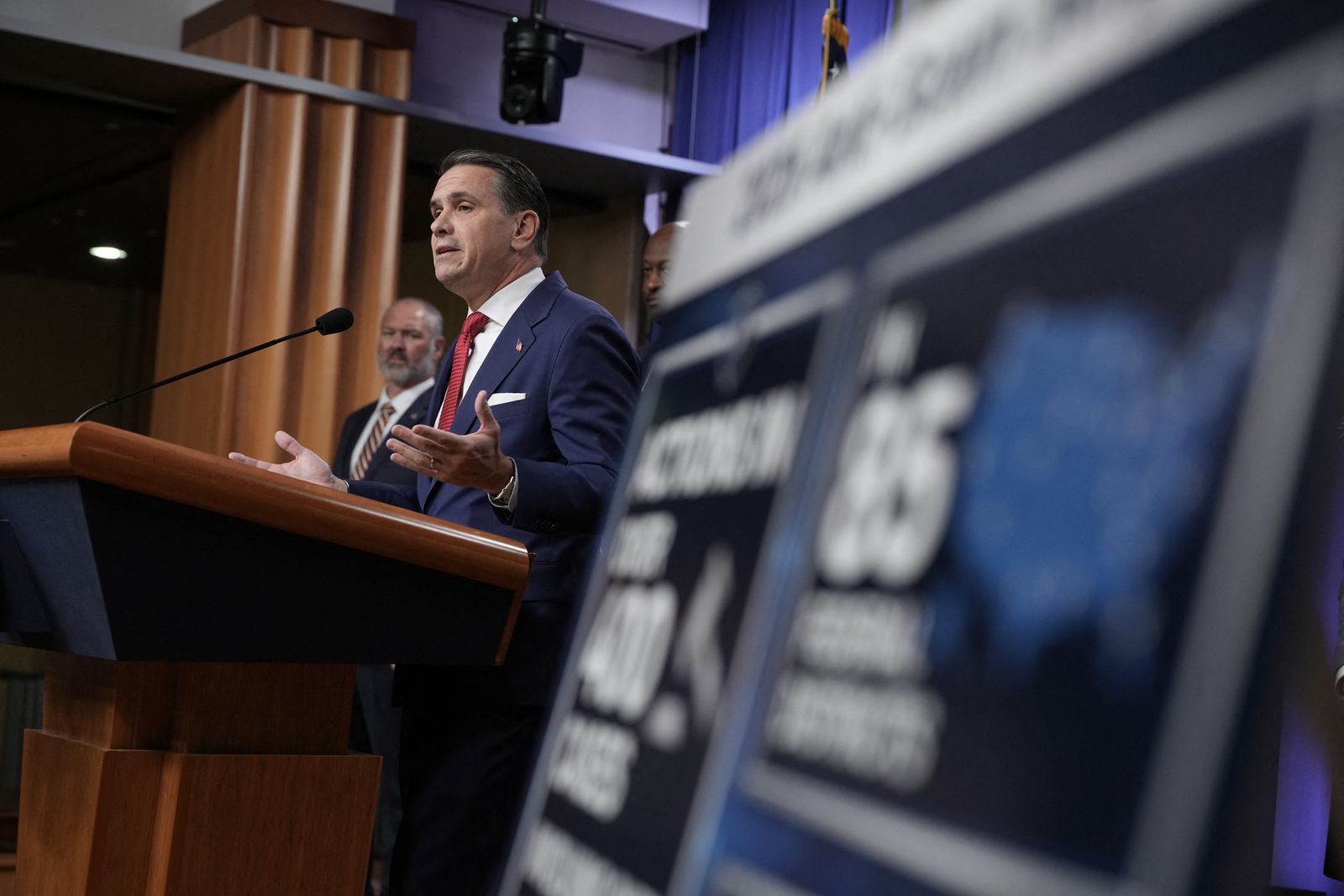
The Department of Justice (DOJ) announced on Tuesday the results of the largest anti-fraud operation in recent U.S. history, launched following Executive Order 14390 that President Donald Trump signed on March 6 to coordinate a whole-of-government response against fraud networks. Since then, federal prosecutors have taken action in more than 400 cases against more than 800 defendants, resulting in new charges, extraditions, guilty verdicts and criminal sentences.
U.S. prosecutors and agents collaborated with law enforcement agencies in more than ten countries in raids on overseas call centers and scam operations that targeted U.S. citizens.
"Predatory scams against the American people will not be tolerated," said Attorney General Todd Blanche. "The unprecedented results of this crackdown are just the beginning. We will continue to prosecute those who perpetrate these schemes and dismantling the activities of transnational criminal organizations before they reach U.S. shores."

The scale of the problem
The DOJ cited Gallup data to explain why it mobilized resources on this scale: 10% of U.S. adults fell victim to a scam last year, either directly or through someone in their household. Nearly three out of four victims reported a negative impact on their mental health or well-being.
The same survey estimates that Americans lost about $68 billion to scams in 2025 alone. The schemes include cryptocurrency investment fraud, financial extortion involving sexual exploitation, impersonation of government agencies, and other tactics that, collectively, cost billions of dollars and leave many families without their savings.
The case of prison gangs in Georgia
One of the cases filed this month illustrates just how sophisticated these networks have become. Current and former members of prison gangs in Georgia used smuggled cell phones to falsely tell victims that they had failed to appear for jury duty and would be arrested if they did not pay a 'fine'."
Fourteen people were charged in three indictments filed in federal and state courts for participating in these schemes. Another 17 were charged in state court for a scheme to smuggle cell phones into Georgia prisons—devices often used to commit fraud and other crimes. Authorities also seized the websites that inmates used to carry out the fake jury scams.

The FBI's Operation Blackout
The FBI, through Operation Blackout, its global initiative to dismantle scam centers, reported that it has seized nearly $17 billion in illicit funds and seized more than 14,000 digital devices, directly warned more than 11,000 Americans about scam attempts, and prevented more than $690 million in potential losses to victims.
"Under President Trump's Executive Order 14390, this FBI has made dismantling predatory scam operations a top priority," said FBI Director Kash Patel. "The message to these scam syndicates is clear: if you target Americans, justice will find you."
The operation also made it possible to identify, disrupt, and dismantle more than 29 fraud operations in Asia, Africa, and the Middle East. These actions led to federal charges against more than 50 scam operators, while coordination with the FBI enabled foreign partners to arrest or detain more than 320 additional perpetrators abroad.
Together with international partners, the FBI also assisted in the rescue and repatriation of more than 2,200 trafficked workers who were forced to work within those operations.
Since the signing of the executive order, Operation Level Up has prevented more than $143 million in losses to victims, warned thousands of Americans that they were being targeted by scammers, and frozen more than $350 million in assets through the FBI's Asset Recovery Team.

The Secret Service and international cooperation
During the operation, Secret Service investigators seized more than $200 million in illicit funds, blocked 1,780 domains operated by scammers, and recovered more than $119 million while investigating more than 1,540 incidents of corporate email compromise.
Among the cases led by the Secret Service is the identification of a cryptocurrency investment scheme operated from scam hubs in Cambodia that had at least 174 U.S. victims. In October, a Chinese citizen was extradited from the Netherlands and formally charged in the Central District of California for his alleged involvement in that conspiracy.
"While we are encouraged by the progress made so far, our investigators continue to lead dozens of cases involving transnational criminal networks that prey on the American people," said Secret Service Director, Sean Curran. "Today's announcement demonstrates that scammers operating anywhere in the world can be identified and brought to justice."
The DOJ, for its part, funded and supported law enforcement agencies in the U.S. and Southeast Asia to freeze more than $1 billion in stolen cryptocurrency, take down more than 1.4 million fraudulent websites and accounts, and facilitate numerous arrests and several pending extraditions.
Their forensic tools helped analyze more than 10,000 devices and hard drives in Thailand alone. In Moldova, it trained local prosecutors who oversaw the October arrests of three suspects in an online romance scam that defrauded American and European victims of $440,000 in a single month. It also supported raids that shut down five call centers and arrested eight alleged operators of fake cryptocurrency trading platforms.
"Behind every statistic is a human story: a family driven into bankruptcy, a retiree reduced to poverty, or a young person driven to suicide," said Under Secretary of State David Bedard.

HSI, USPIS, and regulatory agencies
The Homeland Security Investigations (HSI) made more than 300 arrests, charged more than 100 defendants and secured nearly 80 convictions and guilty pleas. Their investigations resulted in the seizure, restraint, freezing, and recovery of more than $120 million in illicit proceeds, including funds in bank and cryptocurrency accounts, cash, precious metals, vehicles, and real estate.
The U.S. Postal Inspection Service (USPIS) supported cases against dozens of defendants, including those responsible for fake jury schemes, lottery fraud, inheritance fraud, and scams targeting Spanish-speaking Americans. It also seized three domains linked to the fake jury schemes and redirected their traffic to official servers displaying a seizure notice.
The Federal Trade Commission (FTC) filed 16 actions against misleading profit claims, unfair payment processing practices, technical support scams, debt relief schemes, health insurance fraud and impersonation of government agencies and companies.
The Securities and Exchange Commission (SEC) filed charges against 39 entities for allegedly filing false ADV forms to appear to be legitimate advisors and attract investors. It also accused several entities of fraud in alleged "investment confidence" schemes that pretended to comply with SEC regulations while diverting more than $15 million.
The Federal Communications Commission (FCC) approved a rule on November 19 that allows prisons and jails to use blocking technology to block calls from contraband phones. The FCC has also blocked nearly 300 million illegal calls and more than 1,400 providers.
The most recent schemes
- Fraud hubs in Southeast Asia engaged in cryptocurrency investment fraud.
- Schemes by Nigerian citizens with false promises of inheritances in exchange for payments.
- A list broker in Mexico who sold the names and personal information of elderly Americans to dozens of scammers.
- A funeral service provider with deceptive pricing and a hidden location deceived grieving families.
- A call center operator in Peru who demanded payments from Spanish-speaking Americans under threat of arrest or deportation.
- A dozen defendants, including several Jamaicans, for a sweepstakes scam targeting elderly Americans.
- A Nigerian citizen extradited from the United Kingdom for stealing pay from U.S. military personnel.
The Department of Justice also launched a public education campaign to warn of the dangers of fraud, provide guidance on how to avoid scams, and encourage Americans to share their stories during the holiday season.
The statement notes that an indictment is merely an accusation and that all defendants are presumed innocent until proven guilty in a court of law.