

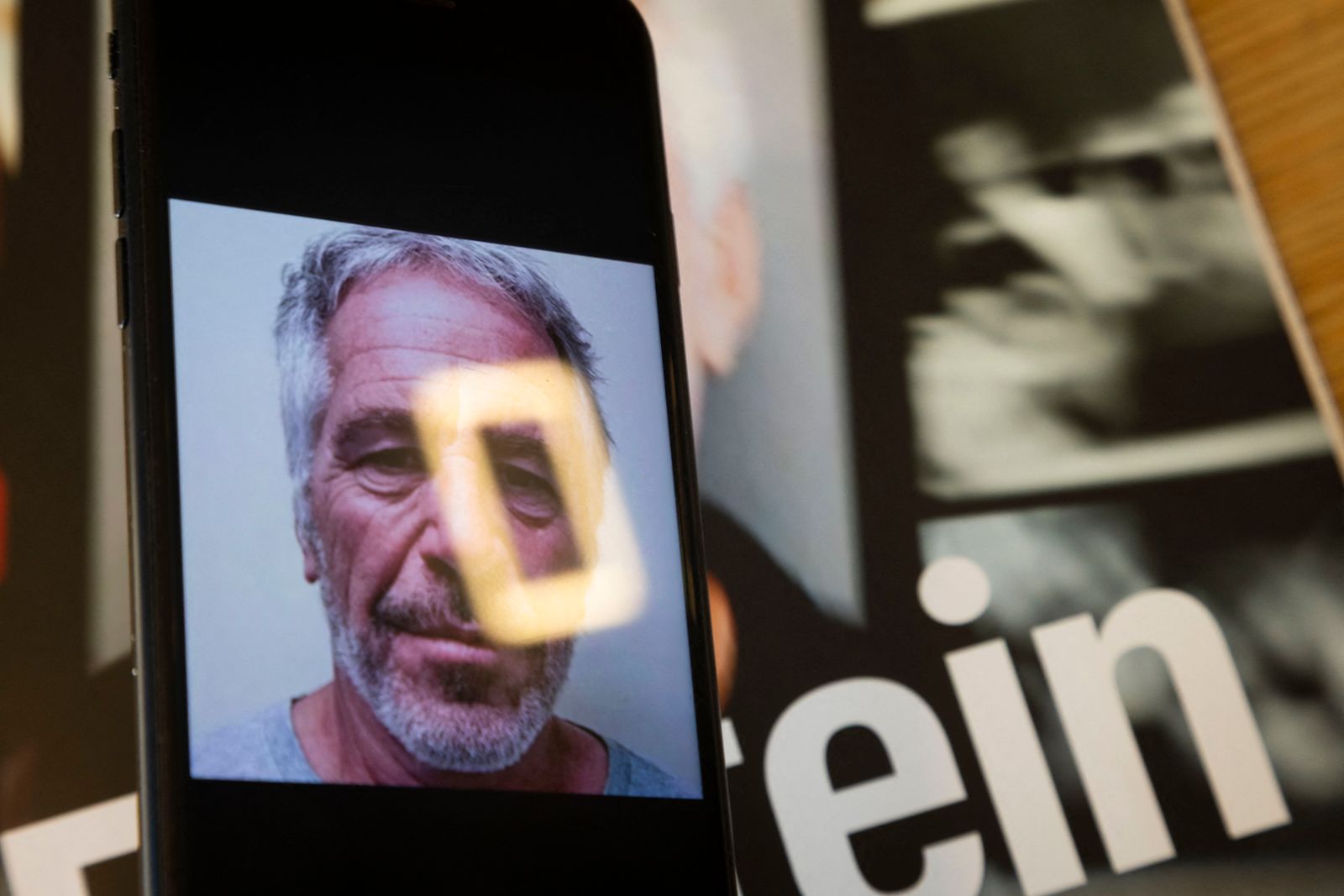
Seven years after the death of Jeffrey Epstein in a federal prison in New York, a renowned forensic scientist challenged the official account and the prevailing consensus surrounding the case, asserting that the financier did not, in fact, take his own life.
Michael Freeman, who spent a year analyzing the complete autopsy report, concluded that Epstein was strangled, most likely from behind, and that the scene was staged to make it look like a suicide.
Freeman presented his findings in interviews with the BBC's "Newsnight" program, the BBC and The New York Times, and presented them on Monday at the Middle Temple, a London law society. The talk was originally scheduled to take place at University College London, but the university canceled it at the last minute citing concerns related to the well-being of its students.
Freeman's track record lends credence to his claims, especially in a case that has often been dominated by unverified theories and unfounded rumors. Freeman served as an expert witness for the prosecution in the trial of the police officer convicted of killing George Floyd and served on a panel that identified dozens of deaths in police custody in Maryland that had been misclassified as natural or accidental. He holds doctorates in epidemiology and forensic medicine, teaches at two universities and edits the journal of the Faculty of Forensic and Legal Medicine of the Royal College of Physicians in the U.K., although he is not a board-certified forensic pathologist in the U.S.

Politics
Official documents suggest that Department of Justice may have withheld classified material related to the Jeffrey Epstein case
Andrés Ignacio Henríquez
The suspicion, he explained, arose from a single image: the mark left by the rope on Epstein did not have the uniform, upward curve typical of a hanging; rather, it was deep, irregular and Y-shaped. From there, Freeman reviewed the rest of the photographs and found what he describes as fingernail marks above the ligature line, consistent with the victim's attempt to free himself, as well as profound bruising on the left shoulder and injuries that could be consistent with blows to the face.
"The pattern and distribution and multitude of injuries are not explained by a suicidal hanging," he told the NYT. Using 3D models based on Epstein's physique and the account of the guard who found the body, the forensic pathologist concluded that he was most likely strangled with a ligature that was later used to hang him.
The official version, however, remains unchanged. The New York City Medical Examiner's Office reaffirmed its conclusion of suicide this week. In 2019, the medical examiner who performed the autopsy, Kristin Roman, assured federal investigators that there were no signs of a struggle or defensive wounds and that the body showed no bruises or debris under the fingernails. Barbara Sampson, then chief medical examiner, also defended that ruling: "I stand firmly behind our determination of the cause and manner of death for Mr. Epstein," she had stated.
Freeman's analysis highlights the flaws that plagued the investigation from day one. There are no photos of Epstein hanging, as the guard who found him lowered the body in an attempt to revive him. The fabric that arrived at the medical examiner's office was not the one used as a noose; Roman was not allowed to inspect the cell; and the DNA under Epstein's fingernails was never analyzed — an omission that the expert strongly questions.

The case file came into Freeman's possession through Mark Epstein, the brother of the financier, who has always maintained that he was murdered. The medical examiner stated that his work is independent and that he received no payment. Shortly before the presentation in London, Mark Epstein posted the autopsy photos online, and at the end of his talk, Freeman displayed a QR code so that anyone could view them.
The findings have not yet been peer-reviewed. Freeman, who co-authored the analysis with neuroscientist Itiel Dror and Swedish pathologist Anders Eriksson, tried to publish it in scientific journals, but so far it has been rejected. Several pathologists who viewed some of the images agree that the mark on the neck is atypical, although they caution that, on its own, it is not sufficient to rule out suicide.
When asked who might have killed Epstein, Freeman said he had no idea and clarified that that question is not part of his work. Faced with the accusation that his position borders on a conspiracy theory, he responded defiantly: "Show me where I got it wrong," he told the BBC, adding that he was open to any well-founded criticism.
Epstein, who was convicted in 2008 of soliciting prostitution from a minor, was found dead on Aug. 10, 2019, at the New York Metropolitan Correctional Center while awaiting trial for running a child sex trafficking ring. Federal investigations concluded that it was a suicide, a conclusion that has never fully settled the debate.