The true success of immigration lies in cultural assimilation, not in the number of immigrants
Amid border overflows and the strain on public services in major cities, the solution requires moving beyond identity-based policies to restore the historical model of integration and respect for the law.
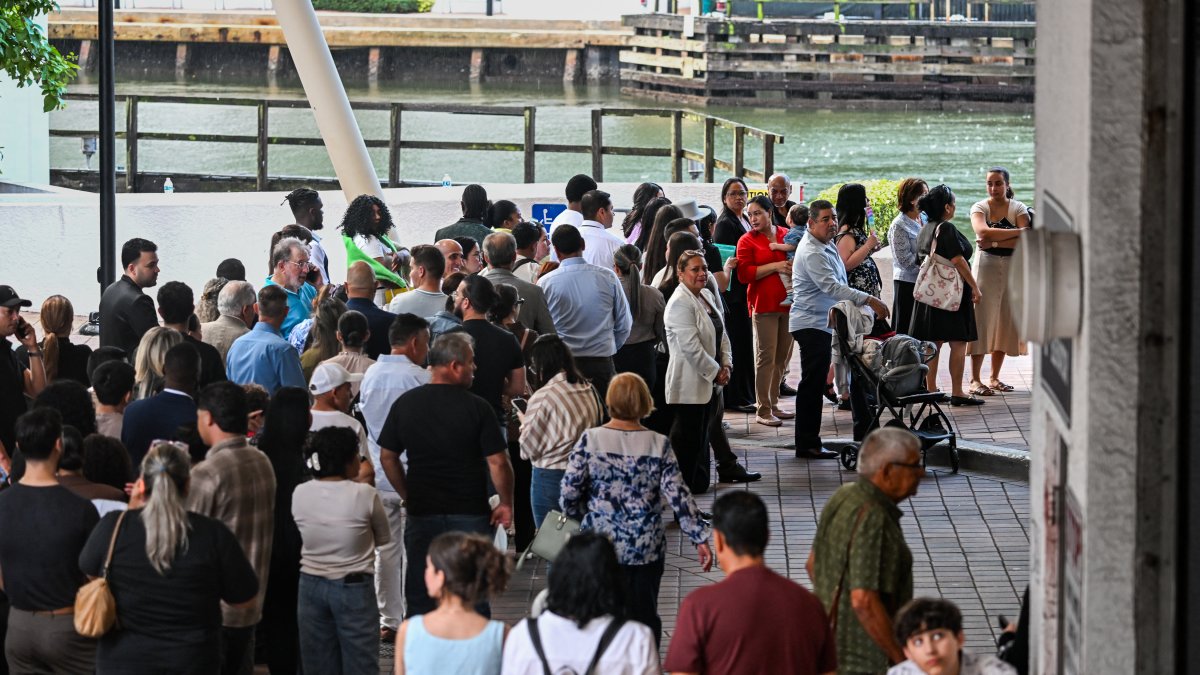
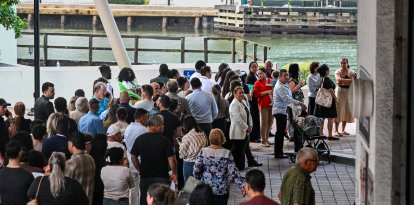
Several people wait in line outside the Miami Immigration Court in Miami, Florida, on September 3, 2026.

The public debate over immigration in the United States often gets bogged down in superficial accounting. People often discuss daily border-crossing figures, shelter overcrowding and federal agencies' processing capacity.
However, this technocratic approach overlooks the phenomenon's essential dimension: the true measure of a functional system lies not in how many people cross the border, but in how many fully assimilate and stop feeling like outsiders in the society that welcomes them.
The collapse of the progressive model in sanctuary cities
The current immigration crisis has laid bare the contradictions of open-border policies and so-called "sanctuary cities."
Cities such as New York, Chicago, and Denver have experienced severe financial and logistical strain while attempting to absorb hundreds of thousands of migrants without an integration plan or requirements for self-sufficiency.
Overburdened public schools, strained healthcare systems, and unlimited fiscal spending show that compassion without order leads to institutional chaos.
Attempting to accommodate massive flows of people without a legal screening process or a clear assimilation process harms both local communities and the immigrants themselves, who are relegated to the informal sector and marginalized from legal economic life.
The historical success of the American integration model was not accidental, but rather the result of an implicit contract between the host nation and the newcomer. On the one hand, the country offered individual freedoms, legal certainty, and economic mobility; on the other, it required adopting its laws, civic culture, and English as the common tongue.
This principle finds solid ethical and philosophical support. The Catechism of the Catholic Church itself, in paragraph 2241, states that the most prosperous nations must welcome the foreigner, but it establishes with equal clarity that the immigrant is obligated to "respect with gratitude the material and spiritual heritage of the host country, obey its laws, and contribute to its burdens."
Assimilation is not a renunciation of one's origins but is, in reality, an explicit commitment to the future of one's adopted homeland.
The danger of balkanization and identity division
In contrast to the traditional model of integration, contemporary progressive ideology has promoted a divisive form of multiculturalism that discourages a sense of national belonging.
By promoting narratives of victimization and fostering ethnic segmentation, it encourages the creation of isolated enclaves where new generations grow up disconnected from civic institutions and the founding values of the Republic.
In the early 20th century, President Theodore Roosevelt warned of the risks of fracturing social cohesion by noting that "there is no place in this country for hyphenated Americanism."
His stance reaffirmed that civic loyalty and patriotism must be indivisible to ensure long-term democratic stability. Learning the language and embracing constitutional principles remain the most decisive factors for upward social mobility among Hispanic families and immigrants in general.
A modern, sovereign immigration system should not aim to provide a constant supply of cheap labor or expand government subsidies. The true triumph of immigration policy occurs when foreigners embrace the country's institutions, respect the rule of law, and find their one true home in the United States.

Society
Trump blames unrest in France on mass immigration and says, 'it's not about the schools'
Diane Hernández

Politics
Neither Democrat nor Republican: Why the Hispanic voter remains the ‘swing voter’ who decides US elections
Emmanuel Alejandro Rondón

LATEST