
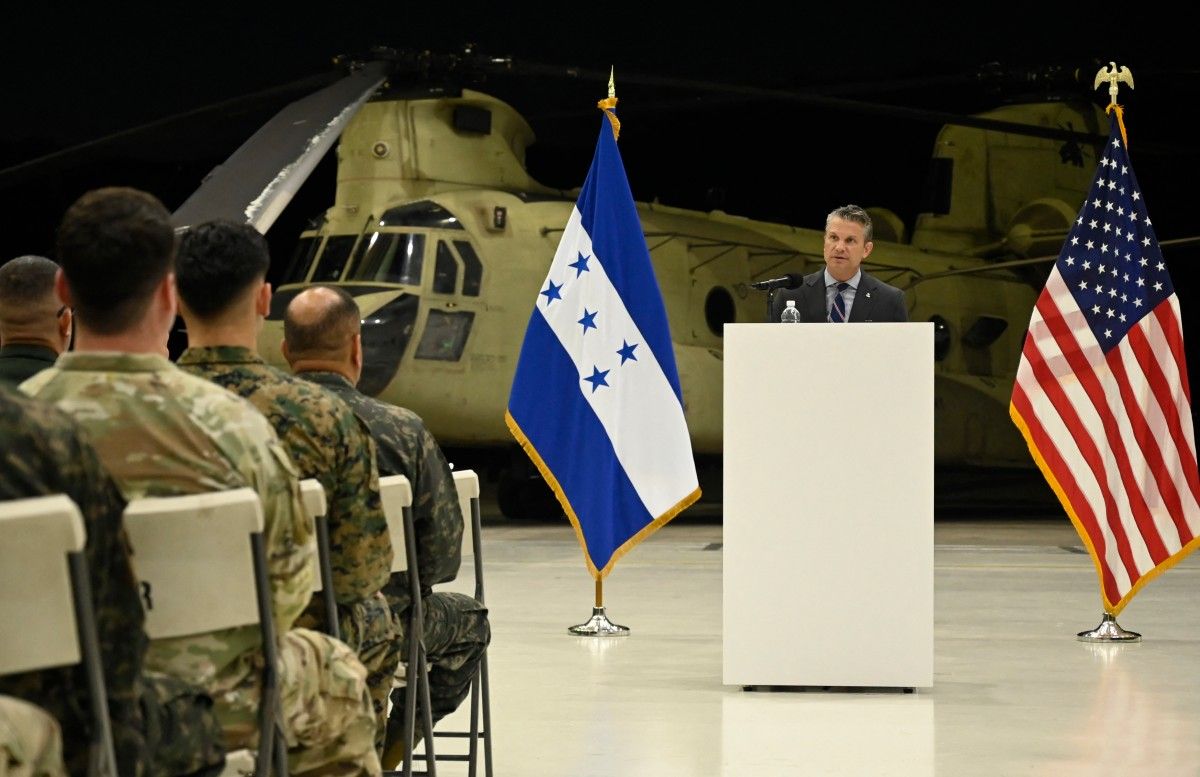
The Secretary of War Pete Hegseth proposed joint "military operations" with Honduras on Thursday and warned that Washington will not leave its "backyard" at the mercy of drug traffickers and foreign adversaries, a reference to the region.
The Pentagon chief arrived in Honduras for the final stop on a tour that took him to Venezuela, Colombia, and Ecuador, aimed at expanding counter-narcotics cooperation.
Hegseth and Honduran President Nasry Asfura met at the U.S. Palmerola Air Base, in Comayagua, about 30 miles north of Tegucigalpa.
There, they signed two agreements on issues such as "cyberdefense" and "areas of national defense," according to Hegseth, who did not provide details.
He also noted that the United States wants to strengthen cooperation with Honduras through "military operations" and under recently approved reforms in the Central American country that strengthen the capacity to "combat narco-terrorism and transnational criminal organizations."
Honduras is part of the anti-cartel alliance Escudo de las Américas created by President Donald Trump.
"We want to achieve results for your country, my country, and our countries together, and that is through bilateral cooperation, through military operations," Hegseth said alongside Asfura, a close ally of Trump.
"We will not cede our own backyard to foreign adversaries or transnational cartels," Hegseth later stated in a speech to military personnel from both countries at Palmerola Air Base.

Politics
Hegseth’s Historic Speech in Venezuela: An Alliance to Reclaim Territory and Secure Borders
Vanessa Vallejo
"Hunt down the savages"
Asfura, who has been in office since last January, received strong backing from Trump in his presidential campaign, after the tycoon threatened to cut off aid to Honduras if the right-wing candidate was not elected.
In the run-up to the elections, Trump pardoned former Honduran President Juan Orlando Hernández—a fellow party member of Asfura—who had been sentenced to 45 years in prison for drug trafficking in the United States.
"We are in the fight against terrorists, drug trafficking, organized crime (...), and gangs. Today, President Trump's policies are strengthening us with all these decisions to face these difficult times," Asfura said during the signing of the documents.
On Wednesday, alleged members of the so-called Devil's Cartel murdered 12 people in an area of the department of Yoro (in the north), apparently in retaliation for operations carried out following legal reforms that toughened the fight against drug trafficking and gangs.
Hegseth highlighted the government's response to "hunt down the savages" who carried out the massacre, while Asfura reiterated that he is determined to subdue criminals through his measures, which emulate the popular security model of Salvadoran President Nayib Bukele against gangs.

Operating in Honduras are the Mara Salvatrucha and Barrio 18 gangs, which the United States and Honduras consider terrorist groups.
Authorities blame drug traffickers and these gangs for Honduras' high homicide rate (24 per 100,000 inhabitants), which is three times higher than the global average.
The Pentagon chief traveled to Latin America after avoiding an impeachment vote in Congress over the war against Iran and attacks on alleged drug-trafficking vessels in the Caribbean and the Pacific, which left more than 200 dead.
Expanded cooperation
In Ecuador, where he met with President Daniel Noboa, Hegseth said Thursday that Ecuador "has set the pace" in the fight against drugs in the Pacific.
The U.S. offensive in Ecuador includes controversial bombings of Ecuadorian fishing boats accused of supplying fuel to drug traffickers' boats.
Hegseth's first tour of South America began on Wednesday with a surprise meeting in Venezuela with interim dictator Delcy Rodríguez—the highest-level U.S. visit since the ouster of former dictator Nicolás Maduro following a U.S. military operation last January.
He then departed for Colombia, where he delivered a C-130 Hercules military aircraft as part of U.S. aid to "hunt down" criminals.
The growing cooperation between the United States and Ecuador is reflected in the unusual deployment of U.S. aircraft at the Taura military base (southwest).
2025 was the most violent year in Ecuador, with more than 9,100 homicides, equivalent to 51 per 100,000 inhabitants.
In the first half of 2026, the country reported more than 4,100 violent deaths.