

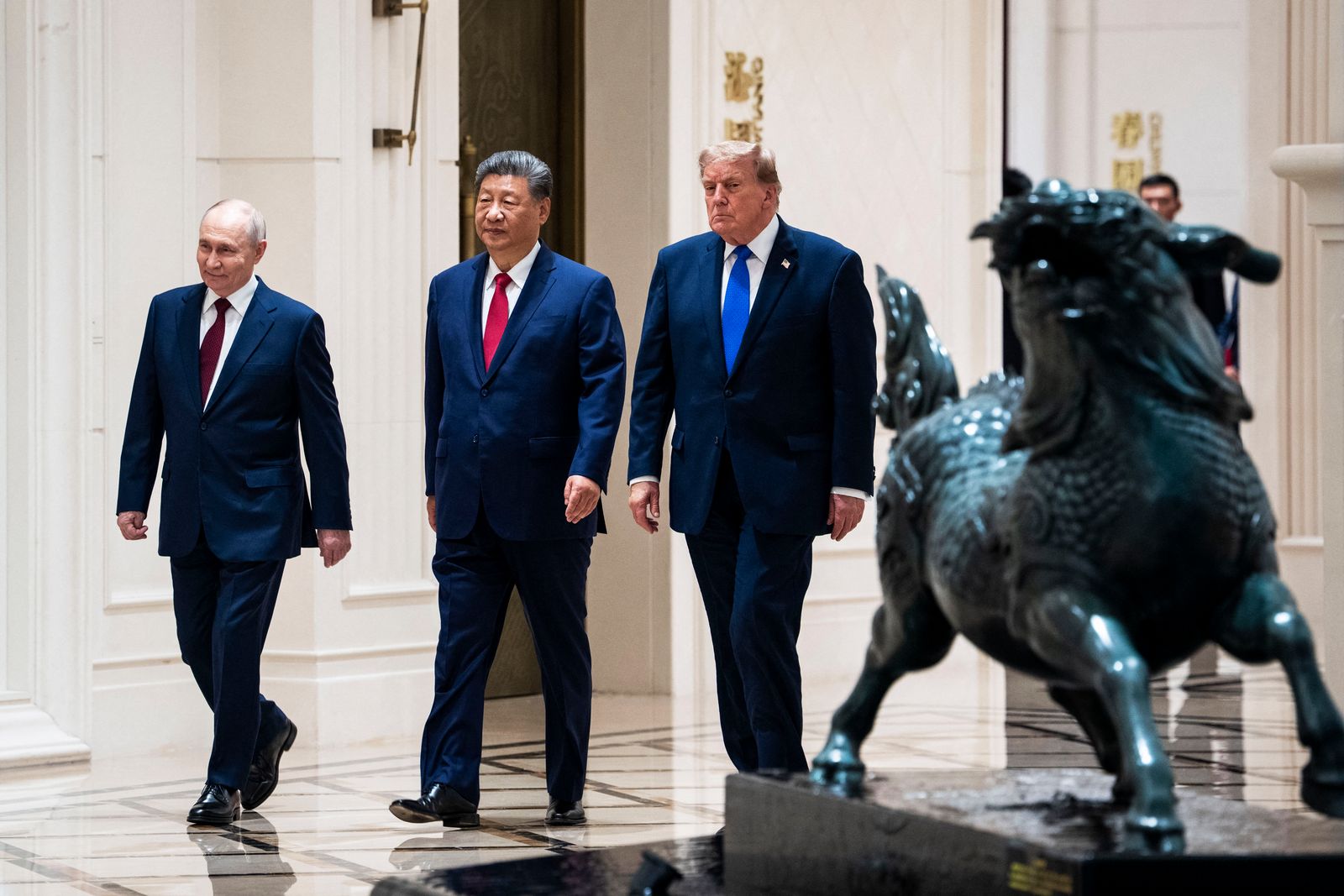
President Donald Trump succeeded in getting the United States, China and Russia to adopt a "Declaration toward Peace" following the first formal trilateral meeting between the leaders of the world's three largest nuclear powers. The document, published by the Chinese state news agency Xinhua and the Kremlin after an 80-minute meeting in Shenzhen, sets out four non-binding political commitments regarding nuclear risk, UN reform, energy and limits on the jurisdiction of the International Criminal Court (ICC).
UN reform
As permanent members of the Security Council, the three countries committed to reforming the UN so that it "can respond more effectively to global challenges and conform to its fundamental mission of international peace and security."

Energy and stability
The second point of the document states that "the three countries plan to increase the production and supply of refined petroleum products for the benefit of all nations," and reaffirms "the importance of stable energy flows."
For the Trump administration, the agreement aligns with its vision that increased energy supply contributes to security and price stability, without relying on international organizations hostile to hydrocarbon production.
Sovereignty vis-à-vis the ICC
The third point recognizes that "the principle of state consent and respect for immunities of State officials are of paramount importance," and maintains that "the International Criminal Court and other similar bodies must not abuse their jurisdiction."
The statement makes it clear that the three powers believe the jurisdiction of international courts must have limits. The ICC has issued an arrest warrant for Putin for alleged war crimes in Ukraine.
The nuclear issue
The most notable commitment concerns nuclear weapons. The three leaders reaffirmed, verbatim, that "a nuclear war cannot be won and must never be fought" and agreed to "conduct a dialogue on reducing nuclear risks and preventing the proliferation of nuclear weapons."
Trump had insisted before and during the meeting that the three powers bear a unique responsibility to reduce risks. The statement does not amount to a disarmament treaty, but it opens a channel for direct dialogue between Washington, Beijing and Moscow at a time of high tension due to the war in Ukraine and the conflict in Iran.
Xi's words
According to Xinhua, Xi Jinping described the summit as "positive, constructive and fruitful." The leader of the Chinese communist regime stated that "there is hope for peace as long as dialogue continues and the door remains open" and assured that "the seeds sown during today's trilateral meeting will undoubtedly take root, sprout and bear fruit."
Ukraine was excluded from the final text
Trump left Shenzhen shortly after the meeting. The White House did not immediately release its own statement.
The "Declaration toward Peace" does not resolve wars or eliminate rivalries between Washington, Beijing and Moscow. It does, however, establish a framework for dialogue in critical areas: nuclear risk, energy, institutional reform and sovereignty vis-à-vis international organizations. The ultimate test will be whether these commitments translate into concrete actions.