

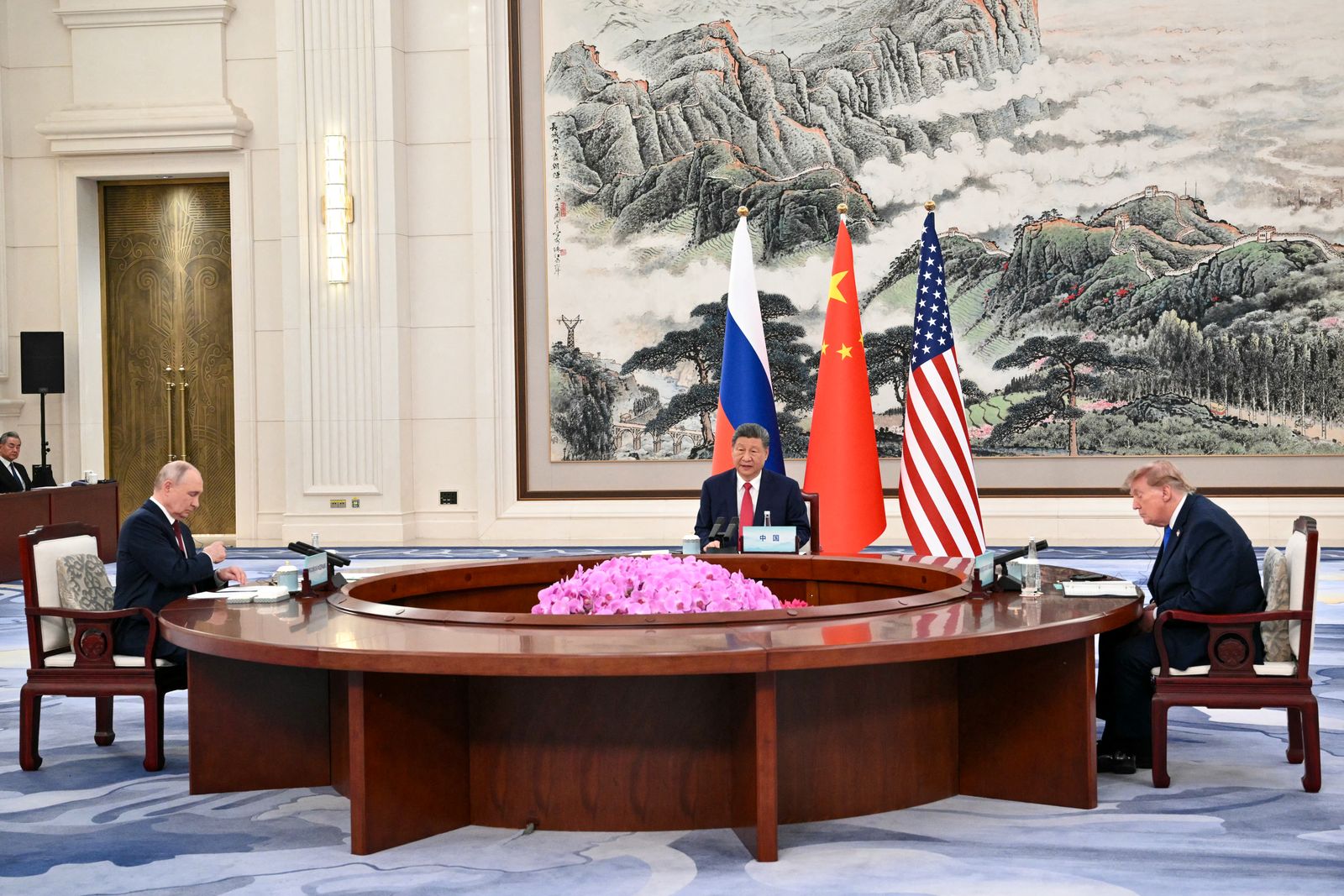
President Donald Trump turned the Asia-Pacific Economic Cooperation (APEC) summit in Shenzhen on Thursday into a platform to defend U.S. interests against China and Russia, champion the freedom of innovation in artificial intelligence, and push for a negotiated end to the war in Ukraine. Ahead of the historic trilateral meeting with Xi Jinping and Vladimir Putin, Trump held bilateral meetings with both leaders and made it clear that the United States will not accept globalist restrictions that undermine the nation's technological competitiveness.
A trilateral meeting of "historic importance"
Chinese President Xi Jinping stated on Thursday that the trilateral meeting with his U.S. and Russian counterparts was of "far-reaching importance," and Donald Trump hailed the historic nature of the meeting in Shenzhen, on the sidelines of the APEC forum.
"The meeting, for the first time in history, of the leaders of China, Russia, and the United States is of far-reaching historical significance," Xi said at the start of the talks with Vladimir Putin and Donald Trump.
The Republican leader, for his part, declared that the three leaders were "making history" by holding talks in the Chinese city of Shenzhen. "I am very pleased that this trip has also given us the opportunity to hold this first trilateral meeting between the leaders of the United States, Russia, and China, and today, in that sense—and I believe in many other respects as well—we are truly making history," Trump said.

Trump: "Together, we are choosing a different course"
Donald Trump used his remarks to question traditional U.S. diplomacy. According to the president, problems have never been solved by avoiding dialogue, and peace has never been built by rejecting opportunities for engagement. "Together, we are choosing a different course," he declared.
Putin stated that the three powers have "a joint responsibility to maintain international peace." The Russian leader also noted that "our countries have numerous shared interests in resolving regional conflicts, including, obviously, the conflict in Ukraine." The statement comes at a time when the Kremlin remains embroiled in the full-scale invasion of Ukraine, the deadliest conflict on European soil since World War II.
China, the U.S., and Russia should "jointly safeguard world peace and stability," Xi Jinping told Donald Trump and Vladimir Putin during the meeting.
"As major world powers and permanent members of the UN Security Council, our three countries must set a good example and cooperate to address global challenges, jointly safeguard world peace and stability, and make greater contributions to human progress," the Chinese president said.
Politics
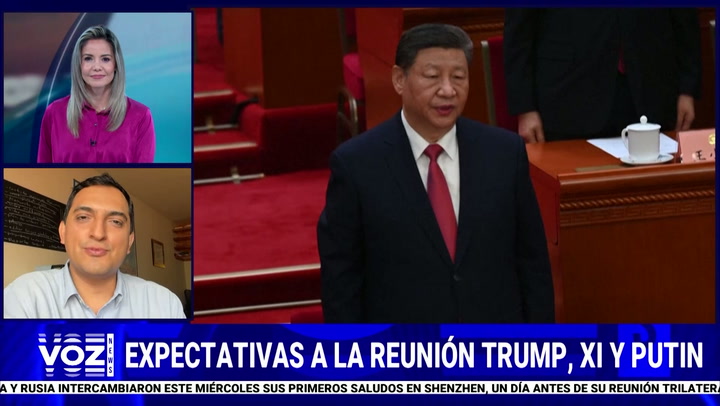
Analyst Esteban Román warns on ‘Voz News’ that ‘Trump cannot trust Xi Jinping's word’
VozMedia Staff
Nuclear disarmament and sovereignty
Trump's stated priority was nuclear disarmament. The president argued that, as the world's three largest nuclear powers, the United States, Russia, and China "are uniquely positioned to discuss how to reduce the number of nuclear weapons on Earth and also to lessen the risk that those weapons will ever be used." He added, however, that reductions is a "very hard thing to do."
President Xi Jinping stated that "every effort must be made to prevent a nuclear war," according to reports by state media on Thursday ahead of the trilateral meeting.
Trump also raised the issue of protecting national sovereignty against international organizations that, in his view, have overstepped their bounds. The president specifically referred to the International Criminal Court (ICC), which he described as a "rebellious globalist organization" that has spiraled out of control and exceeded its jurisdiction.
"In another area of potential cooperation between us, I will propose ways to protect the sovereignty of our nations against dishonest globalist organizations such as the International Criminal Court," Trump said in his brief opening remarks.

AI: innovation, not bureaucracy
November 19 began with the APEC plenary sessions, where the Republican leader participated alongside Xi, Putin, and the other leaders at the forum. In his remarks, President Trump addressed the artificial intelligence revolution and warned of its risks, but categorically rejected any attempt to subject it to restrictive international governance.
"It's superintelligence, but we must keep an eye on it," the president said during the plenary session. He acknowledged that AI "is almost entirely good," though it contains "some negative elements" that require caution. However, his central message was unequivocal: "We oppose any form of globalist regulation or any measure that controls and represses Superintelligence, and, frankly, we will not allow that to happen."
Trump believes the U.S. must lead the technological race, not relinquish it through rules imposed by international organizations or by competitors seeking to level the playing field. In the midst of competition with Beijing for leadership in AI, semiconductors, and advanced computing, the administration believes that U.S. innovation cannot become a hostage to global bureaucracies.

Ukraine: peace through leadership
In his bilateral meeting with Xi Jinping, Trump stated that the United States and China seek to help bring an end to the war between Russia and Ukraine. "We are looking to help with regard to the war between Russia and Ukraine. I would very much like to see it end. I think I can speak for both of us," the Republican leader said.
For Trump, the priority is to stop the bloodshed and achieve a lasting peace, not to prolong indefinitely a conflict that has resulted in enormous human, economic, and strategic costs.
Xi Jinping, for his part, stated that relations between China and the United States have remained "generally stable and have improved," and that this development has brought "tangible benefits" to both peoples and "stability and certainty to the world." It was his third in-person meeting with Trump in 2026, following the meetings in May in Beijing and September in Washington.

Trump and Putin: a long-standing relationship
Prior to the trilateral meeting, Trump held a bilateral meeting lasting approximately 40 minutes with Vladimir Putin. The president referred to the Russian leader as "my friend" and emphasized that the two have maintained a "great relationship for many years."
"We're looking forward to our meeting. We've had great relations for many years; we've known each other for a long time, and I believe many wonderful things can come out of this, or at least get started," Trump said, according to a recording of the meeting released by the Kremlin.
The conversation focused primarily on the war in Ukraine and served as a preparatory session for the three-way meeting. No concrete results were announced, but Trump's willingness to speak directly with Putin is consistent with his view that leaders should resolve major crises face-to-face.

Politics
Trump warns Iran of unprecedented consequences over possible 'dirty bomb' plot in Washington
Carlos Dominguez
The trilateral meeting: a commitment to stability
The trilateral meeting between Trump, Xi, and Putin was scheduled to nuclear arms control, the war in Ukraine, the conflict in Iran, trade, and artificial intelligence.
Beijing has framed the meeting in terms of "world peace" and strategic stability among major powers. For the Trump administration, the goal is not to establish a new world order led by international bureaucracies, but rather to protect U.S. security, strengthen its economic and technological position, and open avenues for negotiation where common interests exist.
The joint presence of the three leaders carries enormous symbolic value, but it also poses risks. In Ukraine and Europe, there is concern about the possibility that aspects of the conflict might be discussed without the direct presence of Kiev or its European allies. The Trump administration will have to demonstrate that any rapprochement with Moscow does not result in concessions that undermine the security of Ukraine, NATO, or U.S. allies.
The 18th: courtesy and ignals
The two leaders exchanged a brief embrace, in return for the reception Trump had hosted for Xi at Joint Base Andrews in September. Putin, who had arrived earlier, did not receive the same welcome on the tarmac.
That same day, Xi and Putin delivered speeches ahead of the formal opening of APEC. Xi advocated for free and open trade and criticized protectionism, while Putin denounced Western sanctions and referred to Western powers as "former hegemonies."
Later, the three leaders posed together for the APEC group photo and attended the welcome banquet. Trump and Putin exchanged greetings and a handshake in Xi's presence, marking their first in-person meeting since the talks in Alaska in August 2025.