ANALYSIS
'Thumos' the West is missing: Rubio invokes Greeks to call on Europe for fire, courage, pride
"For all their lofty ideals, the ancient Greeks were not naive. They understood that nations have interests. They understood that statecraft requires prudence and diplomacy, but they also understood that it requires the ability to wield force when prudence and diplomacy fail," Rubio said.
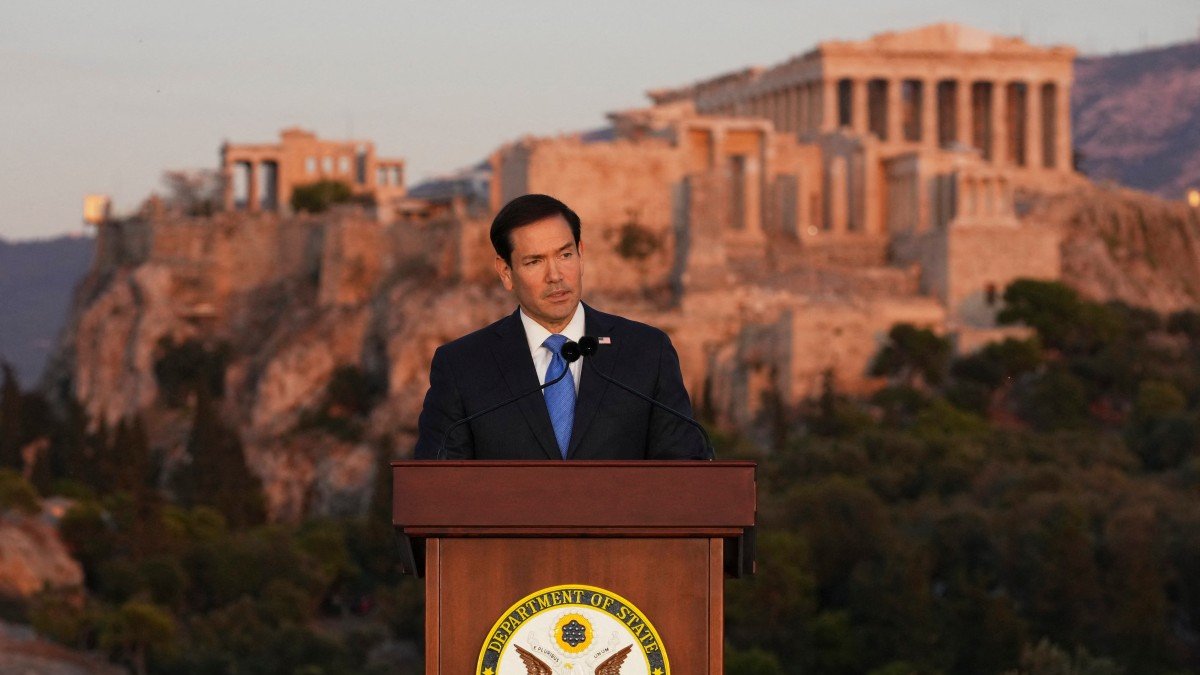
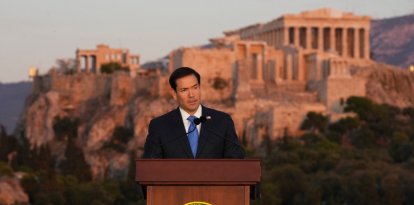
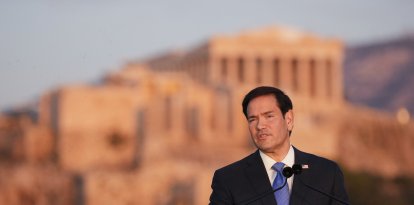
Marco Rubio delivers a speech on Pnyx Hill with the ancient Parthenon visible in the background

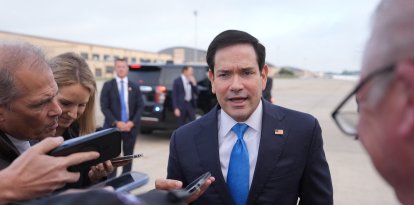
Secretary of State Marco Rubio spoke Wednesday from the Pnyx, the hill in Athens where ancient citizens gathered to deliberate, with the Acropolis behind him. It was a clearly atypical speech for a political leader holding the world's most important diplomatic post. Rubio began with a history lesson and ended by signing a manifesto with a clear recipient — Europe — which he invited to rediscover pride in its heritage right here in Greece.
During his nearly 30-minute address, Rubio devoted a significant portion of his remarks to the Greeks and only toward the end turned to current politics.
The city that rose from its ashes
The Secretary of State began with a scene from 2,500 years ago. In 480 B.C., he recounted, the armies of the Persian King Xerxes arrived at Athens and set fire to its sanctuaries. Most Athenians had already fled by ship to a nearby island, but a handful refused to leave their homes, barricaded themselves on the rock of the Acropolis and held out for days, hurling huge stones at the invaders. The Persians ended up razing everything to the ground. When the Athenians returned, they gathered the shattered remains of the old temple and buried them on the hill itself. Decades later, under Pericles, they built the Parthenon.
"For 25 centuries since, the Parthenon has stood. Empires have risen and fallen beneath its shadow," Rubio said. "And the progeny of the men who built it — the sons of Athens and Rome — have carried their civilization with them to the ends of the Earth."
From there, he drew a parallel with his own country. He introduced himself as the secretary of state of a republic two and a half centuries old and as the great-grandson of settlers who arrived in the New World from Spain, and said he was there to bear witness to a debt that neither time nor distance can erase.
"The history of America, the history of my country, is covered with the fingerprints of antiquity. Greece is literally carved into the architecture of our government: in the towering columns, in the domes and the monuments across our capital city," he said. He also recalled that Philadelphia, the city where the Constitution was born, has a Greek name, and that the most frequently cited author in "The Federalist Papers" was Plutarch, the biographer of the great men of Greece and Rome.

The fire that went out
For Rubio, what the West inherited from Athens goes beyond democracy, philosophy or oratory. He spoke, in broad terms, of a character forged from ambition, curiosity, impatience with the impossible and the conviction that the unknown can be known. That thread, he argued, connects the Greek sculptors with Michelangelo; the philosophers who sought the structure of the universe with Copernicus, Galileo and Newton; and the thirst for knowledge that led Columbus to cross the Atlantic and Apollo 11 to reach the moon.
"A civilization that we must fight to defend today with the same passion as our forefathers did. The men who built the Parthenon were succeeded by the architects of European Christendom, who raised the cathedrals of Milan, Cologne and Florence," he said.
At the heart of his speech, he used a Greek word. "The thumos, as the ancient Greeks called it – the fire of passion, strength, courage, pride – is the heart of great civilization," the Secretary of State continued. Without it, he warned, nations lose the will to fight, to strive and to survive.
In his view, much of the West has forgotten thumos. He said that in this part of the world people came to feel ashamed of what made them exceptional, that "nationalism" became a dirty word, that monuments were torn down, and that children were taught to be ashamed of their countries. And he's not wrong. For many years, the explosive growth of wokeness, driven by the State, supranational organizations and the press, led many to lose sight of what is desirable for our nations: strengthening the family, protecting our symbols and borders, economic progress, preserving the community and, above all, cultivating faith, with God as the great guide. Almost overnight, Western society began arguing over trivialities and turning real priorities upside down, waving absurd and, in many cases, indefensible banners, such as tearing down statues of historical figures like Christopher Columbus, rewriting history, burning flags and a long list of other atrocities committed over the past decade.
"Too often these days, we build downwards. We design our standards to ensure no one will lose," he said, and offered a lesson to those who think the opposite by recalling the figures on the Parthenon, who point upward.
He also contrasted the heroes of the West — from Socrates to the 300 Spartans and Achilles — who die for a cause, but do not worship death, with the radical terrorists of Iran, whose cult of death, he argued, turns child suicide bombers into national heroes.
A crossroads
He moved from history to current events, culminating in a harsh, hard-to-swallow assessment. He said that the West opened its borders, outsourced its industry, allowed its armies to weaken and gradually ceded sovereignty to global bureaucracies beyond its control, and that its rivals, such as China, took advantage of this vacuum. And now the entire West stands at a crossroads, because the decisions of the coming decade will shape the history of the next century. "We will either choose to act now or lose the choice to act at all," he warned.
Under the leadership of President Donald Trump, he asserted, the U.S. has already made its choice. He listed regaining control of critical supply chains, reindustrializing the economy, rebuilding defense capabilities and competing for dominance in technologies such as superintelligence, drones, chips and minerals, as well as returning astronauts to the moon. And he turned to the Greeks to justify the use of force. According to Rubio, they understood that power requires not only the means to defend oneself, but also the credibility that one is willing to use them. That, he asserted, is the classical conception of politics that the Trump administration wants to restore for all of civilization, including Europe.
"For all their lofty ideals, the ancient Greeks were not naive. They understood that nations have interests. They understood that statecraft requires prudence and diplomacy, but they also understood that it requires the ability to wield force when prudence and diplomacy fail. They understood that power requires not only having the means to defend yourself, it requires the credibility that you are willing to use it. This is the classical understanding of politics and of statecraft that the Trump administration hopes to reclaim – reclaim not just for our country, but for the whole of our civilization."
These words are backed by facts. Just ask, for example, the tyrant Nicolás Maduro, who now awaits trial for narcoterrorism in New York, alongside his wife Cilia Flores, after his capture last January 3 at the hands of U.S. forces. Maduro spent years mocking the U.S., the European countries and international organizations, flooding the continent with drugs and causing the worst mass exodus in the region's history through his evil, embodied in tyranny. He stole elections, caused famine, persecuted dissidents and believed himself untouchable. He got a taste of the new U.S. policy: the use of force when prudence and diplomacy fail.
The call to Europe
The final section of his speech was an invitation. "We believe that Europe can awaken from its long slumber and rekindle the fire that was lit here millennia ago," Rubio said. He saw signs on the continent — such as the sharp increase in defense spending, new alliances and increased production — following the commitments made last year in The Hague. And he cited Greece as an example, a model ally in energy, migration and defense.
He admitted that passions have at times strained the ties between the U.S. and Europe, but urged that they not be broken. As an example of what he envisions, he cited the agreement with Denmark and Greenland, which, he said, will reshape the Arctic and strengthen the security of all of NATO. "We want to win together. We must win together," he declared, although, perhaps, for the old continent it is already too late. The U.S. and China compete with each other for global dominance, by a wide margin over everyone else. Europe handed over its border and trade sovereignty, as well as its workforce and the trust of its citizens, who are now leaving to see the world, to breathe a little freedom and calm, and to try to forge their own path far from the bureaucratic state that tramples on them.
He concluded with a quote from Daniel Webster, who told the U.S. Congress in 1824 that Greece had once existed and that his country, like the rest of humanity, owed it a great deal.
"This free form of government, this popular assembly… this practice of free debate and public discussion, the contest of mind with mind… even the edifice in which we assemble, these proportioned columns, this ornamented architecture, all remind us that Greece has existed and that we, like the rest of mankind, are greatly her debtors."
LATEST