
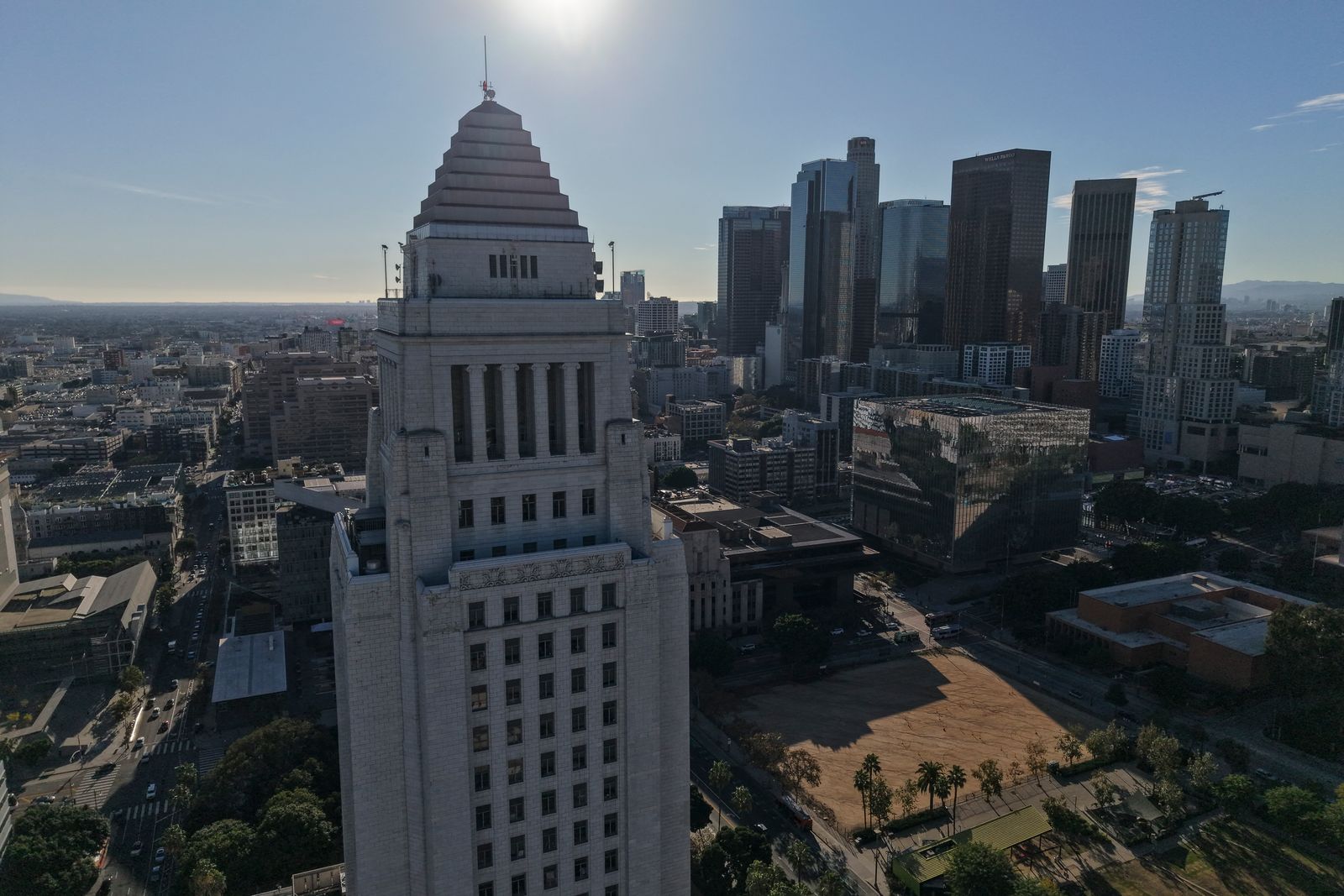
A magnitude 5.0 earthquake struck the Southern California coast on Saturday and was felt in various parts of the Los Angeles metropolitan area, where it caused damage at Los Angeles International Airport (LAX), disrupted some flight operations and raised concerns about a plume of smoke that appeared over a nearby refinery.
The earthquake was recorded around 9:30 a.m., with its epicenter in the Pacific Ocean, approximately four miles off the coast of Manhattan Beach in Los Angeles County and at a depth of 7.6 miles, according to the U.S. Geological Survey (USGS). The tremors were also felt in communities such as Venice and Silver Lake, spreading across a wide area of the southern part of the state.
One of the most noticeable incidents occurred at Los Angeles International Airport, where several windows were damaged and workers had to remove shards of glass. In addition, some aircraft interrupted their landing maneuvers as a precaution, and several images shared on social media showed a plane approaching a runway that suddenly had to climb back up as the camera captured the tremors.
The seismic activity did not go unnoticed at the industrial facilities in El Segundo either, after a plume of smoke rising from the Chevron refinery caused widespread concern among residents and people in the immediate vicinity. Despite this, local authorities clarified that it was a controlled safety venting and flaring operation, automatically triggered in response to the earthquake, and not an out-of-control fire.
According to several media reports, the incident prompted the precautionary evacuation of several dozen workers and customers from a shopping center located across from the refinery; they were led to the parking lot. Firefighters from El Segundo and Manhattan Beach responded to the scene to address the incident and assess safety conditions.
Neither the earthquake nor the incidents caused significant damage
In a statement, Los Angeles Mayor Karen Bass reported that no significant damage had been reported in the city so far. However, the Los Angeles Fire Department activated its earthquake response protocols to assess potential consequences and address any emergencies resulting from the tremor.

The main quake was accompanied by a series of aftershocks. During the first few minutes, tremors measuring 2.8 and 3.0 were recorded near Hermosa Beach, as well as another measuring 2.5 near Manhattan Beach. The strongest of the aftershocks occurred at 11:41 a.m., when a magnitude 4.5 aftershock was detected in the same offshore area.
Initial estimates by the USGS placed the earthquake's magnitude between 4.7 and 5.2, before definitively setting it at 5.0. Lucy Jones, a research associate at the California Institute of Technology (Caltech), explained that this was one of the strongest earthquakes recorded in the Los Angeles area in quite some time.
Despite the concern caused by the tremors, authorities did not issue any tsunami alerts, warnings or advisories. The earthquake occurred in the Pacific Ring of Fire, a vast band stretching approximately 25,000 miles around the ocean where intense seismic and volcanic activity is concentrated due to the movement and interaction of various tectonic plates.
California remains particularly vigilant about these types of events due to the risk of a major earthquake, popularly known as "The Big One," which scientists believe could occur along the San Andreas Fault.