ANALYSIS
Alito warns about the future of the Supreme Court: 'There has been a concerted effort to intimidate the court'
The justice admitted that he is "concerned about the escalation in public rhetoric in general and about the things that people in important positions say about the Supreme Court as a whole and about individual justices." He also warned of the "long-term effect of that on the standing of the court."
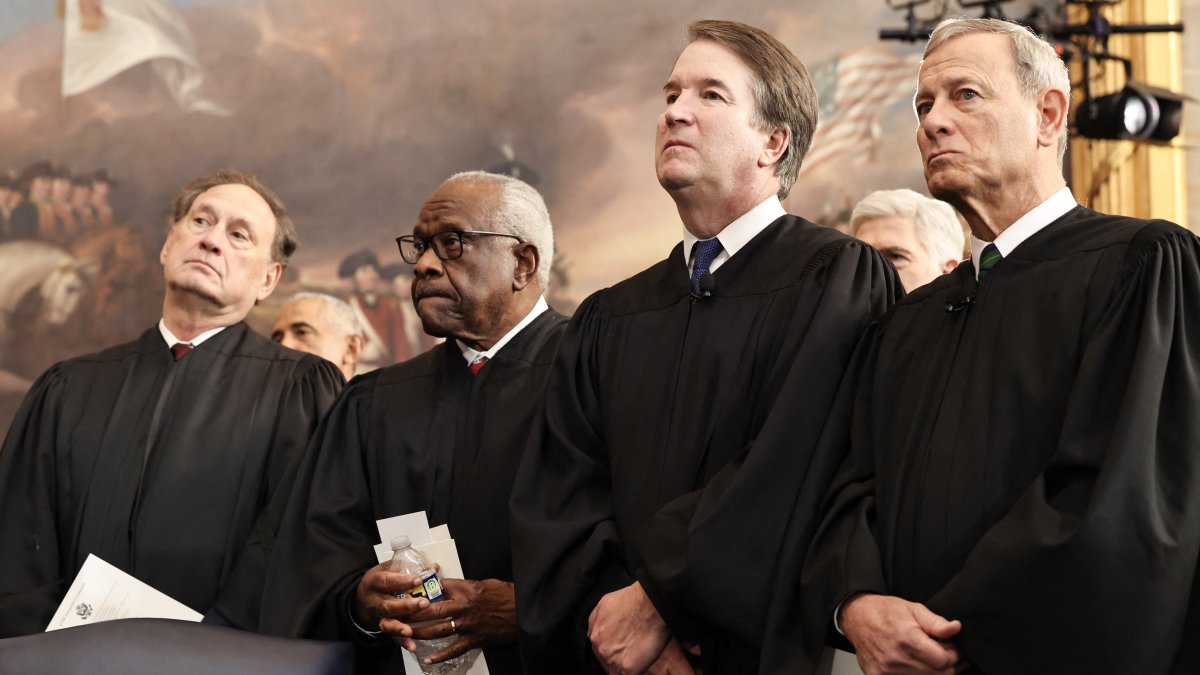
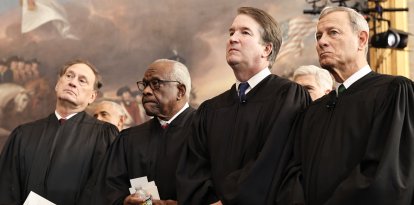
SCOTUS Justices Samuel Alito Jr., Clarence Thomas and Brett Kavanaugh, along with Chief Justice John Roberts

Justice Samuel Alito has warned that he is "concerned" about the future of the Supreme Court (SCOTUS) due to what he describes as an extreme level of public rhetoric and political pressure surrounding its rulings.
In an interview with "Fox News Sunday" to promote his new book "So Ordered: An Originalist's View of the Constitution, the Court, and Our Country," Alito stated that "there has been a concerted effort to intimidate the court and justices on the court."
According to Alito, the goal is to try to "influence" them so that they decide cases differently than they have been deciding them.

Politics
Exxon, Suncor ask Supreme Court to block local lawsuits that threaten domestic fuel production
Andrés Ignacio Henríquez
Pressure from Trump and other political actors
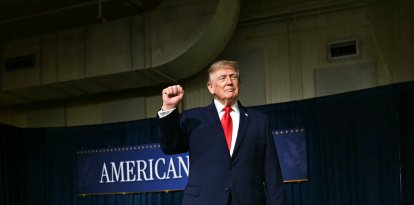
Public pressure on the Supreme Court has intensified, particularly from President Trump, who has repeatedly weighed in on how the court should rule on issues ranging from tariffs to birthright citizenship.
In late September, Trump questioned on Truth Social the rulings on tariffs and birthright citizenship. "Unfortunately, the United States Supreme Court has lacked the Courage to MAKE AMERICA GREAT AGAIN," he wrote, attributing those "faulty, political, and ridiculous decisions" to a cost of trillions of dollars and "forever damaged the way people become citizens."
In the interview, Alito stated that he and his eight colleagues, on a conservative-majority court, try to ignore statements by public figures. He admitted, however, that he is "concerned about the escalation in public rhetoric in general and about the things that people in important positions say about the Supreme Court as a whole and about individual justices." He also warned of the "long-term effect of that on the standing of the court."
Alito on the Dobbs leak
The justice again referred to the May 2022 incident, when Politico published the draft majority opinion in Dobbs v. Jackson Women's Health Organization, the ruling that months later struck down the constitutional right to abortion recognized in Roe v. Wade.
The leak, unprecedented in the court's recent history, remains unattributed. The justice reiterated that he has an idea of who might have done it, though he does not consider himself in a position to identify the person.
"I do have an opinion, but the evidence available at this time is not strong enough for the court or for me to say this is the person who was responsible," he stated.

Just The News
SCOTUS agrees to hear challenge to ICE's mass detention policy
Just The News/Ben Whedon
Barrett sounds the alarm in Congress
Conservative Supreme Court Justice Amy Coney Barrett, appointed by Donald Trump, warned in mid-July before Congress that the surge in threats against her and her colleagues is increasingly crossing the line from the professional sphere into her private and family life. In testimony before a House appropriations subcommittee, she recalled that a few years ago she had to return home wearing a bulletproof vest, an experience she found difficult to explain to her 12-year-old son.
"I didn't expect that performing this service was going to put me in the position of explaining to my children what a bulletproof vest was and why I had to wear one," she said. Alongside Justice Elena Kagan, Barrett advocated for increasing the security budget for members of the Supreme Court, at a time when judges across the country are experiencing a rise in violent threats and acts of intimidation.
A court divided between its legal role and its public image
Beyond specific controversies, Alito defended the Supreme Court's historical role. "I think it’s an important institution and it has not always done the right thing, but I think on the whole it has been fundamental in protecting our constitutional structure and the rights that all Americans enjoy," he stated.
With the new judicial term already underway and high-profile cases involving guns, citizenship, abortion and presidential power, Alito's warnings reflect an underlying concern. That of a court which, despite its conservative majority and legal victories, feels increasingly under political siege and with its public legitimacy eroded.
"We didn't have to agree to be appointed," Alito said. "We don't have to remain. We can always quit."
Republican President George W. Bush nominated Alito to the Supreme Court in 2005 to replace Justice Sandra Day O'Connor, and the Senate confirmed his nomination after a lengthy process in 2006.
Politics
The Supreme Court gives the Trump administration the green light to resume deportations to third countries
Andrés Ignacio Henríquez
The court's worst image since 1972
A Gallup poll published last week noted that Americans' opinion of the institution is the least favorable since the organization began tracking it in 1972.
Only 34% of U.S. adults approve of the court's work, virtually unchanged from the all-time low of 33% recorded in July, according to Gallup.
LATEST