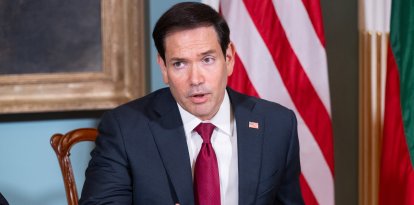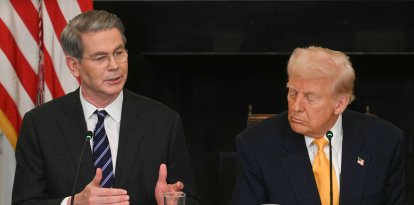
Where’s Marco?
Theories abound as to why Rubio has virtually vanished from center stage.
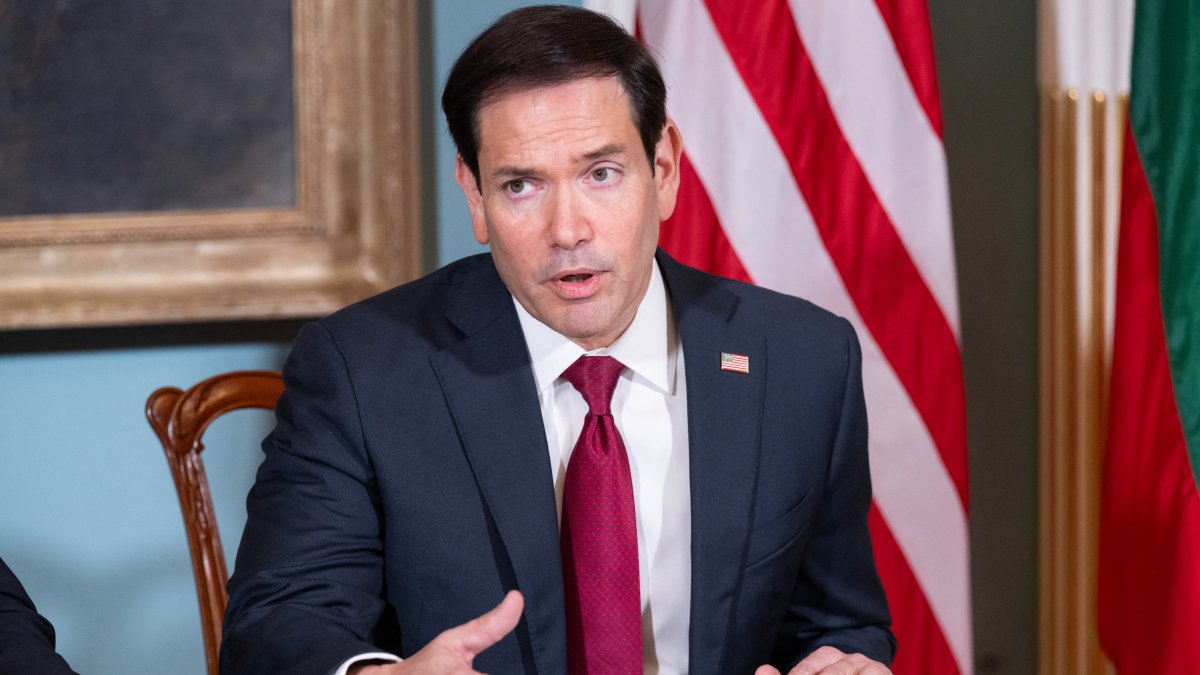
Marco Rubio, secretario de Estado/ Saul Loeb
Not long ago, Marco Rubio seemed to have more jobs than there were hours in the day. U.S. secretary of state. National security advisor. Point man on Latin America. A key player in negotiations between Israel and Lebanon over cooperation against Hezbollah.
It got to the point that memes began circulating online showing Rubio in the same pose, but in an array of costumes. The joke became so widespread that the White House granted him a gold-framed collage for his 55th birthday featuring 68 photos of him transformed into every type of figure, including an ayatollah.
At the center of the picture, signed by U.S. President Donald Trump in gold ink with the words, “You are great,” is the original photo of Rubio slumped on a couch in the Oval Office.
Then, suddenly, he seemed to vanish. Not literally, of course. Rubio hasn’t been idle. On the contrary, he’s been busy meeting with foreign leaders and engaging in the kind of activity that his role as top diplomat requires.
Meanwhile, Vice President JD Vance—who, for a while, was far less visible than Rubio—has been dominating headlines and generating viral clips.
The flip is striking.
At the Republican Party’s first-ever national midterm convention, held last month in Dallas, for example, Trump delivered a lengthy speech and Vance took center stage. But Rubio was absent.
The reason given for this oddity was that he was on a mission in South America. Still, his lack of attendance at the event didn’t go unnoticed.
The optics raise an interesting question: What, exactly, is going on with Rubio?
One theory is that Trump is deliberately elevating Vance as his heir apparent while sidelining Rubio. A second is that it’s Rubio who’s choosing to step back, since maintaining a lower profile may be the smartest strategy if he harbors hope of becoming Trump’s successor.

After all, why create friction with either Trump or Vance? Why become entangled in every political battle when patience might serve him better?
A third possibility is that he’s thinking even further ahead. Perhaps he sees a Vance-Rubio ticket in 2028 as an option that would open the door to a future presidential bid in 2032 or 2036.
Here’s where Israel enters the discussion.
Unlike Vance, Rubio has been an unwavering champion of the Jewish state. Yet it was Vance whose appearance at the Republican Jewish Coalition Annual Leadership Summit in Las Vegas at the end of August was highlighted.
And this is despite his insistence that his remarks be delivered in a closed-door setting, without press coverage. That made it sound as though he didn’t want his anti-Israel cohorts on the far right thinking he was catering to the Jewish coalition.
Nevertheless, and to the chagrin of many Rubio supporters, Vance was treated to a warm embrace at the venue and subsequent reassurances to doubters that he was actually aligned with Israel.
It didn’t feel that way last week when Vance said on the “All-In Podcast”: “I think that more than, frankly, any president in the last 40 years, [Trump] has shown a willingness to actually part ways with [Israeli Prime Minister] Bibi Netanyahu when he feels like the interests of the American people are different from the interests of the government of Israel.”
Equally disturbing was his declaration that United States foreign policy can’t be “subservient to the State of Israel.”
Rubio would never have made such a statement. But he probably prefers not to contradict Vance openly or otherwise at this stage, when neither of them has even announced a presidential run.
Conservative commentator Ben Shapiro recently explained on the “PBD [Patrick Ben-David] Podcast” why he believes that Rubio won’t, not should be, entering the race.
Calling Rubio “a pretty risk-averse politician,” Shapiro assessed the secretary of state’s calculations as follows:
“If you’re Marco, and you’re gaming out what the next few years will look like for you, here are your choices: You run against JD, you lose, you’re done. You run against JD, you win, it’s a rough election cycle anyway, because the president’s riding in the 30s, and the country’s in the mood for ‘something new,’ and you lose, you’re done. You don’t run, JD may pick you as his VP candidate, JD loses, you’re next. JD does not pick you and JD loses, you’re also next.”
LATEST