

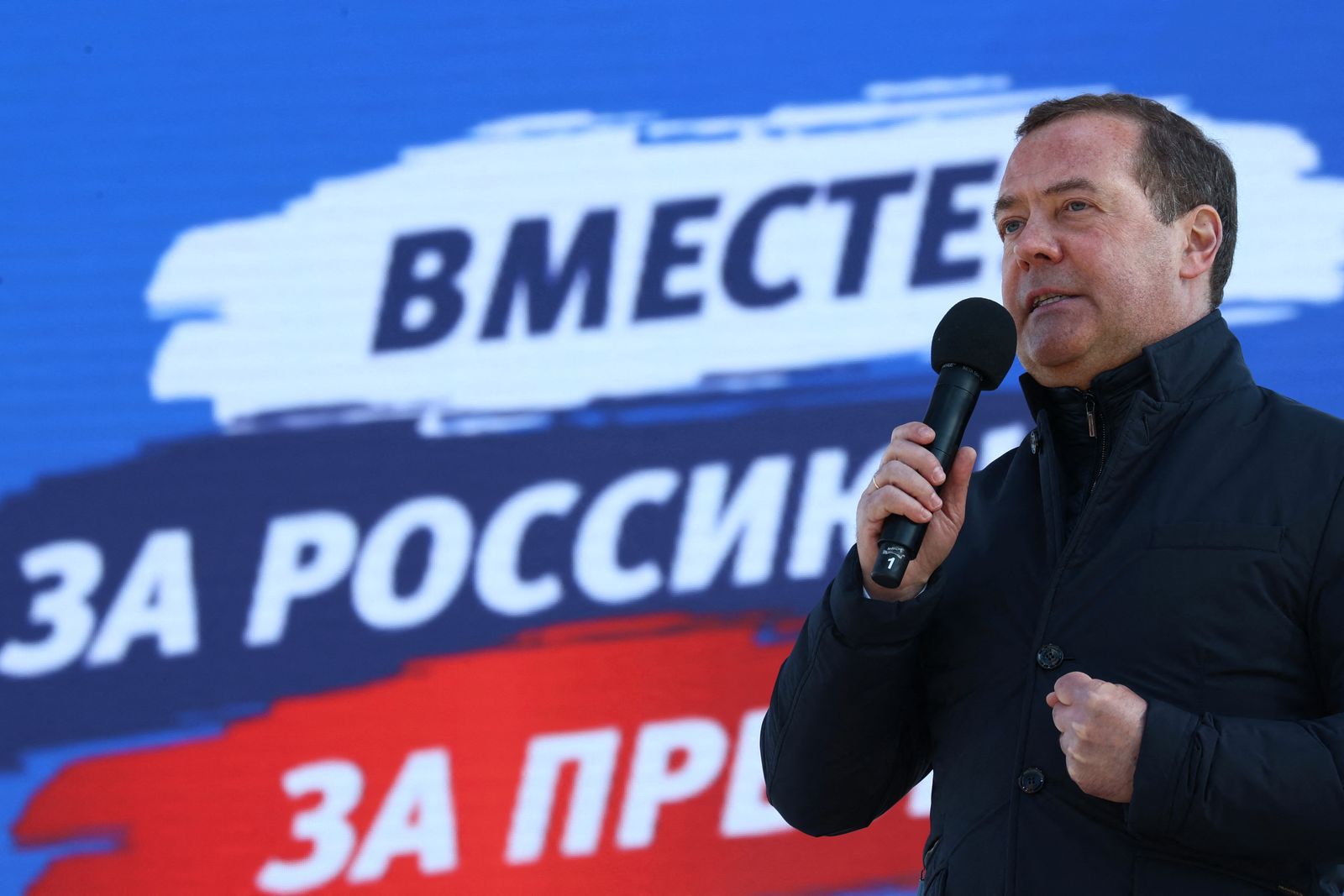
Dmitry Medvedev, former Russian president and current vice chairman of the Russian Security Council, warned that Moscow could carry out a preemptive nuclear strike under certain circumstances and accused Ukraine and its Western allies of having crossed lines that could lead the Kremlin to consider the use of such weapons.
According to Fox News, Medvedev raised this possibility in an article published in the Moscow Journal of International Law, excerpts of which were published by the Russian state news agency TASS. In the article, titled "State Sovereignty and Nuclear Weapons: International Legal Aspects for Ensuring National Security," he argued that the massive use of non-nuclear means capable of causing catastrophes could justify a preemptive nuclear response.
"The massive use of non-nuclear means that cause catastrophes makes a preventive nuclear attack by the Russian Federation possible," Medvedev wrote.
The Russian leader also warned that any secret or covert supply of Western nuclear weapons to Kyiv would, in his view, trigger a legitimate preemptive nuclear strike by Moscow.
"Kyiv and its allies must remember that the Russian Federation not only has the right, but in various situations has the obligation to use nuclear weapons," he stated.
Medvedev argues that Ukraine and NATO have crossed the line
Medvedev argued that Ukraine and its Western allies have already created situations in which Russia might consider launching a nuclear attack.
"Formally, in a number of cases, the parties collectively opposing us (Ukraine, NATO countries and several Western countries outside the alliance) have already created situations in which Russia considers the possibility of launching a nuclear strike," he wrote.
However, the former leader noted that Russian President Vladimir Putin carefully analyzes the consequences before making a decision of that nature.
Medvedev acknowledged that Russia has not used nuclear weapons during the war against Ukraine because, so far, it has not considered there to be a direct need to do so. However, he warned that this assessment could change if the circumstances he mentioned in his article were to arise.
He also argued that, although Russian nuclear doctrine does not expressly authorize preemptive nuclear strikes, certain scenarios could justify preemptive action. The final decision on the use of these weapons rests exclusively with Putin, he specified.
The warning comes after the meeting between Trump, Putin and Xi
His warnings also come just days after Donald Trump met with Putin and Chinese President Xi Jinping on Nov. 19 in Shenzhen, China. The leaders of the three nuclear powers agreed to promote talks aimed at reducing nuclear risks and preventing the proliferation of these weapons.
Although the meeting did not yield significant progress on arsenal reduction, the leaders reaffirmed in a joint statement that a nuclear war cannot be won and must never be fought.
In his article, Medvedev also cited a 1996 advisory opinion from the International Court of Justice to support his arguments regarding international law. The court concluded that, generally speaking, the threat or use of nuclear weapons would be contrary to international humanitarian law, although it did not definitively rule on their legality in extreme circumstances of self-defense where the survival of a state was at stake.
Medvedev served as president of Russia from 2008 to 2012 and subsequently held the position of prime minister under Putin. Since Russia's invasion of Ukraine, he has become one of the Kremlin's most forceful voices in warning of a possible nuclear escalation.