

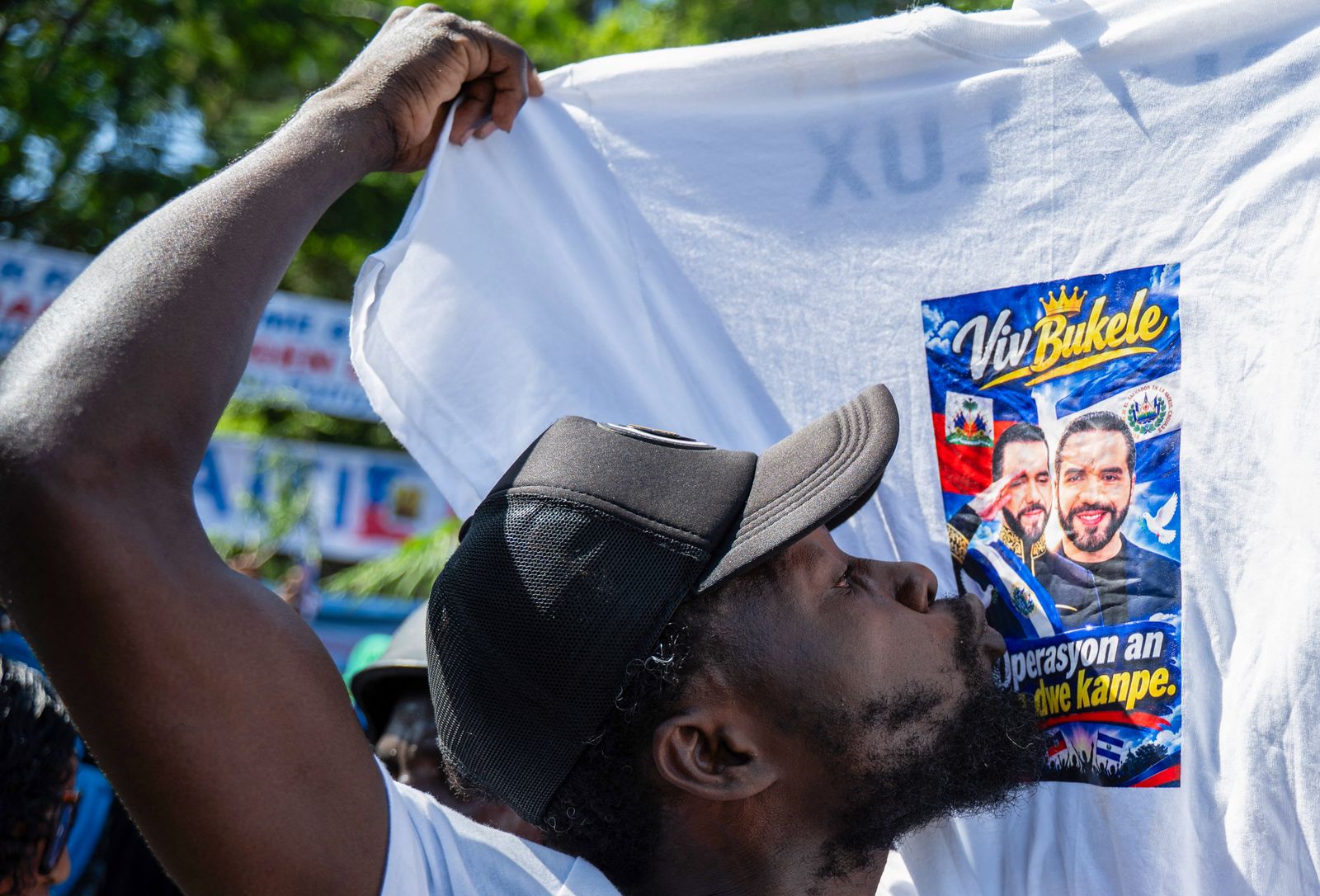
In the soccer match between Haiti and the United States, some Haitian fans cheered on their national team and Salvadoran President Nayib Bukele, whose military deployment in Haiti has raised hopes that the gangs might be contained.
Bukele sent more than 2,000 military personnel to Haiti in late October to rescue four Salvadoran soldiers who had gone missing following an attack by gang members near Port-au-Prince.
Thousands of Haitian fans flocked to Miami's Nu Stadium on Saturday to support their national team, which lost 6-0 to the United States in a CONCACAF Nations League match.
Some of them waved Salvadoran flags while chanting "Bukele! Bukele!" as they walked toward the stadium.
"All I can say is 'Long live Bukele.' He's the only one trying to see if there's a way to get rid of the gangs," Guito Ledix, a 41-year-old fan of Haitian descent, told AFP.
"As long as he keeps delivering results, that shows me that there were things that could actually be done," added the man, who has not been able to visit his country for ten years.
The "Grenadiers" played the match away from home, a common situation for the Haitian national team since gang violence rendered the Sylvio-Cator Stadium in Port-au-Prince inoperable in March 2024.
The stadium was recently reclaimed by authorities.
Bukele has boasted on social media about his troops' advance in the Caribbean country and even shared a video from inside the stadium showing fans chanting his name.
However, analysts and critics of his government have warned that the operation is being conducted in secret and have cast doubt on whether its sole objective is to rescue the soldiers.
"Things are going to get better"
Haiti, the poorest country in the Americas, has been facing for years a deep political and security crisis, exacerbated by a rise in murders, kidnappings and gang-related rapes.
The country has not held elections in years, and the election initially scheduled for December of this year were postponed to July 2027.
As a result of the crisis, many Haitians have emigrated, and some members of the diaspora in the United States have not returned to their homeland for years.
Florida is home to one of the largest concentrations of people of Haitian descent in the United States.
Stephanie Jeanty, a 28-year-old Haitian woman, says she used to live in fear of the violence in her country, where much of her family still resides. She also views the Salvadoran military deployment with optimism.
"Seeing the Salvadoran delegation working to restore peace is a very good thing. Things are getting better," said Jeanty, who arrived in the United States four years ago on a humanitarian flight.
"I'd really like to go back to my country, but not right now," he added.