

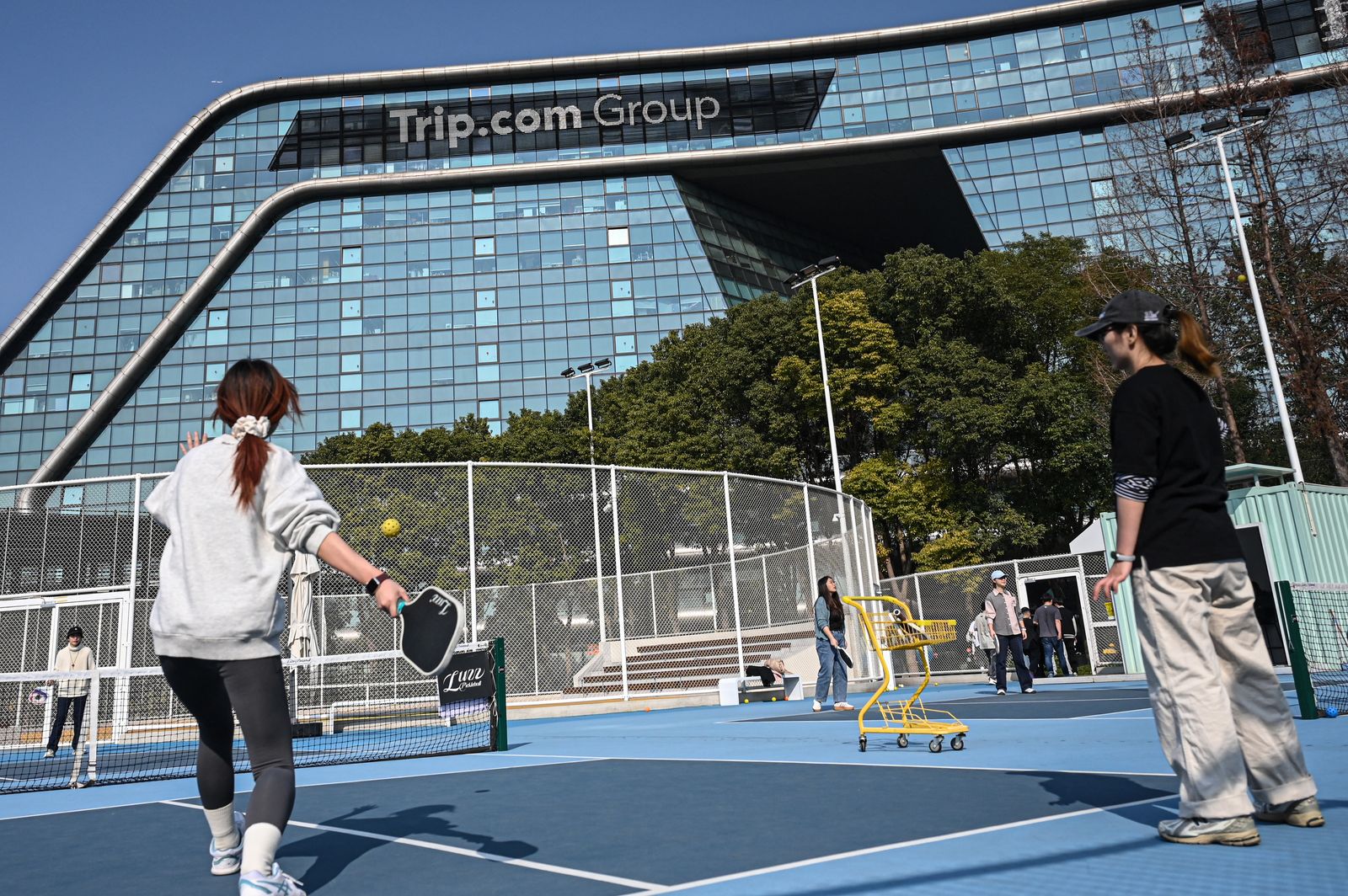
The pickleball has evolved from a recreational pastime to one of the fastest-growing sports in the country, going from being unknown to many to attracting, year after year, a growing number of enthusiasts. According to estimates, about 7% of the population plays it and have incorporated it into their daily or weekly routine.
Behind this growth lies the USA Pickleball (USAPA), the official national governing body that is dedicated to "preserving the integrity of pickleball and foster its growth nationwide." It is responsible for "authorizing major tournaments, certifying equipment and facilities, training referees, and providing educational resources," as well as "maintaining the official rules to ensure fair play at all levels."
Before assessing the progress of pickleball, it is necessary to look back at its origins and understand its rules for those who are still unfamiliar with the sport.
An impromptu invention to entertain some children
Pickleball was born in 1965 on Bainbridge Island, Wash., when Joel Pritchard, Bill Bell and Barney McCallum invented a game to entertain their children. To do so, they improvised using ping-pong paddles, a perforated ball, and a low-hanging badminton net. The activity quickly gained popularity among neighbors, and basic rules were established so that the whole family could play.
Over the following decades, the sport gained more and more players until, in 1984, the United States Amateur Pickleball Association (USAPA) was founded to organize competition and standardize rules. Growth accelerated in 1989 with the construction in Florida of the first permanent courts for this sport in Florida.
Just one year later, in 1990, pickleball was already being played regularly in all 50 states.
Its formal structure was established in the 21st century. In 2005, USA Pickleball was founded under the presidency of Mark Friedenberg, and in 2008, the modern official rules were published. This made it possible to hold the first national tournament in 2009 in Buckeye, Ariz.—an event that brought together nearly 400 participants from 26 states and several Canadian provinces.
The big media breakthrough came in 2016 with the first U.S. Open Pickleball Championships in Naples, Fla., which became the first pickleball competition to be broadcast nationally on television. More than 60 years after its creation, that home-based pastime has established itself as a sporting phenomenon.
Serve, sets...: How the game is played
Pickleball is played in singles or doubles under the same rules and court dimensions, always beginning with a single diagonal serve. On the volley serve, the motion must be upward, with contact below the waist and the racket head lower than the wrist; as an alternative, there is the drop serve, with no mechanical restrictions after dropping the ball. In both cases, the server must keep at least one foot behind the baseline without stepping on the court or the imaginary extensions of the sidelines or centerline.
The double-bounce rule requires the ball to bounce once on each side of the court after the serve before any volley is allowed, thereby neutralizing the server's initial advantage. Once this requirement is met, the ball may be hit in the air or after a bounce, always respecting the no-volley zone. It is prohibited to volley while stepping into or standing within this area, even if it is the momentum from the hit that causes the player to enter it; however, it is legal to enter the area to hit balls that have already bounced.
In traditional scoring, only the team on serve scores points in sets of 11 (with a two-point lead, or to 15 and 21 in certain tournaments), although there is also the “rally scoring” where every rally counts as a point. In doubles, both partners serve before yielding the turn—except for the first serve of the match, when only one player serves—starting each rotation from the right and alternating sides after scoring. Positioning is determined by the team's own score: if the score is even, the team's initial server must stand on the right, and if it is odd, on the left.

Finally, any ball that touches a line is good, except on the serve, where touching the no-volley zone line results in a fault for a short serve. Likewise, a fault is committed if the ball bounces twice, hits a fixed object before bouncing, strikes a player's body or clothing while in play, or if a player or their paddle touches the net during the point.
478% growth in just five years
The tremendous momentum pickleball has gained in recent years is reflected in the numbers. In just five years, the number of pickleball players has skyrocketed by 478.57%.
According to the Sports and Fitness Industry Association (SFIA)—a nonprofit trade association that serves more than 700 sports organizations through participation research—in its annual report published in June, 24.3 million Americans played pickleball in 2025, compared to 4.2 million participants in 2020.
In addition, the SFIA revealed that regular players—those who play pickleball at least eight times a year—increased from 1.4 million in 2020 to 7.5 million by 2025.
"The rise of pickleball is no longer limited to increased participation. It's about the expansion and diversification of the player base. We're seeing strong adoption among younger generations, continued growth among women, and a rapidly expanding population of regular participants. These data help the industry better understand where the sport is headed and identify opportunities for future growth," said Alex Kerman, senior director and head of research at the SFIA.
Major League Pickleball: The leap to franchises
The Major League Pickleball (MLP) has established itself as one of the most dynamic competitions in American professional sports by transforming a traditionally individual sport into a team-based franchise spectacle. With more than 100 of the world's top professional players and the backing of some of the most influential owners in professional sports, the league brings together 20 teams representing different cities in a season designed to maximize local rivalries.
Each match between two teams consists of four matches: women's doubles, men's doubles and two mixed doubles matches. The true hallmark of the competition emerges when the overall score is tied 2–2 after the first four matches. In that scenario, the match is decided by a singles tiebreaker played to 21 points under the rally scoring system, in which players from each team rotate on the court every four points.
For the 2026 season, the league consolidated its divisions so that all 20 franchises could compete on equal footing. The official schedule includes 13 major events held between May and August: regular season, midseason tournament, playoffs and finals.
LeBron James, Brady, Phelps, Cuban, the duke of Sussex...
The rise of pickleball in the United States and internationally has attracted dozens of stars from the worlds of sports, Hollywood, music and business, both as owners and investors in Major League Pickleball (MLP) franchises and as regular players who help drive its popularity.
Some of the athletes who own franchises are NBA stars LeBron James, Dirk Nowitzki, Devin Booker and Kevin Love; NFL stars Tom Brady, Patrick Mahomes, Dak Prescott and Josh Allen; tennis players Naomi Osaka, Kim Clijsters, John Isner and Mardy Fish; former swimmer Michael Phelps; and former MLB pitcher Justin Verlander, among others.
Outside of sports, notable figures with ties to the MLP include actor Michael B. Jordan, actress Eva Longoria, and models Heidi Klum and Kate Upton, rapper Drake, and businessman Mark Cuban. Also Prince Harry, the duke of Sussex, who has been spotted playing pickleball on several occasions.
