

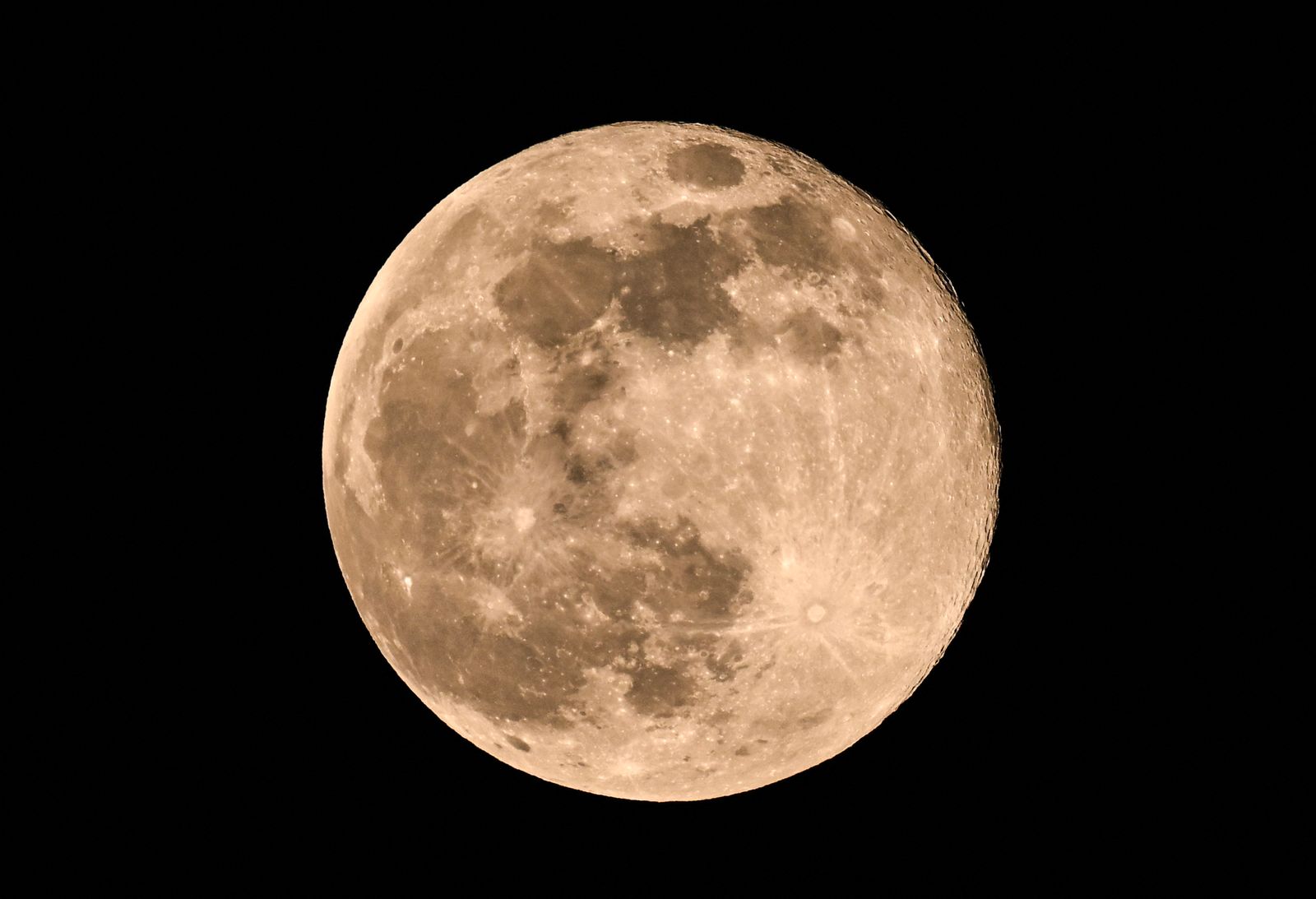
On Tuesday, Nov. 24, the country's skies will offer one of the year's most spectacular astronomical events: the beaver Moon, a full moon that on this occasion will also be a supermoon, so it will appear slightly larger and brighter than usual.
The phenomenon will coincide with the days leading up to Thanksgiving, which is celebrated on Thursday, Nov. 26, and can be enjoyed from various regions across the country, provided weather conditions allow for good visibility.
According to the Old Farmer's Almanac, the Beaver Moon will reach its peak brightness at 9:53 a.m. Eastern Time, although the best times to view it will be on the nights of Monday, Nov. 23, and Tuesday, Nov. 24.
NASA confirmed in its November astronomical calendar that this full moon will occur near the point of the Moon's closest approach to Earth, a circumstance that makes it a supermoon.
What time will the beaver moon be visible?
Here are the times for the major regions of the United States:
East Coast (New York, Miami): 9:53 a.m.
Central Time Zone (Chicago, Dallas): 8:53 a.m.
Mountain Zone (Denver): 7:53 a.m.
West Coast (Los Angeles, San Francisco): 6:53 a.m.
Although the moment of maximum illumination will occur in the morning, the Moon will appear nearly full on the nights of Nov. 23 and 24.
Experts recommend observing it after sunset, when it appears above the eastern horizon. At that time, its visual proximity to buildings, trees, and mountains may make it appear especially large.
Those interested can check the exact time of moonrise in New York or use the time and date lunar calendar to find out the viewing conditions in their city.
Why is it called the beaver moon?
The name beaver moon, comes from North American seasonal traditions that linked full moons to changes in nature.
According to the Old Farmer's Almanac, November is a time when beavers reinforce their lodges, build dams and store food to prepare for the arrival of winter.
Another historical interpretation links the name to the season when traps were traditionally set to catch beavers before the rivers and lakes began to freeze.
NASA explains that the November full moon is also known by names such as frost moon and snow moon, due to the weather conditions typical of this time of year in the Northern Hemisphere.
What is a supermoon, and why will it appear brighter?
A supermoon occurs when the full moon phase coincides with the Moon being relatively close to Earth within its elliptical orbit.
That point of closest approach is called perigee.
NASA notes that, under extreme conditions, a supermoon can appear up to 14% larger and 30% brighter than a full moon located near the farthest point in its orbit, known as apogee.
However, these figures correspond to a comparison between the orbital extremes and do not mean that this Tuesday's full moon will necessarily experience an increase of that magnitude compared to a average full moon .
During the Nov. 24 event, the Moon will be approximately 224,000 miles from Earth, close enough to be considered a supermoon.
The event also marks the beginning of a sequence of three consecutive supermoons that will continue in December 2026 and January 2027, according to the Old Farmer's Almanac.
Where is the best place to view the beaver moon?
The supermoon will be visible throughout the United States, including Alaska and Hawaii, although visibility will depend on cloud cover and local weather conditions.
No telescopes or binoculars will be necessary. To enjoy the phenomenon, simply find a spot with a clear view to the east, preferably away from tall buildings and natural obstacles.
NASA notes that the Moon may appear especially large when it is near the horizon. This effect, known as lunar illusion, is related to human perception and not to a sudden change in the Moon's size.
Those wishing to photograph the phenomenon can take advantage of the first few minutes after the Moon rises, when it is still possible to capture elements of the landscape alongside the lunar disk.

Can the supermoon cause higher tides?
The coincidence of the full moon and the Moon's proximity to Earth may also have a slight effect on ocean tides.
During these periods, perigee spring tides may occur, raising sea levels above the usual values for some tides.
However, a supermoon does not necessarily mean coastal flooding. The risk also depends on factors such as wind, atmospheric pressure, wave action and the geographical characteristics of each region.
The National Oceanic and Atmospheric Administration (NOAA) provides up-to-date information on sea levels, tide forecasts, and potential coastal flooding.
When will the next full moon be?
After the beaver moon on Nov. 24, the next full moon will occur on Dec. 24, 2026, on Christmas Eve, at 1:28 a.m. UTC, that is, during the night of Dec. 23 in the continental United States.
This full moon, traditionally known as cold moon, will also be a supermoon, according to the 2026 astronomical calendars.
This means Americans will have two opportunities to observe supermoons during the year-end holiday season: the first during Thanksgiving week and the second during the Christmas holidays.