

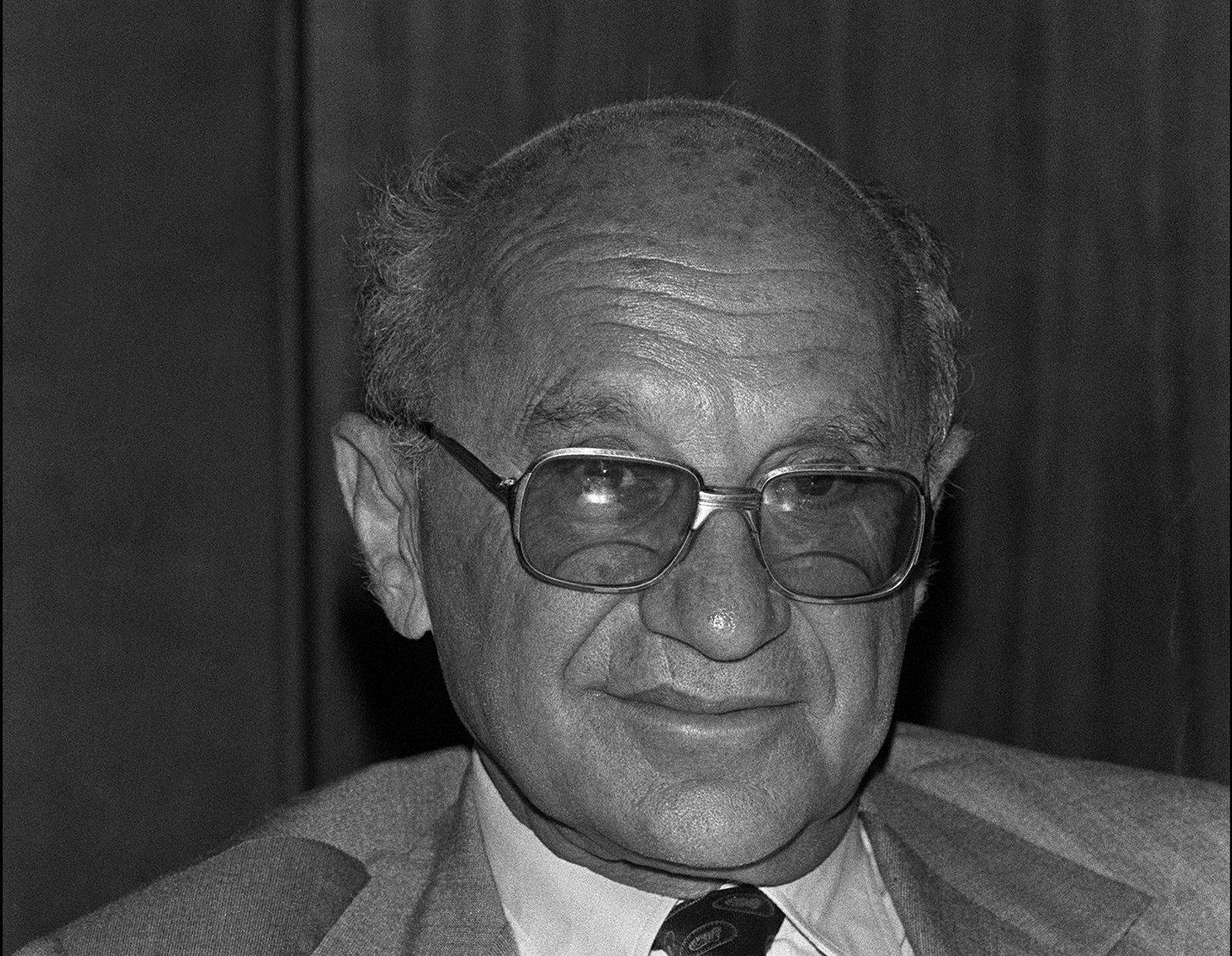
Peter Robinson, a researcher at the Hoover Institution and former speechwriter for Ronald Reagan, had his office in the same hallway as Milton Friedman. In fact, he interviewed him three times during the famous economist's final decade. In one of those interviews, as Robinson recounted years later, Friedman made an argument that particularly caught his attention because of its reasoning.
"Milton I think you’re making a moral argument not an economic argument," Robinson told him.
"A moral argument? Of course, is there any other kind?" Friedman replied.
Robinson never forgot that answer. To him, it summed up how Friedman understood his discipline. "For this great man, economics was not a game. It was a moral matter, human freedom as a moral matter, economic freedom was an aspect of human freedom. It was enabling people to better their lives. It wasn’t an intellectual construct and it wasn’t a game, it was something deep and important," Robinson noted in 2018 in an interview with The Dartmouth Review.
November 16 marked the 20th anniversary of Friedman's death; he passed away in 2006 at the age of 94. A Nobel Prize winner in Economics, he advised presidents and became one of the most famous economists of the 20th century thanks to a television series in which he explained how the market economy works. Among other things, he became well-known for comparing inflation to alcoholism.
From Brooklyn to Chicago
Milton Friedman was born on July 31, 1912, in Brooklyn, New York, the son of Jewish immigrants from Eastern Europe. He studied economics and mathematics at Rutgers University and graduated in 1932. The following year, he earned his master's degree from the University of Chicago and, in 1946, his Ph.D. from Columbia University.
Later, he went on to teach, spending three decades as a professor at the University of Chicago. He arrived just as World War II was ending, a time when the prevailing consensus among many academic economists favored expansionist models and increased public spending over the free market. Years later, he would become the leading figure of the Chicago School, the term used to describe economists from that university who gained prominence for defending the market economy.
As a fun fact, among his students was Thomas Sowell, who resisted his teacher's teachings and left his class still a staunch Marxist.
In 1955, he published an essay titled "The role of government in education," in which he began to lay out what would become one of his great crusades: educational freedom. According to the economist, the fact that the federal government funds education does not mean it should run the schools. For decades, his idea never made it beyond academic debate over a cup of coffee.
The rise to fame
Friedman began gaining recognition outside academia in the 1960s. In 1962, he published "Capitalism and Freedom," in which he outlined proposals to limit the role of the federal government, ranging from school vouchers to the end of compulsory military service.
In 1964, the Republican presidential candidate Barry Goldwater brought him on as an economic advisor for his campaign. Although the Arizona senator lost by a wide margin to President Lyndon Johnson, Friedman's ideas began to enter public debate. He even began writing a column for Newsweek, in which he explained complex economic issues to a mass audience.
As early as 1968, he advised Richard Nixon's presidential campaign. Once in the White House, President Nixon appointed him to the commission studying the replacement of the draft with a volunteer army. As Friedman recounted in his memoirs, when General William Westmoreland said he did not want to lead "an army of mercenaries," Friedman interrupted him and replied: "General, would you rather command an army of slaves?" Conscription would end in 1973.
However, this would not be his last famous anecdote from the Nixon administration. Some time later, as he also recounted, he was received in the Oval Office along with economist George Shultz, then an official in Nixon's administration. As Friedman was leaving, the president assured him that the controls would end soon and asked him not to blame Shultz for "this monstrosity." "I don't blame George. I blame you, Mr. President," Friedman replied.
"Always and everywhere a monetary phenomenon"
In the academic arena, his great battle was against the Keynesians, who saw the Great Depression as historical proof of the importance of government intervention in the economy. Together with Anna Schwartz, Friedman wrote that the primary culprit had not been the market, but the Federal Reserve. According to the authors, the Fed caused a crisis that could have been temporary to become the worst economic depression in the country's history.
In 2002, Ben Bernanke, then a member of the Federal Reserve Board of Governors, acknowledged Friedman's work: "Regarding the Great Depression. You’re right, we did it."
In the early 1960s, the economist coined what would become one of his most famous phrases: "Inflation is always and everywhere a monetary phenomenon." In 1967, he went further, warning that printing money to lower unemployment would only work for a while and that, in the long run, it would lead to more inflation. This warning came on the eve of the 1970s, a decade marked by periods of simultaneously high inflation and high unemployment.
In 1975, he was criticized for meeting with Chile's then-dictator, Augusto Pinochet, whose regime received advice from economists trained at Chicago.
"Free to choose"
Friedman would be awarded the Nobel Prize in Economics in 1976 for his contributions to monetary history and theory. However, the prize alone would not make him one of the most famous economists of the 20th century. Television would.
In January 1980, the public broadcasting network PBS premiered the series "Free to Choose," which consisted of ten one-hour episodes in which Friedman explained the market economy to the public in an accessible way.
In the ninth episode, "How to Cure Inflation," he explained the problem using one of his most famous analogies. "Inflation is just like alcoholism. In both cases when you start drinking or when you start printing too much money, the good effects come first. The bad effects only come later. That’s why in both cases there is a strong temptation to overdo it: to drink too much and to print too much money."
"When it comes to the cure, it’s the other way around. When you stop drinking or when you stop printing money, the bad effects come first and the good effects only come later. That’s why it’s so hard to persist with the cure," he continued.
The book that accompanied the series, written with his wife Rose, was one of the best-selling nonfiction books of 1980 in the United States. That same year, Ronald Reagan won the presidency and brought Friedman on as an advisor.
The battle for schools and its legacy
In his later years, he returned to the cause of education. In 1996, at the age of 83, Friedman and Rose founded the Milton and Rose D. Friedman Foundation to promote policies supporting school choice. In the founding letter, they presented it as the culmination of an interest spanning more than four decades.
In 2016, it was renamed EdChoice, which continues to operate today and is very active in the public debate on education. It conducts research, surveys, and advises state legislators on the design of public policies regarding school choice.
Thirty-five years passed between that essay and the first modern vouchers, created in Wisconsin in 1990 for about 300 low-income families. Today, according to its latest annual report from EdChoice, more than 1.5 million students participate in 75 private school choice programs across 34 states, Washington, D.C., and Puerto Rico, a 25% increase from the previous year.