

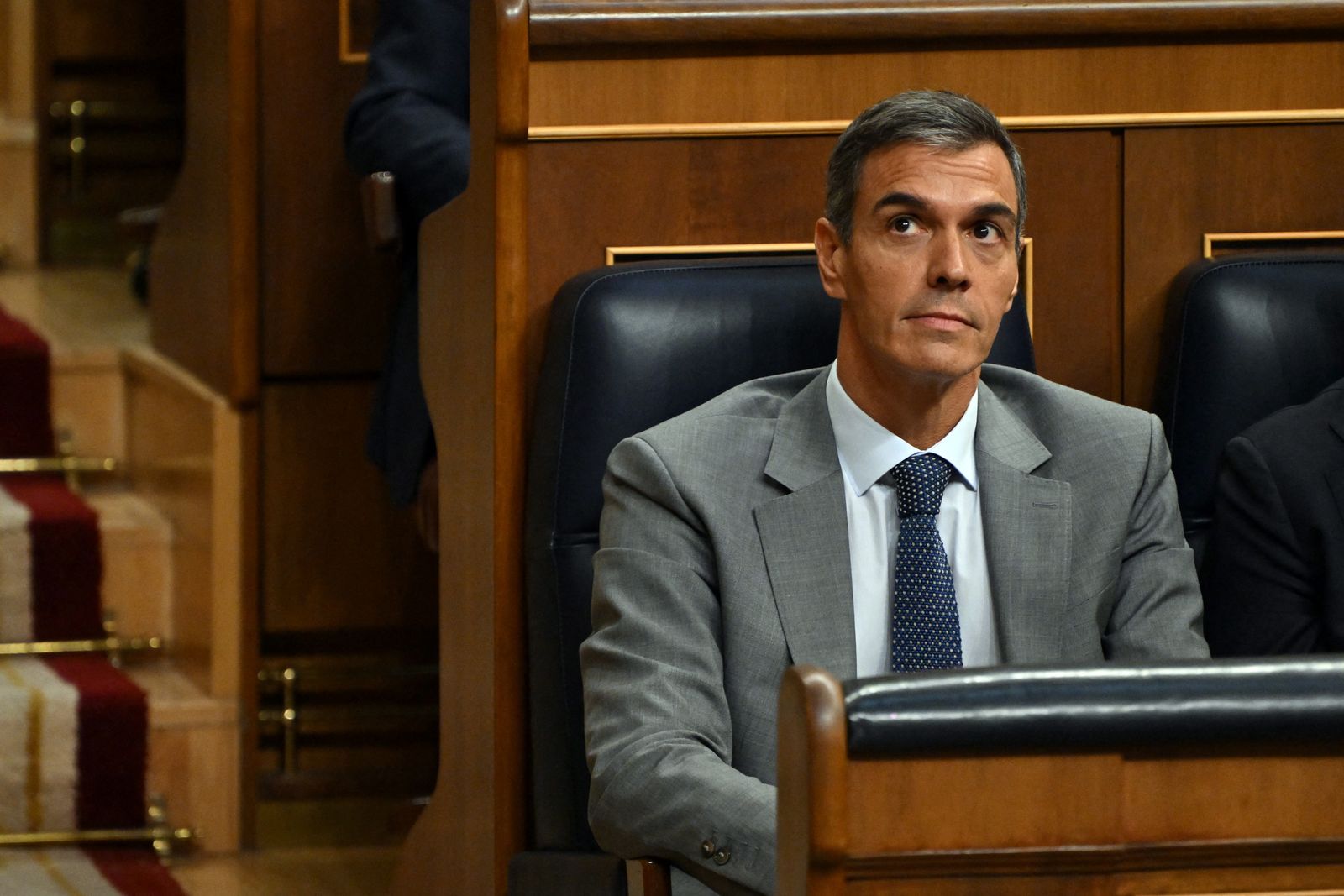
Pedro Sánchez lost the election this Sunday in Spain. The socialist prime minister failed to secure the votes needed to continue governing and will step down after more than eight years in office. With 84% of the votes counted, the new Spanish government is projected to be formed by an alliance between the People's Party (center-right) and Vox (conservatives).
Unlike the U.S. system, Spain operates as a parliamentary monarchy. Citizens do not directly elect the prime minister, but rather the 350 members of the Congress of Deputies, who then elect the head of the executive branch.
Specifically, the deputies are distributed across 52 constituencies (the 50 provinces and the autonomous cities of Ceuta and Melilla) through a proportional system that favors the parties with the most votes in each province. Once the new Congress has convened, the candidate for prime minister needs the support of 176 deputies in a first round of voting (absolute majority) or more votes in favor than against (simple majority) in a second round of voting.
As for the leaders of the main parties in the election, Pedro Sánchez led the Spanish Socialist Workers' Party (PSOE), Alberto Núñez Feijóo led the People's Party (P.P.), Santiago Abascal led Vox and Ada Colau headed the Broad Front (left).
In addition, several nationalist and regionalist parties which, although they only run in their own territories, are often key to forming a government. Among them are the Catalan independence advocates of ERC and Junts; the Basques of the PNV and EH Bildu; the Galician nationalists of the BNG; and the regionalists of Coalición Canaria and Unión del Pueblo Navarro (UPN). In 2023, the support of these parties was key to Sánchez retaining power.
Results in Spain
With 84% of the votes counted, here is the breakdown of the 350 seats in Congress:
P.P.: 32% of the vote (133 seats).
PSOE: 29% of the vote (117 seats).
Vox: 16% of the vote (51 seats).
Broad Front: 4.8% of the vote (10 seats).
ERC: 3.2% of the vote (11 seats).
Between the People's Party and Vox, they hold a combined total of 184 seats, exceeding the 176-seat threshold needed to form a government. Compared to the 2023 elections, Vox was the party that grew the most and gained the most seats, increasing its total from 33 to 51.
Who will be Spain's next prime minister?
Based on these numbers, everything indicates that Alberto Núñez Feijóo will be the next prime minister. However, he must first pass the investiture vote in Congress, for which he will need the support of the deputies from Santiago Abascal's Vox party.
As for Sánchez, he has been governing Spain since 2018, when he came to power through a motion of no confidence against Prime Minister Mariano Rajoy of P.P. This is a parliamentary mechanism that allows Congress to remove the head of government and replace him in the same vote with an alternative candidate, provided that the latter secures an absolute majority.